

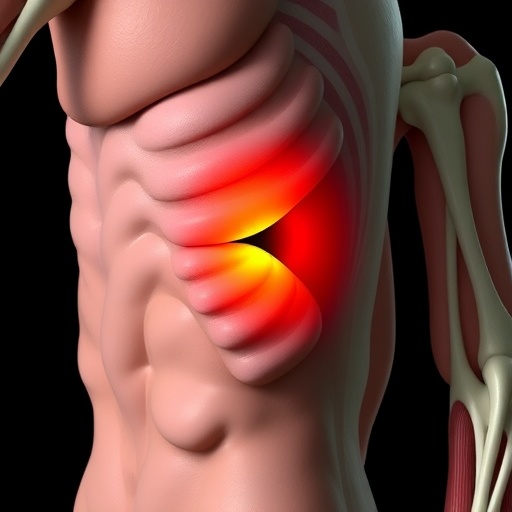
In a world where orthopedic health and bioengineering are increasingly intertwined, a group of researchers has unveiled groundbreaking work that promises to reshape our understanding of spinal health. Helmed by luminaries in the field—L.L. Frazer, S.K. Shaffer, and J. Seifert—the study delves into the complex interactions taking place within the annulus fibrosus, a critical structure in spinal discs. Their innovative approach incorporates a reactive viscoelastic framework that not only models the intricate mechanisms of fatigue and damage development but also sets a precedent for future research in biomechanical engineering.
The annulus fibrosus, often overlooked in studies of spinal integrity, plays a fundamental role in maintaining the overall health and function of intervertebral discs. This multilayered structure is vital in absorbing compressive loads and distributing stress throughout the spine. However, much remains unknown about how this vital tissue experiences and sustains damage over time. The researchers sought to fill this gap by constructing a comprehensive model that could accurately replicate the physical behavior of the annulus fibrosus under various stressors.
Utilizing a reactive viscoelastic framework allowed the investigators to simulate the annulus fibrosus’s response to continuous mechanical stresses. This modeling technique not only captures fundamental viscoelastic behaviors—such as creep and stress relaxation—but also accounts for the tissue’s intrinsic healing mechanisms. This multifaceted approach presents a more holistic view of how the annulus fibrosus tolerates and adapts to mechanical challenges over time.
One of the more striking findings from the research indicates that the annulus fibrosus is susceptible to fatigue damage—a phenomenon previously underappreciated in biomedical engineering. The implications of this discovery resonate through various fields, as it suggests that even healthy spines could gradually succumb to injury without overt symptoms. This raises critical questions about preventive measures and early detection strategies for spinal injuries and degenerative diseases.
The researchers used advanced materials characterization and in vitro testing techniques to validate their model. By applying cyclic loading to samples derived from the annulus fibrosus, they were able to observe real-time changes in mechanical properties and structural integrity. This empirical data was essential in refining the predictions made by their theoretical model, thus enhancing its reliability and applicability in clinical settings.
The potential applications for such a comprehensive model are profound. One immediate utility is in the realm of personalized medicine, where assessments of individual patients’ spinal health could be conducted using simulations derived from the framework. By tailoring treatment options based on predicted fatigue and damage patterns, healthcare providers can develop targeted rehabilitation programs that enhance the healing process and restore functionality more effectively.
Moreover, this research opens the door to innovations in spinal implants and therapies. The findings suggest that design parameters for artificial discs or enhanced graft materials could be optimized to better mimic the biomechanical behavior of natural tissue, allowing for longer-lasting and more effective solutions in spinal surgery.
As aging populations worldwide grapple with increased incidences of back pain and related ailments, the urgency for improved understanding and management of spinal health has never been clearer. This research not only sheds light on the mechanics of the annulus fibrosus but also emphasizes the need for interdisciplinary collaboration between engineers, biologists, and clinicians to address complex health issues.
Understanding the reactive mechanisms of the annulus fibrosus provides entry points for further inquiries into therapeutic avenues. Future investigations may involve exploring biochemical pathways that influence tissue regeneration or developing novel materials that can dynamically adapt to mechanical loading, mirroring the adaptive qualities of biological tissues.
As the scientific community digests these findings, the hope is that further research will catalyze advancements in both diagnostics and interventions. By prioritizing a preventive rather than reactive approach to spinal health, we may bend the trajectory of degenerative disc diseases away from pain and limitations and toward a future where individuals can enjoy active, pain-free lives.
While still in its nascent stages, this emerging framework represents a milestone in our understanding of spinal biomechanics. As researchers like Frazer, Shaffer, and Seifert continue to push the boundaries of what’s possible, we can look ahead with optimism to a future where spinal health is not defined by reactive treatments but instead by proactive knowledge that safeguards our mobility and quality of life.
The realm of biomedical engineering continues to evolve, and with studies such as these paving the way, the confluence of technology and healthcare can yield transformative benefits for individuals suffering from spinal issues. The challenge remains—how do we harness this knowledge and translate it into practice? The answers lie within the ongoing dialogues among scientists and clinicians eager to integrate fresh insights into real-world solutions.
In conclusion, the work of L.L. Frazer and colleagues represents a formidable leap in discourse surrounding spinal health. Their utilization of a reactive viscoelastic framework to understand the fatigue and damage mechanisms of the annulus fibrosus invites a new era of exploration that may unlock previously inaccessible doors to understanding, preventing, and treating spinal injuries. The implications are staggering and hint at the potential for a reimagined landscape in orthopedic medicine, where proactive measures based on sound scientific principles can lead to a dramatically improved standard of care for patients globally.
Subject of Research: Fatigue and damage development in the annulus fibrosus using a reactive viscoelastic framework.
Article Title: Correction: Modeling Fatigue and Damage Development in the Annulus Fibrosus Using a Reactive Viscoelastic Framework.
Article References:
Frazer, L.L., Shaffer, S.K., Seifert, J. et al. Correction: Modeling Fatigue and Damage Development in the Annulus Fibrosus Using a Reactive Viscoelastic Framework.
Ann Biomed Eng (2026). https://doi.org/10.1007/s10439-026-03987-0
Image Credits: AI Generated
DOI: 10.1007/s10439-026-03987-0
Keywords: annulus fibrosus, viscoelastic framework, spinal health, fatigue damage, biomechanical engineering, personalized medicine, therapeutic avenues, degenerative disc diseases.


