

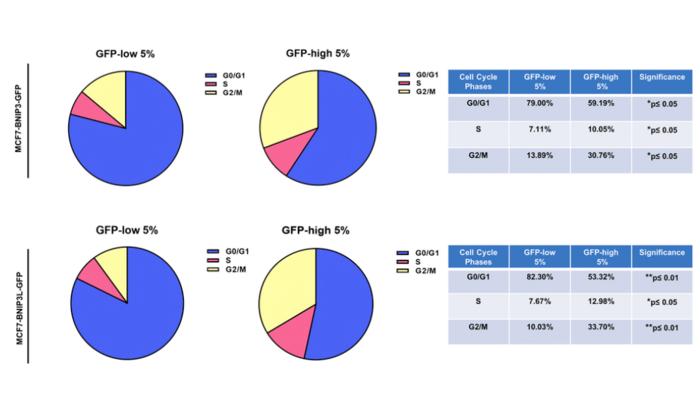
“[…] our current work has provided a novel strategy to enrich for a sub-population of cancer cells, with high basal levels of mitophagy.”

Credit: 2024 Mauro-Lizcano et al.
“[…] our current work has provided a novel strategy to enrich for a sub-population of cancer cells, with high basal levels of mitophagy.”
BUFFALO, NY- June 17, 2024 – A new research paper was published on the cover of Aging (listed by MEDLINE/PubMed as “Aging (Albany NY)” and “Aging-US” by Web of Science) Volume 16, Issue 11, entitled, “Mitophagy and cancer: role of BNIP3/BNIP3L as energetic drivers of stemness features, ATP production, proliferation, and cell migration.”
Mitophagy is a selective form of autophagy which permits the removal of dysfunctional or excess mitochondria. This occurs as an adaptative response to physiological stressors, such as hypoxia, nutrient deprivation, or DNA damage. Mitophagy is promoted by specific mitochondrial outer membrane receptors, among which are BNIP3 and BNIP3L.
The role of mitophagy in cancer is being widely studied, and more specifically in the maintenance of cancer stem cell (CSC) properties, such as self-renewal. Given that CSCs are responsible for treatment failure and metastatic capacity, targeting mitophagy could be an interesting approach for CSC elimination. In this new study, researchers Marta Mauro-Lizcano, Federica Sotgia, and Michael P. Lisanti from the University of Salford describe a new model system to enrich sub-populations of cancer cells with high basal levels of mitophagy, based on the functional transcriptional activity of BNIP3 and BNIP3L.
“Briefly, we employed a BNIP3(L)-promoter-eGFP-reporter system to isolate cancer cells with high BNIP3/BNIP3L transcriptional activity by flow cytometry (FACS).”
The model was validated by using complementary lysosomal and mitophagy-specific probes, as well as the mitochondrially-targeted red fluorescent protein (RFP), namely mt-Keima. High BNIP3/BNIP3L transcriptional activity was accompanied by increases in i) BNIP3/BNIP3L protein levels, ii) lysosomal mass, and iii) basal mitophagy activity. Furthermore, cancer cells with increased BNIP3/BNIP3L transcriptional activity exhibited CSC features, such as greater mammosphere-forming ability and high CD44 levels.
“To further explore the model, we also analysed other stemness characteristics in MCF7 and MDA-MB-231 breast cancer cell lines, directly demonstrating that BNIP3(L)-high cells were more metabolically active, proliferative, migratory, and drug-resistant, with elevated anti-oxidant capacity. Therefore, high levels of basal mitophagy appear to enhance CSC features.”
Read the full study: DOI: https://doi.org/10.18632/aging.205939
Corresponding Authors: Federica Sotgia, Michael P. Lisanti – fsotgia@gmail.com, michaelp.lisanti@gmail.com
Keywords: mitophagy, BNIP3, BNIP3L (NIX), cancer stem cells (CSCs), flow cytometry (FACS)
Click here to sign up for free Altmetric alerts about this article.
About Aging:
Aging publishes research papers in all fields of aging research including but not limited, aging from yeast to mammals, cellular senescence, age-related diseases such as cancer and Alzheimer’s diseases and their prevention and treatment, anti-aging strategies and drug development and especially the role of signal transduction pathways such as mTOR in aging and potential approaches to modulate these signaling pathways to extend lifespan. The journal aims to promote treatment of age-related diseases by slowing down aging, validation of anti-aging drugs by treating age-related diseases, prevention of cancer by inhibiting aging. Cancer and COVID-19 are age-related diseases.
Aging is indexed by PubMed/Medline (abbreviated as “Aging (Albany NY)”), PubMed Central, Web of Science: Science Citation Index Expanded (abbreviated as “Aging‐US” and listed in the Cell Biology and Geriatrics & Gerontology categories), Scopus (abbreviated as “Aging” and listed in the Cell Biology and Aging categories), Biological Abstracts, BIOSIS Previews, EMBASE, META (Chan Zuckerberg Initiative) (2018-2022), and Dimensions (Digital Science).
Please visit our website at www.Aging-US.com and connect with us:
- X, formerly Twitter
- YouTube
- Spotify, and available wherever you listen to podcasts
Click here to subscribe to Aging publication updates.
For media inquiries, please contact media@impactjournals.com.
Aging (Aging-US) Journal Office
6666 E. Quaker Str., Suite 1B
Orchard Park, NY 14127
Phone: 1-800-922-0957, option 1
###
Journal
Aging-US
Method of Research
Observational study
Subject of Research
People
Article Title
Mitophagy and cancer: role of BNIP3/BNIP3L as energetic drivers of stemness features, ATP production, proliferation, and cell migration
Article Publication Date
4-Jun-2024

