

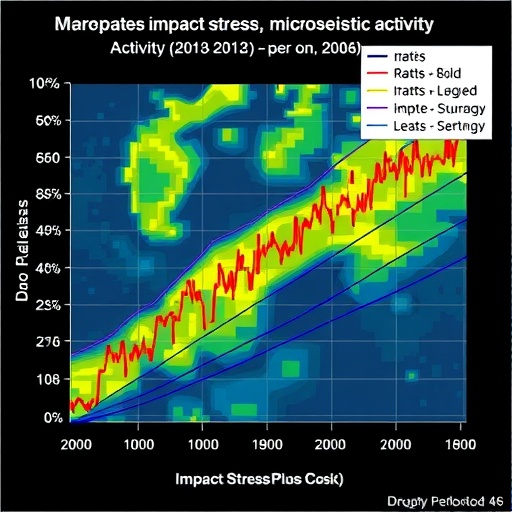
In the ever-evolving field of mining engineering and geotechnical studies, understanding the intricate relationship between stress distribution and induced microseismic activity remains pivotal, particularly in the extraction of coal from thick seams beneath hard rock layers. A recent groundbreaking study by Gu, Guo, Jiang, and colleagues, published in Scientific Reports in 2026, sheds new light on how varying mining rates influence stress patterns and microseismic responses in hard roof thick coal seams. This research not only advances our fundamental comprehension of subterranean rock mechanics but also holds profound implications for enhancing mining safety and operational efficiency.
Coal seams trapped beneath substantial hard roof rock layers present unique challenges. These overlying strata, which are significantly more rigid than the coal seams themselves, strongly affect how stress is transferred and redistributed during mining activities. The dynamic process of extracting coal inevitably alters the stress equilibrium, giving rise to microseismic phenomena. These subtle seismic events, often imperceptible without sensitive instrumentation, serve as crucial indicators of stress relief, fracturing, and potential instabilities within the geological formation. Understanding the genesis and propagation of such microseismicity is therefore essential for anticipating hazardous conditions, including roof collapses and rock bursts.
The study meticulously examines how different mining rates—the speed at which coal is excavated—affect stress fields and resultant microseismic activity patterns. Through extensive field monitoring and numerical modeling, the researchers observed that faster mining rates precipitate more abrupt stress redistributions, triggering a higher frequency and intensity of microseismic events. Conversely, slower mining rates allow for a more gradual re-equilibration of in-situ stresses, resulting in diminished seismic activity. These findings underscore the critical balance between operational pace and geotechnical stability, suggesting that mining strategies must carefully consider rate modulation to mitigate risk.
Stress concentration zones, particularly in thick coal seams under hard roofs, are prone to rapid alterations during active mining. The research employs advanced microseismic monitoring tools to map these zones dynamically, revealing that stress waves propagate differently depending on the excavation speed. Fast extraction tends to cause stress “shock” loading in localized pockets, instigating brittle failure in the overlying rock and intensifying the frequency of microseismic events. Such bursts of seismicity can serve as precursors to larger structural failures, emphasizing the importance of real-time monitoring for early warnings.
Intriguingly, the study also explores the mechanism of stress transfer from the coal seam to the hard roof. The hard roof’s rigidity means that when the coal is removed rapidly, the roof undergoes significant bending and fracturing. This not only alters the original stress state of the coal seam but also generates complex stress gradients at the coal-rock interface. Microseismic events cluster predominantly along these interfaces in response to differential stress buildup, providing essential clues about the evolving mechanical state of the rock mass.
The authors employ sophisticated numerical simulations to capture the interplay between mining-induced stress modifications and microseismic event distributions. These models incorporate the geological heterogeneity of the thick coal seams, anisotropy of the rock layers, and the viscoelastic properties of the hard roof strata. The results point to nonlinear responses where small increments in mining rates lead to disproportionately larger increases in seismicity, reflecting the complex, scale-dependent nature of rock failure processes.
Another critical revelation pertains to the temporal evolution of stress and seismicity as mining advances. The researchers report that microseismic activity tends to intensify not immediately after coal extraction begins but after a lag period corresponding to the time required for stress to propagate and concentrate sufficiently within the hard roof. This latency phase varies with mining speed, signaling that temporal patterns of seismicity could be refined to predict imminent roof failure risks, thus enriching existing hazard assessment frameworks.
Moreover, the paper discusses how different mining geometries, combined with variable rates, influence the spatial distribution of stress and microseismic events. Underground coal extraction typically involves creating voids and pillars whose arrangement dictates stress flow. Rapid mining coupled with suboptimal pillar designs exacerbates stress concentrations and seismic hazards, implying that mining rate decisions cannot be decoupled from the overall mine layout and structural considerations.
The integration of microseismic monitoring with stress analysis also opens novel avenues for proactive mine management. By continuously tracking microseismicity, operators can infer the real-time stress states of critical rock zones and adjust mining speeds accordingly. This dynamic feedback loop enhances both safety and productivity, reducing the likelihood of catastrophic geotechnical failures and economic losses due to unexpected roof collapses or downtime.
An additional layer of complexity arises from the geomechanical aspects of thick coal seams themselves. The coal mass often exhibits various scales of discontinuities, cleat systems, and bedding planes, which influence how stress waves are absorbed or transmitted. The study highlights that mining rates modulate not only macro-scale stress but also micro-scale fracture mechanics, as rapid extraction may exacerbate existing fissures, enhancing microseismic emissions and accelerating damage accumulation within the coal seam.
Crucially, these insights extend beyond coal mining to other underground operations where thick rock layers overlay softer strata. Understanding the nexus between excavation pace, stress redistribution, and induced seismicity informs broader domains such as tunnel construction, geothermal energy extraction, and underground waste repositories. The methodologies and findings presented establish a benchmark for multidisciplinary investigations into subterranean stress-seismicity coupling.
Furthermore, this research emphasizes the vital role of technological advancements in microseismic detection and data analytics. The deployment of high-resolution seismic arrays with improved sensitivity and spatial coverage, combined with machine learning approaches to pattern recognition, enables unprecedented characterization of underground stress environments. These innovations transform microseismic monitoring from a purely diagnostic tool into a predictive asset deeply integrated with mine planning and operational decision-making.
The implications of Gu and colleagues’ work resonate deeply within the safety culture of mining industries worldwide. Historically, microseismic monitoring has served as a post-failure investigative technique; this study pioneers a shift toward real-time risk mitigation through controlled mining rates. By illuminating the cause-effect chain from excavation velocity to seismic response and stress alterations, the study lays down a scientific foundation for safer, smarter mining modalities.
As the global demand for coal and other subterranean resources persists amid rising environmental and economic pressures, optimizing extraction methodologies to minimize hazards is paramount. Innovations grounded in studies like this one prop the mining industry towards sustainability, combining resource efficiency with workforce protection. This manifests not only in lives saved but also in enhanced operational reliability, regulatory compliance, and societal acceptance.
Taken together, the findings represent a significant leap forward in rock mechanics and seismic hazard research, revealing the nuanced ways mining practices interact with geological realities. The 2026 publication in Scientific Reports offers a detailed, multifaceted approach that enriches theoretical frameworks while delivering actionable knowledge for field implementation. Its interdisciplinary approach marrying geoscience, engineering, and data science underscores the contemporary spirit of scientific inquiry.
Gu and colleagues’ meticulous investigation sets the stage for future explorations, including in-situ experiments at full mining scale, enhancement of predictive seismic models, and integration of real-time monitoring systems with automated mining controls. Their pioneering work not only elucidates the complexities of mining-induced stress and microseismicity but also inspires a safer and more technologically advanced era in underground resource extraction.
Strongly anchored in rigorous research and rich empirical evidence, this transformative study reiterates the critical importance of mining rate control in managing dynamic subterranean environments. It represents a landmark case of how targeted scientific advances translate into tangible strategic improvements in an industry defined by its inherent risks and challenges.
Subject of Research: Mining-induced stress and microseismic activity in thick coal seams beneath hard roof strata under varying mining rates
Article Title: Stress and microseismic activity in hard roof thick coal seams under varying mining rates
Article References:
Gu, ST., Guo, ZY., Jiang, BY. et al. Stress and microseismic activity in hard roof thick coal seams under varying mining rates. Sci Rep (2026). https://doi.org/10.1038/s41598-026-44826-5
Image Credits: AI Generated
DOI: 10.1038/s41598-026-44826-5


