

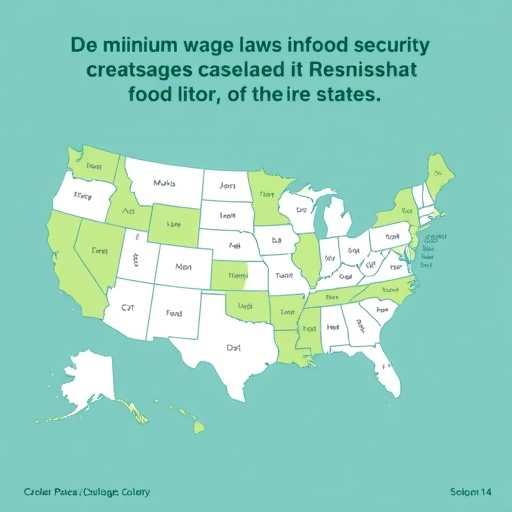
The intricate relationship between minimum wage legislation and food security has become an urgent focus in public health research, particularly in the wake of persistent economic disparities. The study conducted by Linde, Walker, and Egede provides an in-depth analysis of how both federal and state-level minimum wage laws can influence food security among vulnerable populations. In recent years, food security has been increasingly recognized as a critical social determinant of health, fundamentally impacting individuals’ well-being across the United States. As discussions surrounding economic policies continue to evolve, understanding the connections between income, food access, and legislation is more important than ever.
At the core of this research is the examination of income inequality, which has reached alarming levels in many parts of the country. Minimum wage adjustments are often hailed as a potential solution to mitigate poverty, yet their actual impact on food security is a nuanced issue that warrants further exploration. The authors embark on a comprehensive analysis to investigate whether legislative changes at both the federal and state levels have a direct correlation with food security metrics, particularly for low-income households. This comprehensive study utilizes a plethora of datasets, covering various regions and demographic groups, to paint a clearer picture of these economic realities.
One of the primary motivations for the study is the fact that food insecurity affects millions of Americans, which has significant implications for public health. Individuals who experience food insecurity are at a higher risk for chronic health conditions, including obesity, diabetes, and cardiovascular diseases. The study posits that raising the minimum wage could ultimately lead to improved health outcomes by enabling low-income families to afford healthier food options. The authors emphasize that without analyzing the broader implications of wage legislation, policymakers may miss crucial opportunities to improve public health outcomes for these vulnerable populations.
As Linde, Walker, and Egede delve deeper into the topic, they aggregate data from various sources to evaluate the effects of minimum wage increases on food security. They identify trends that suggest a strong inverse relationship; as minimum wage increases correspond with decreased rates of food insecurity. This indicates that when families have more financial resources, they are more capable of purchasing sufficient, nutritious food, thus enhancing their overall well-being. The authors note that this relationship provides compelling evidence for advocates of increasing the minimum wage as a pivotal approach to ameliorating food insecurity.
The methodology of the study is robust, applying sophisticated statistical techniques to analyze the data collected. The researchers strategically segmented their data by state, allowing for a nuanced understanding of how localized wage policies may uniquely influence food security. They considered various demographic factors, including age, race, and household composition, to enhance the comprehensiveness of their findings. This attention to detail ensures that the conclusions drawn are both valid and generalizable across diverse contexts.
The article also acknowledges the criticisms surrounding minimum wage increases, addressing arguments that higher wages might lead to job losses or reduced employment opportunities. However, the authors counter these points by highlighting studies illustrating that wage increases can stimulate economic growth, as individuals with higher disposable incomes are likely to spend more in their local economies. This economic stimulation can create a favorable cycle that benefits both employers and employees, supporting the continuous call for wage reform as a means of improving food security.
An essential element of the discourse surrounding food security is the additional burden placed on marginalized communities, especially amidst systemic inequities. The research sheds light on the disproportionate effects that food insecurity has on people of color and low-income populations. By spotlighting these disparities, Linde, Walker, and Egede invoke a call to action, urging policymakers to consider the societal implications of their minimum wage regulations and food access strategies. They advocate for a multi-faceted approach that combines wage increases with policies aimed at improving food distribution networks and initiatives targeting nutrition education.
The implications of this research extend beyond merely advocating for wage increases; it underscores the need for holistic policy approaches that encompass a range of socioeconomic factors. The interconnectedness of income, food security, and health outcomes necessitates collaborative efforts across various sectors, including healthcare, education, and social services. The authors highlight existing initiatives where integrated strategies have successfully reduced food insecurity, providing practical examples of how policy action can yield positive results.
Ultimately, Linde, Walker, and Egede’s research presents a compelling case for reevaluating current minimum wage practices and their broader implications for public health. By connecting wage policy to food security, the authors provide a framework that encourages stakeholders to adopt a more comprehensive perspective on economic legislation. Their findings serve as a stepping stone for future research exploring these relationships and inform a policy agenda that prioritizes the well-being of those at the margins of society.
In conclusion, the investigation into the association between minimum wage legislation and food security enriches the ongoing dialogue surrounding economic reform. As the nation grapples with pressing issues related to income inequality and public health, the insights distilled from this research provide valuable guidance for policymakers and advocates seeking to enact change. Through a deeper understanding of how wages influence food access, the path towards equitable economic policies becomes clearer, ultimately leading to a healthier, more secure population.
Policymakers should heed the evidence presented in this study, recognizing that legislative changes in minimum wage can serve as a powerful tool in the fight against food insecurity. As public concern for social justice issues continues to rise, advocating for equitable wages not only addresses economic discrepancies but also enhances community well-being. Thus, the work of Linde, Walker, and Egede marks a significant contribution to the intersection of economic policy, public health, and food security in 21st-century America.
Subject of Research: Association of Federal and State Level Minimum Wage Legislations and Food Security
Article Title: Association of Federal and State Level Minimum Wage Legislations and Food Security
Article References:
Linde, S., Walker, R.J. & Egede, L.E. Association of Federal and State Level Minimum Wage Legislations and Food Security.
J GEN INTERN MED (2026). https://doi.org/10.1007/s11606-025-10076-w
Image Credits: AI Generated
DOI: https://doi.org/10.1007/s11606-025-10076-w
Keywords: minimum wage, food security, public health, economic policy, income inequality, socioeconomic factors, health outcomes.


