

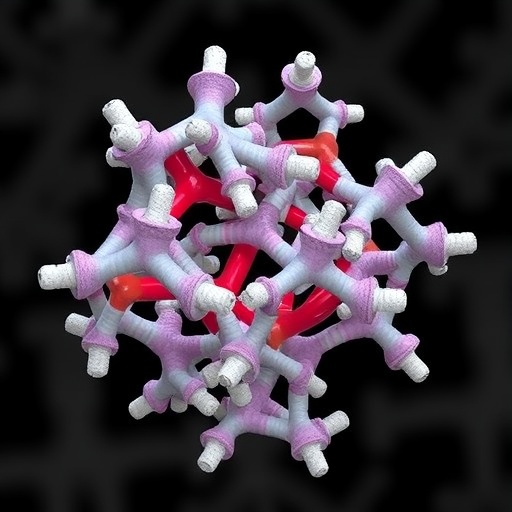
In a groundbreaking advancement poised to redefine cellular imaging, researchers have leveraged MINFLUX microscopy to elucidate the intricate subunit architecture and three-dimensional orientation of the cardiac ryanodine receptor (RyR) within living cells. This research, led by Clowsley, Meletiou, Janicek, and colleagues, promises to deepen our molecular understanding of cardiac excitation-contraction coupling, potentially fueling novel therapeutic strategies against heart diseases rooted in calcium signaling dysfunction.
The cardiac ryanodine receptor, a massive homotetrameric calcium release channel embedded in the sarcoplasmic reticulum membrane, plays a pivotal role in regulating intracellular calcium levels that govern heartbeat rhythm and contractility. Despite its crucial physiological function, visualizing RyR at nanometer resolution within the cellular context has remained an ambitious challenge. Traditional super-resolution fluorescence techniques have either lacked the necessary spatial precision or failed to accurately reconstruct three-dimensional orientations due to optical and physical constraints. Here, the integration of MINFLUX microscopy delivers a transformative leap.
MINFLUX (MINimal emission FLUXes) microscopy represents a state-of-the-art localization technique combining the photon efficiency of stimulated emission depletion (STED) microscopy with single-molecule tracking fidelity. Its approach centers on positioning a doughnut-shaped excitation laser pattern over fluorescent labels, enabling precise triangulation of emitter positions with localization precision down to a few nanometers. The reduced photon budget required for localization, along with the minimized photobleaching, renders MINFLUX especially suited for detailed structural mapping of proteins in native cellular milieus over extended durations.
By applying MINFLUX microscopy specifically to fluorescently tagged cardiac RyRs in live cardiomyocytes, the researchers achieved unprecedented resolution in discerning individual subunits’ spatial arrangements within the complex tetrameric assembly. The analysis revealed distinct subunit clustering and conformational heterogeneity correlating with functional states. This subunit-level resolution was not only spatially defined but also contextualized within the cell’s three-dimensional environment, a feat unattainable with prior two-dimensional imaging modalities.
The team’s experimental methodology involved the genetic incorporation of fluorescent probes strategically positioned on RyR subunits, enabling selective and precise labeling without compromising receptor function. Sequential localization events were acquired under cryogenic conditions to further stabilize molecular structures for imaging, minimizing thermal drift and enhancing spatial accuracy. Such meticulous sample preparation harmonized with MINFLUX’s photon-efficient detection, culminating in clarity and positional exactitude that illuminates RyR’s nano-architecture.
One of the most revealing outcomes of this study was the observation of RyR subunits’ angular orientation regarding the sarcoplasmic reticulum membrane. Prior assumptions centered on a planar, symmetrical distribution; however, the three-dimensional reconstructions disclosed subtle yet significant tilts and rotations of subunits, suggesting a dynamic conformational plasticity potentially linked to gating mechanisms. These findings resonate profoundly with electrophysiological data hinting at allosteric modulation within the receptor complex.
Moreover, the capacity to differentiate individual RyR subunits in situ lays the groundwork for dissecting complex interactions with accessory proteins and regulatory factors that modulate receptor activity. This approach, bridging structural biology with cell physiology at unmatched resolution, could unravel how molecular perturbations contribute to arrhythmogenic pathologies such as catecholaminergic polymorphic ventricular tachycardia (CPVT) and heart failure.
The implications extend beyond cardiology, as RyRs share structural and functional homology with other intracellular calcium channels implicated in neurological and skeletal muscle disorders. The methodology introduces a versatile platform for probing such macromolecular assemblies’ architecture and orientation, potentially catalyzing targeted drug design tailored to specific conformational states.
From a technical standpoint, this study underscores MINFLUX microscopy’s versatility and robustness in real biological systems, confronting challenges such as fluorophore density heterogeneity, background noise, and cellular autofluorescence. The researchers capitalized on advanced computational algorithms to filter and correct localization events, ensuring that data interpretation faithfully represented molecular positioning and orientation.
Importantly, the use of MINFLUX revealed functional heterogeneity even within a nominally uniform population of RyR clusters, suggesting that cardiac calcium release units operate with subtle structural variations that could fine-tune excitation-contraction coupling in response to physiological demands. This insight aligns with recent paradigms emphasizing spatial microdomain specificity in intracellular signaling.
The study also opens exciting prospects for longitudinal imaging, enabling visualization of dynamic conformational changes in RyRs during various physiological and pathological states. Coupled with optogenetic or pharmacological manipulation, it becomes possible to experimentally interrogate real-time correlations between molecular structure, calcium flux, and contractile behavior in intact cardiac tissue.
Although the current work focused on isolated cardiomyocytes, future extensions to in vivo models and human cardiac tissue biopsies could validate these structural signatures and their clinical relevance. The researchers envisage integrating MINFLUX data with complementary modalities such as cryo-electron tomography for a comprehensive multi-scale mapping of cardiomyocyte architecture.
In conclusion, this pioneering application of MINFLUX microscopy represents a landmark achievement in nanoscale cardiac biology, illuminating the RyR’s subunit layout and orientation with unprecedented clarity. By merging cutting-edge optical imaging with molecular labeling strategy and sophisticated image analysis, the study heralds a new era of precision cardiac proteomics aimed at decoding the spatial logic of cellular calcium signaling. The findings promise to catalyze innovative therapeutic avenues for arrhythmia and heart failure by targeting ryanodine receptor microstructure.
This investigation stands as a testament to the power of technological innovation in unraveling fundamental biological questions, prophetizing the transformative impact of next-generation microscopy in life sciences. As MINFLUX continues to evolve and integrate with functional assays, the molecular choreography underlying cellular physiology will become increasingly accessible, enabling scientific discoveries once relegated to theoretical speculation.
The ongoing refinement and adoption of MINFLUX microscopy techniques will likely spur a wave of new insights across diverse fields, from neuroscience and immunology to cancer biology and developmental studies. This study exemplifies how pushing the boundaries of spatial resolution directly translates into enhanced understanding of biological function, driving progress in biomedical research and precision medicine.
Ultimately, the detailed visualization of cardiac ryanodine receptor subunits and their 3D orientation in cells fuels hope for deciphering the molecular basis of cardiac excitability and contractility at an unprecedented scale. With such clarity, even the most intricate physiological processes become tangible, paving the way for interventions crafted at the nanoscopic interface of structure and function.
Subject of Research: Cardiac ryanodine receptor structural organization and 3D orientation in cells
Article Title: MINFLUX microscopy resolves subunits of the cardiac ryanodine receptor and its 3D orientation in cells
Article References:
Clowsley, A.H., Meletiou, A., Janicek, R. et al. MINFLUX microscopy resolves subunits of the cardiac ryanodine receptor and its 3D orientation in cells. Nat Commun (2025). https://doi.org/10.1038/s41467-025-67801-6
Image Credits: AI Generated


