

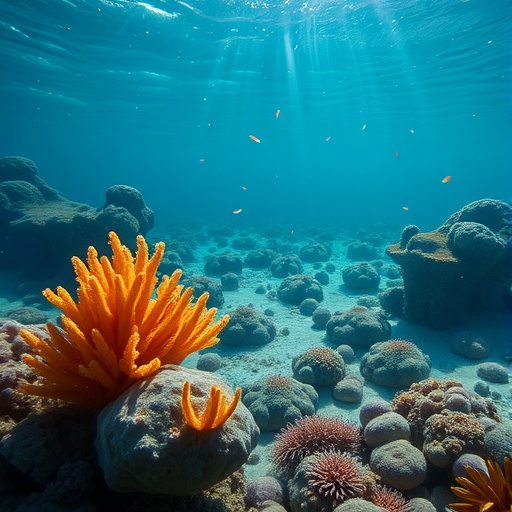
A newly unveiled study illuminates a groundbreaking pathway for abiotic carbon dioxide (CO₂) reduction facilitated by carbonate and phyllosilicate minerals present on the early Earth’s primitive seafloor. This research, recently published in Nature Communications, offers compelling insights into the geochemical processes that could have set the stage for life’s origins by transforming atmospheric CO₂ into organic precursors without biological intervention. The findings spearheaded by Zhong, Zhang, Huan, and their colleagues, reshape our understanding of prebiotic chemistry and the environmental conditions that prevailed during Earth’s formative years.
At the heart of this investigation lies the central question of how early Earth managed to convert the abundant yet inert CO₂ emissions into more reduced carbon compounds necessary for the advent of life. Conventional wisdom has long speculated that biological mechanisms or hydrothermal vent systems were primarily responsible for these transformations. However, this study challenges such notions by demonstrating that certain mineral assemblages—specifically carbonate and phyllosilicate minerals—played a pivotal catalytic role in promoting CO₂ reduction through abiotic pathways on the seafloor.
Utilizing state-of-the-art laboratory simulations that mimic the temperature, pressure, and chemical milieu of the Hadean and early Archean oceans, the researchers meticulously recreated conditions akin to those on the primitive seafloor. They observed that when CO₂ was introduced in the presence of these naturally occurring minerals, reduction reactions proceeded efficiently, yielding molecules that are considered key organic building blocks. This suggests that the mineralogical composition of the oceanic crust influenced early carbon cycling in a previously underappreciated manner.
Delving deeper into the mineral mechanics, carbonate minerals, such as calcite and aragonite, provided a reactive surface that enhanced CO₂ adsorption and activation. Phyllosilicates, which are layered silicate minerals abundant in ancient sediments, facilitated electron transfer and stabilization of intermediate reduction products. The synergy between these mineral types created a feedback loop enabling sustained chemical conversions, potentially alleviating the need for high-energy biological catalysts and bridging the gap in early Earth’s chemical evolution.
Importantly, the study employed advanced spectroscopic techniques alongside isotopic analysis to accurately identify the molecular species formed during the abiotic reduction reactions. These analytical methods revealed a surprising diversity of organic molecules, including simple hydrocarbons and oxygenated compounds, which are considered stepping stones towards more complex prebiotic organic chemistry. The presence of these molecules underscores the integral role minerals could have played in seeding the primordial soup from which life eventually emerged.
Beyond laboratory observations, the researchers connected their findings to geological evidence from ancient seafloor deposits dating back over 3.5 billion years. The mineral assemblages in these ancient strata align remarkably well with those tested experimentally, providing a geochemical context that validates the relevance of the proposed mechanism in Earth’s early environment. The convergence of experimental and geological data lends substantial weight to the hypothesis that mineral-induced abiotic CO₂ reduction was a significant biogeochemical process.
This study decisively refines our understanding of the carbon cycle in the primordial ocean-atmosphere system. Carbonate minerals, commonly thought to serve mainly as carbon sinks, are now attributed a catalytic function in carbon fixation chemistry. Concurrently, phyllosilicates emerge as essential facilitators in electron transfer reactions essential for the transformation of CO₂. Together, these minerals formed a natural, mineral-based reactor that sustained primordial organic synthesis even in the absence of biological agents.
Another striking implication of this research concerns the energy sources driving abiotic CO₂ reduction. Unlike biological pathways that rely on complex enzymatic machinery and cellular energy dynamics, mineral surfaces harness geochemically available energy fluxes, such as redox gradients and hydrothermal heat, to catalyze these reactions. This insight suggests that environments rich in carbonate and phyllosilicate minerals could have provided stable, long-lived niches conducive to organic synthesis during Earth’s early epochs.
Furthermore, the detailed mechanistic understanding provided by Zhong and colleagues could facilitate the identification of similar processes on other planetary bodies. The presence of carbonate and phyllosilicate minerals on Mars and some icy moons suggests that abiotic carbon reduction might be a universal phenomenon, expanding the implications of this study from Earth’s ancient past to the broader search for extraterrestrial life. If such mineral-catalyzed reactions occur elsewhere, they might offer pathways for the emergence of life or its chemical precursors beyond Earth.
In the grand narrative of life’s origins, the findings underscore the critical importance of geochemical environments where minerals actively shape molecular complexity. The traditional emphasis on biological or hydrothermal vent-centered theories gains a new dimension with this mineral-based catalytic route. This paradigm shift not only broadens the scope of prebiotic chemistry but also opens new avenues for experimental exploration of abiotic organic synthesis under early Earth-like conditions.
The authors highlight that this mineral-promoted reduction system operates efficiently under a range of geochemical variables, enhancing its plausibility under fluctuating early Earth conditions. This robustness also challenges existing dogmas restricting prebiotic chemistry to very narrow environmental windows, suggesting instead that a wider spectrum of geological contexts could have contributed to life’s chemical precursors.
This research further invites reconsideration of the roles played by the oceanic crust and sedimentary environments in modulating early Earth’s carbon reservoirs. The interplay between water-rock interactions, mineral catalysis, and CO₂ dynamics appears more complex and interconnected than previously appreciated. Consequently, it reframes mineralogy as a central actor in the global geochemical cycles essential for the planet’s habitability and the emergence of life.
As future work expands on these findings, incorporating in situ analyses of modern analog environments and extending experimental conditions to wider pressure-temperature regimes will be critical. Understanding how mineral surfaces evolve over geological timescales and their interactions with evolving atmospheric conditions will also help pinpoint specific phases during Earth’s history when abiotic CO₂ reduction was most active.
The impact of this study extends beyond Earth sciences, touching upon astrobiology, planetary chemistry, and the origins of life research. The demonstration that simple, abundant minerals can autonomously drive complex organic synthesis disrupts the conventional narrative emphasizing biological or energetically complex systems. This opens transformative possibilities, inspiring new interdisciplinary research to unravel the mineralogical underpinnings of life’s molecular genesis.
Ultimately, this research acts as a cornerstone in redefining how we perceive the early Earth environment—no longer as a passive stage but as an active chemical reactor where minerals intricately choreographed the reduction of CO₂, paving a plausible path toward organic complexity and life’s inception. As such, this work stands as a landmark contribution, bridging geochemistry with molecular origins and inspiring a richer understanding of our planet’s ancient past and universal life potential.
Subject of Research: Abiotic carbon dioxide reduction facilitated by carbonate and phyllosilicate minerals on the primitive seafloor.
Article Title: Abiotic CO₂ reduction promoted by carbonate and phyllosilicate minerals on the primitive seafloor.
Article References:
Zhong, Y., Zhang, N., Huan, D. et al. Abiotic CO₂ reduction promoted by carbonate and phyllosilicate minerals on the primitive seafloor. Nat Commun 17, 3229 (2026). https://doi.org/10.1038/s41467-026-71130-7
Image Credits: AI Generated


