

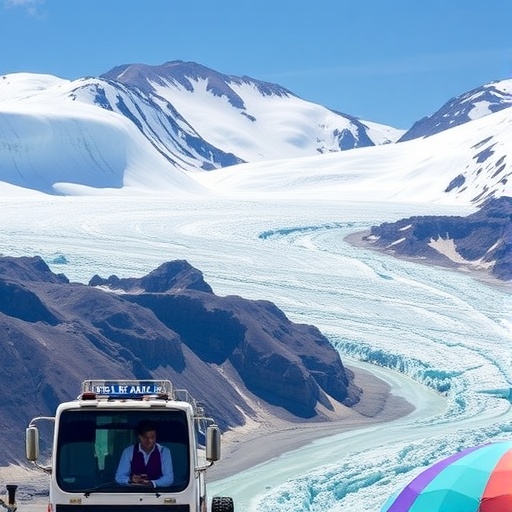
In a groundbreaking study published in Nature Climate Change, Van Tricht, Zekollari, Huss, and colleagues reveal a startling prognosis for the world’s glaciers: peak glacier extinction is expected to occur well within the mid-twenty-first century. This comprehensive research synthesizes advanced modeling approaches with empirical data, projecting an unprecedented acceleration in glacial retreat that reshapes our understanding of cryospheric dynamics under a rapidly warming climate.
The study deploys an innovative numerical ice flow model that accounts for detailed glacier physics, including ice dynamics, surface mass balance, and feedback mechanisms influenced by atmospheric warming. Unlike traditional static assessments, this dynamic modeling captures the evolving geometry and flow responses of glaciers, yielding a nuanced picture of their lifespan and extinction timelines. The researchers utilized climate forcing scenarios aligned with the Intergovernmental Panel on Climate Change’s Representative Concentration Pathways (RCPs), enabling a robust assessment of how varying greenhouse gas trajectories might influence glacier fate.
One of the key revelations of this analysis is the relatively narrow window remaining before glaciers worldwide approach their extinction thresholds. Under higher-emission scenarios, many mid-latitude and low-elevation glaciers are projected to vanish within the next three decades, with nearly total loss anticipated around 2050. This contrasts starkly with earlier projections that suggested more protracted timelines, highlighting the critical role of improved model resolution and updated climate data in refining glacier disappearance estimates.
Crucially, the study disaggregates glacier loss by geographical regions, exposing heterogeneous vulnerabilities. Alpine glaciers in Europe and the North American Rockies are slated for rapid diminishment, jeopardizing freshwater resources and regional hydrology. Similarly, glacialized tropical mountain ranges, such as those in the Andes and East Africa, face near-complete deglaciation, threatening local water security and ecosystem stability. These findings underscore the uneven spatial footprint of climate impacts, emphasizing the pressing need for localized adaptation strategies.
The authors impress upon the complex interplay between surface melt processes and glacier dynamics. Enhanced atmospheric temperatures not only accelerate surface ablation but also modulate glacier flow speeds and mass redistribution. The feedback loops are exacerbated by decreasing glacier sizes, which diminish their buffering capacity against episodic warm spells. This dynamic decrease ushers in a phase of rapid retreat and thinning, contributing to the sharp decline projected in the coming decades.
Beyond the physical mechanisms of glacier decline, the research elucidates broader climatic implications. Glaciers act as critical sentinels of the cryosphere and as repositories of freshwater essential for millions globally. Their loss threatens to disrupt hydrological cycles, reduce seasonal water availability, and induce socio-ecological stresses in vulnerable communities. The disappearance of glaciers will also reduce Earth’s albedo, potentially accelerating warming trends by allowing increased solar energy absorption in formerly reflective areas.
Moreover, peak glacier extinction has significant consequences for sea-level rise. While the contribution of mountain glaciers is smaller compared to ice sheets in Greenland and Antarctica, their rapid mass loss currently accounts for a substantial fraction of observed sea-level rise. The projected extinction timelines indicate a nonlinear increase in contribution rates during the mid-century, amplifying coastal vulnerability and necessitating updated risk assessments for coastal management.
The research methodology showcases the integration of field observations, remote sensing data, and climate model outputs into a cohesive simulation framework. This multidisciplinary approach improves the reliability of extinction estimates by reconciling observational uncertainties with process-based understanding. It also facilitates scenario analysis that incorporates socio-economic pathways, illuminating how human choices in emissions mitigation will critically influence glacier futures.
The study highlights the urgent imperative of limiting global temperature rise to preserve the remaining glacier mass. Simulations under aggressive mitigation scenarios suggest that although extinction cannot be entirely averted, substantial delays and reductions in glacier loss are feasible if warming is constrained below 2°C relative to preindustrial levels. This reinforces the scientific consensus that near-term emissions trajectories will decisively shape cryospheric outcomes.
Furthermore, these findings carry pronounced implications for global water security policies. Many downstream ecosystems and human populations depend on glacier-fed rivers, particularly in dry seasons. As glaciers dwindle, the diminishing dry-season runoff will exacerbate current water scarcity challenges, undermining agriculture, hydropower generation, and drinking water supplies. This necessitates coordinated international efforts to develop resilient water management frameworks that accommodate evolving hydrological regimes.
The projected timeline of glacier extinction also serves as a stark benchmark for climate communication and policy advocacy. The mid-century horizon conveys an urgency that transcends abstract scientific models, making the issue tangible for policymakers, stakeholders, and the public. By framing glacier loss as an imminent and measurable crisis, the study amplifies the narrative around climate action as imperative and immediate.
In addition, the loss of glaciers will also affect regional biodiversity. Alpine ecosystems, which depend on unique microclimates and meltwater, face habitat degradation and species displacement. The collapse of glacier-fed environments may precipitate cascading ecological disruptions, reducing biodiversity and ecological resilience in mountain regions. Understanding these cascading effects is a critical frontier for future interdisciplinary climate impact research.
The research also brings to light methodological challenges for glacier modeling, emphasizing the need for continued improvements in data resolution, physical process representation, and the inclusion of feedbacks such as debris cover dynamics and glacier-bed interactions. Refining these model parameters will be crucial for narrowing uncertainty ranges and enhancing predictive accuracy in subsequent assessments.
Finally, Van Tricht and colleagues advocate for sustained observational efforts combined with enhanced monitoring networks, including satellite and in-situ measurements of glacier mass balance and dynamics. Such empirical data are indispensable for validating model projections and adjusting forecasts in real time as climatic conditions evolve. This adaptive science approach supports responsive climate policy formulation grounded in up-to-date evidence.
In conclusion, this seminal study delineates a critical window for glacier preservation amidst escalating climate change. By quantifying the temporal thresholds for peak glacier extinction across diverse regions and emission pathways, the research delivers a clarion call to global society. Mitigation actions taken today will reverberate profoundly in the fate of glaciers and, by extension, the stability of water resources, ecosystems, and sea levels through the remainder of this century.
Subject of Research: Glacial extinction dynamics and projections under climate change scenarios.
Article Title: Peak glacier extinction in the mid-twenty-first century.
Article References:
Van Tricht, L., Zekollari, H., Huss, M. et al. Peak glacier extinction in the mid-twenty-first century. Nat. Clim. Chang. (2025). https://doi.org/10.1038/s41558-025-02513-9
Image Credits: AI Generated


