

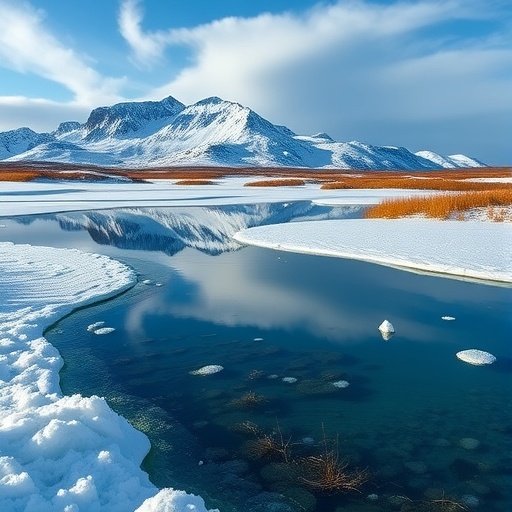
In the rapidly changing Arctic environment, new research is uncovering previously underestimated processes that influence cloud formation and, by extension, regional and global climate dynamics. Recently published findings from researchers at Colorado State University delve into the role of meltwater ponds atop sea ice as prolific sources of ice-nucleating particles (INPs)—tiny airborne agents that catalyze ice formation in clouds. This emerging understanding has the potential to reshape climate models that currently struggle to accurately replicate Arctic atmospheric behavior.
Cloud formation in polar regions is known to be a critical component in Earth’s radiative energy balance, affecting both the reflection of incoming solar radiation and the emission of thermal energy back into space. Ice-nucleating particles serve as the scaffolding on which water vapor can freeze, thereby enabling the development of ice crystals and cloud droplets. These particles originate from various natural sources, including mineral dust, sea spray, and biological materials like bacteria. However, until now, the contribution of meltwater ponds forming on sea ice to this process remained inadequately studied.
The new research highlights that these meltwater pools—composed largely of melted snow with interspersed seawater and sediment released from the underlying ice—harbor unique biological activity. This biological complexity likely drives elevated concentrations of biologically derived INPs that are then released into the Arctic atmosphere. By conducting meticulous measurements of aerosols emanating from these ponds and analyzing sea ice cores, the scientists demonstrated that these environments serve as localized hot spots for ice nucleation particle production, far exceeding the particle abundance found in adjacent seawater.
Such findings stem from samples collected during the high-profile MOSAiC Expedition, an unprecedented international scientific endeavor designed to study Arctic climate mechanisms over extended timescales. Led by Germany’s Alfred Wegener Institute and supported by numerous global institutions including Colorado State University’s Department of Atmospheric Science, the project afforded researchers rare access to the extreme high Arctic environment, where data acquisition is typically hampered by logistical and environmental barriers.
The ice-nucleating particles derived from these meltwater ponds exhibit particular significance because they can trigger ice formation at relatively warm temperatures. This implies that as Arctic warming accelerates—now occurring at a rate four times that of the global average—the proliferation or alteration of these ponds could substantially influence cloud characteristics. Changes in cloud cover and cloud phase have profound consequences on the region’s surface energy budget and precipitation patterns, thereby affecting sea ice persistence and ecosystem dynamics.
Furthermore, this research underscores the uniqueness of Arctic cloud systems. Compared to mid-latitude or tropical clouds, polar clouds manifest different behaviors despite some shared physical and chemical mechanisms. Therefore, local aerosol sources such as meltwater ponds possess distinct chemical and biological signatures that modulate cloud microphysics in ways not fully captured by existing models.
The team, led by doctoral student Camille Mavis with senior contributions from CSU Research Scientist Jessie Creamean and University Distinguished Professor Sonia Kreidenweis, emphasized that greater understanding of these processes is essential for refining atmospheric models, particularly those projecting future Arctic climate scenarios. Current models often underestimate or oversimplify the complexity of aerosol-cloud interactions in polar regions, leading to uncertainties in predicting feedbacks that accelerate regional warming.
Future investigation plans include detailed characterization of the biochemical makeup of these ice-nucleating particles and elucidation of the mechanisms controlling their emission from meltwater environments. Research will explore how factors such as meltwater chemistry, biological activity, and environmental conditions synergize to influence particle release and longevity in the atmosphere.
The implications of these discoveries extend beyond the Arctic itself. Given the global climate system’s interconnectedness, shifts in Arctic cloud behavior feed back into worldwide atmospheric circulation and energy transport. Thus, comprehensively characterizing regional aerosol sources helps sharpen predictions of not only Arctic change but also its global climatic repercussions.
As the Arctic continues to transform dramatically due to climate change, understanding every link in its complex system becomes imperative. The airborne ice-nucleating particles sourced from meltwater ponds represent a subtle yet pivotal piece of this puzzle—a biological and physical nexus controlling ice formation processes that, in turn, influence broader climate outcomes.
Through concerted international collaboration and cutting-edge fieldwork during the MOSAiC expedition, the researchers have illuminated a previously obscured facet of Arctic atmospheric chemistry. Such insights highlight the critical need to integrate fine-scale biological and chemical aerosol processes into Earth system models to better anticipate the trajectory of polar climate change.
In sum, this pioneering work from Colorado State University contributes a vital piece to our understanding of how tiny particles born in idyllic Arctic melt ponds play an oversized role in cloud microphysics. As ice melt and pond formation expand in the warming high latitudes, these particles could materially alter cloud dynamics and energy fluxes, reinforcing the urgency for refined climate observations and modeling in this fragile region.
Subject of Research: Arctic ice-nucleating particles and their role in cloud formation over meltwater ponds on sea ice.
Article Title: Meltwater as a Local Source of Ice Nucleating Particles in the Central Arctic Summer
News Publication Date: 13-Apr-2026
Web References:
DOI link to article
MOSAiC Expedition
Colorado State University Atmospheric Science Department
Image Credits: Colorado State University/Walter Scott, Jr. College of Engineering
Keywords: Arctic climate, ice-nucleating particles, cloud formation, meltwater ponds, sea ice, atmospheric aerosols, MOSAiC Expedition, climate modeling, aerosol-cloud interactions, polar climate change


