

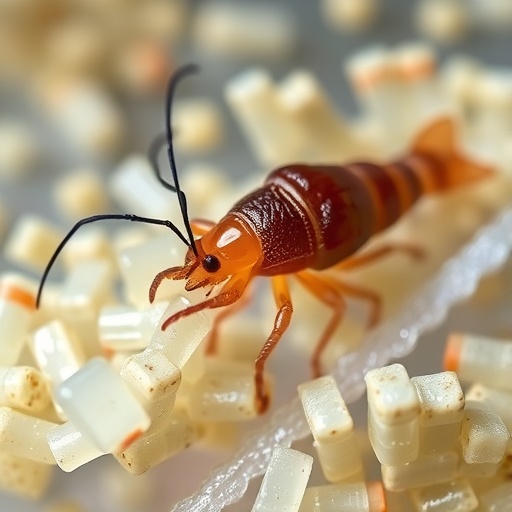
In a groundbreaking study conducted at the City University of Hong Kong, scientists have unveiled the alarming impact of micro(nano)plastics (MNPs) on the delicate microbial ecosystems within marine copepods, organisms fundamental to oceanic carbon cycling. This research leverages advanced aggregation-induced emission luminogen (AIEgen) bacterial probes, enabling unprecedented visualization of bacterial populations inside copepod guts and fecal matter, illustrating how MNP exposure disturbs these critical microbial communities.
Marine copepods play an indispensable role in the carbon cycle by processing organic material and producing fecal pellets that transport nutrients and carbon to the ocean’s depths. The study reveals that when copepods are exposed to MNPs at environmentally relevant concentrations (200 μg/L), there is a pronounced accumulation of microplastics and nanoplastics in gut bacterial clusters, with observed increases of 51.8% and 74.4%, respectively. Simultaneously, fecal bacterial abundance diminishes significantly, declining between 41.4% and 52.0%. These findings suggest that MNPs may obstruct gut passage and hinder microbial transfer to feces, ultimately disrupting nutrient cycling in marine ecosystems.
Using metagenomic sequencing, the researchers identified a decrease in overall microbial diversity within fecal communities, marking a considerable ecological shift. Notably, core bacterial taxa crucial for maintaining microbial community stability, such as Pseudophaeobacter, suffered reductions of 18.7% to 20.5%. Conversely, genera known for their plastic-degrading capabilities, including Psychrobacter, were found to become enriched. This microbial reshuffling points to an adaptive microbial response, yet raises concerns about long-term ecosystem functions.
Although short-term exposure to MNPs did not cause major functional disruption in microbial metabolic pathways—a phenomenon attributed to microbial functional redundancy—the proportional contributions of different microbial communities experienced marked shifts. These shifts underscore the potential vulnerability of microbial networks under sustained MNP stress, foreshadowing the risk of compromised resilience and functional collapse over time.
Professor Wen-Xiong Wang, the study’s lead researcher, emphasized the ecological ramifications, stating, “The loss of core taxa weakens community resilience. Prolonged stress may lead to functional vulnerability.” This prognosis is particularly worrying given the central role of copepod fecal pellets in sequestering carbon and facilitating nutrient transport in marine environments.
The study offers compelling evidence that plastic pollution’s impact extends far beyond physical debris and chemical contamination. It penetrates complex biological relationships, distorting microbial consortia that underpin essential ecosystem services. This microbial disruption within copepods represents a previously underappreciated pathway through which plastic particles may exacerbate marine environmental decline.
Furthermore, the research highlights the sophisticated methodologies now available to environmental scientists, such as AIEgen bacterial probes, which are revolutionizing the visualization and tracking of microbial communities in vivo. These tools are crucial for dissecting the nuanced interactions between pollutants and marine organisms at microscopic scales, advancing our understanding of anthropogenic stressors.
The findings carry significant implications for global marine biogeochemical cycles. As copepods constitute a primary link in the marine food web and contribute massively to carbon export via fecal pellet production, any alterations in their gut microbiota could cascade through trophic levels, influencing ocean productivity and carbon sequestration capabilities.
Efforts to address marine plastic pollution must now integrate microbial perspectives, recognizing that micro and nanoplastics inflict biological and ecological harm that threatens ocean health. Policymakers and environmental managers should consider the invisible microbial dimensions of plastic contamination in developing mitigation strategies.
This pioneering research underscores the urgent need for comprehensive monitoring frameworks combining molecular biology, microbial ecology, and oceanography to fully elucidate the cascading effects of MNPs on marine ecosystems. The resilience of ocean carbon cycling hinges upon understanding and protecting these vital microbial partnerships.
As plastic production and waste continue to escalate globally, the insights garnered from this work provide an important foundation for evaluating the long-term ecological consequences. Identifying shifts in microbial community function and diversity due to MNP exposure is key to predicting ocean ecosystem trajectories in a plastic-saturated world.
This study marks a decisive step toward unraveling the complex interplay between anthropogenic pollutants and marine microbial communities. By illuminating how micro(nano)plastics interfere with copepod gut and fecal microbiomes, it challenges scientists and society to rethink our stewardship of the oceans—from the largest whale to the smallest microbe.
Subject of Research: Animals
Article Title: Gut and Fecal Microbial Community Responses of a Marine Copepod to Micro(Nano)plastics
Web References: http://dx.doi.org/10.1016/j.enceco.2025.12.030
Image Credits: Wen-Xiong Wang, et al
Keywords: Bioinformatics, Microbiology, Freshwater biology, Toxicology


