

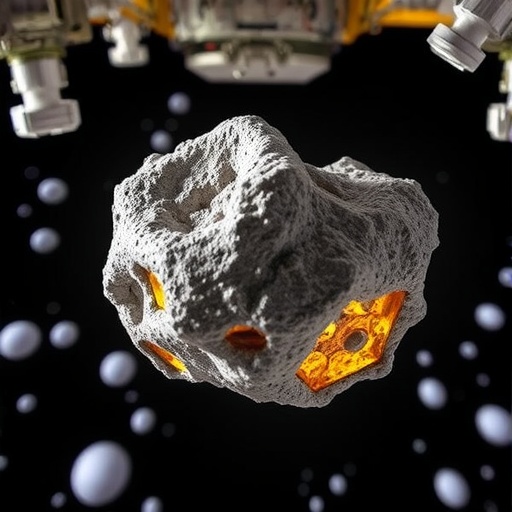
In a groundbreaking collaboration between Cornell University and the University of Edinburgh, researchers have unlocked new insights into the potential of microorganisms to harvest precious metals from asteroidal material in microgravity environments. This pioneering study, conducted aboard the International Space Station (ISS), marks an unprecedented exploration into biomining with fungi and bacteria, revealing novel pathways to sustainable resource extraction both in space and on Earth.
The study focused on the ability of microorganisms to extract platinum group elements (PGEs) from meteorite fragments, specifically targeting the valuable metal palladium. Microbial biomining, as the process is known, leverages the natural metabolic activities of bacteria and fungi to solubilize and extract metals embedded within rocks. This environmentally friendly alternative to traditional mining not only reduces the need for heavy Earth-to-space transport but also opens the possibility of mining extraterrestrial bodies with minimal ecological footprint.
Central to the experiment were two microbial species: the bacterium Sphingomonas desiccabilis and the fungus Penicillium simplicissimum. These microorganisms were chosen for their known proficiency in bioleaching—an ability to chemically break down minerals to release metals. Researchers sought to understand their metabolic behavior and extraction efficiency in the absence of gravity, as encountered in low-Earth orbit aboard the ISS. A terrestrial lab-based control helped compare the influence of Earth’s gravitational force on microbial activity.
The experimental setup involved exposing fragments of L-chondrite asteroidal material—among the most common meteorite types—to these microbes under microgravity conditions. The rationale for selecting L-chondrites lies in their well-characterized mineral composition rich in PGEs, making them ideal candidates for developing space biomining protocols. The microbial interactions with the meteorite surface were meticulously monitored, and subsequent chemical analyses were performed to quantify element solubilization.
One of the most compelling findings was the fungus Penicillium simplicissimum’s enhanced production of carboxylic acids in microgravity. Carboxylic acids serve as vital agents in biomining because their molecular structures facilitate binding with metal ions, promoting dissolution and extraction. Under space conditions, this fungus significantly intensified its metabolic output of these organic acids, leading to an increased leaching of palladium, platinum, and other elements—highlighting a distinct metabolic adaptation to microgravity.
Contrastingly, experiments excluding the fungus displayed diminished metal extraction rates, underscoring its crucial role in facilitating bioleaching in microgravity. The bacterium Sphingomonas desiccabilis also contributed but with distinct metabolomic profiles and extraction capabilities, suggesting that the combined action of various microbial species could be optimized for targeted extraction of specific elements in space mining operations.
Metabolomic analysis—a powerful tool for profiling small molecule metabolites produced by organisms—revealed shifts in microbial secondary metabolite production under microgravity. By analyzing liquid culture samples post-experiment, researchers gained deeper understanding of the biochemical pathways that underlie microbial biomining activity in space. These pathways govern the synthesis of complex organics instrumental to mineral dissolution and metal complexation, offering vital clues to enhancing biomining efficacy beyond Earth.
The research holds promising implications for in-situ resource utilization (ISRU), a critical component of long-term space exploration and habitation strategies. By tapping into native mineral resources on asteroids, lunar surfaces, or Mars, astronauts could potentially access metals required for construction, life support systems, and manufacturing, thus reducing dependency on costly resupply missions from Earth.
Beyond its extraterrestrial applications, the study’s insights into microbial bioleaching mechanisms provide a blueprint for advancing sustainable mining on Earth. Resource-depleted sites, mine tailings, and other environmental burdens can be remediated through biotechnologies inspired by these findings. The ability to selectively extract PGEs using microbial processes could revolutionize circular economies and reduce the environmental impact of conventional mining practices.
The ISS experiment was conducted by NASA astronaut Michael Scott Hopkins, who carefully managed the live microbial cultures in microgravity, ensuring accurate simulation of space conditions. Parallel control experiments on Earth allowed for comparative analyses, thereby validating the distinct effects of microgravity on microbial physiology and metal leaching dynamics.
Lead author Rosa Santomartino, an assistant professor at Cornell University’s Biological and Environmental Engineering department, emphasized the novelty and generality of the approach: “By investigating two fundamentally different microbial species, we aimed to decipher both shared and unique biomining mechanisms adapted to space conditions. This expands our understanding of microbial-driven mineral extraction beyond terrestrial boundaries.” Co-author Alessandro Stirpe contributed extensive microbiological expertise, enabling precise metabolic characterization crucial for interpreting the complex data.
Senior author Charles Cockell, professor of astrobiology at the University of Edinburgh and leader of the BioAsteroid project, highlighted the breakthrough nature of performing biomining on an actual meteorite in space. The project embodies a significant step toward realizing autonomous, efficient resource extraction methods that could support humanity’s push into the solar system.
In sum, this innovative research bridges microbiology, astrobiology, and materials science to chart new terrain in sustainable biomining. By leveraging microbial metabolisms under microgravity to release critical metals like palladium and platinum from asteroidal rock, the study flings open a new frontier for extracting resources in space, promising far-reaching benefits for planetary science, industrial biotechnology, and environmental sustainability alike.
Subject of Research: Microbial biomining of platinum group elements from meteorite material under microgravity conditions.
Article Title: Microbial biomining from asteroidal material onboard the international space station.
News Publication Date: January 30, 2026
Web References:
- https://www.nature.com/articles/s41526-026-00567-3
- https://news.cornell.edu/stories/2026/02/microbes-harvest-metals-meteorites-aboard-space-station
References:
Santomartino, R., Stirpe, A., et al. (2026). Microbial biomining from asteroidal material onboard the international space station. npj Microgravity. DOI: 10.1038/s41526-026-00567-3
Image Credits: Cornell University
Keywords: Microbial biomining, microgravity, International Space Station, platinum group elements, palladium extraction, Penicillium simplicissimum, Sphingomonas desiccabilis, metabolomics, asteroidal material, space mining, sustainable resource extraction, in-situ resource utilization


