

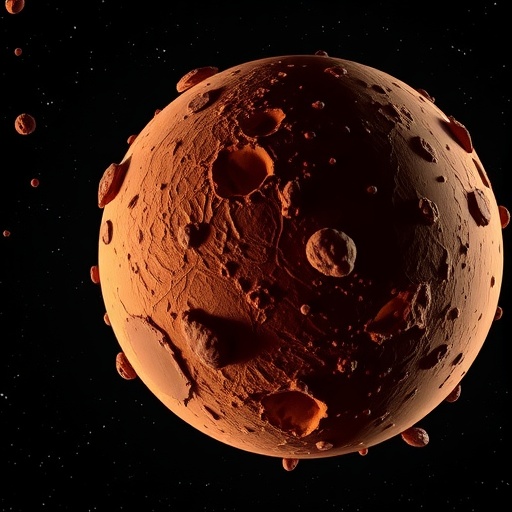
In a groundbreaking study poised to redefine our understanding of life’s resilience beyond Earth, researchers have unveiled compelling evidence that the extremophile bacterium Deinococcus radiodurans can withstand the formidable pressures encountered during ejection from a planetary surface—specifically Mars—following colossal asteroid impacts. This discovery inscribes new chapters in astrobiology, planetary science, and the theories explaining life’s potential interplanetary transfer.
The solar system is inherently meteor-scarred. Both Mars and Earth’s moon display surfaces peppered with impact craters, direct evidence of the ceaseless bombardments by asteroids and comets over billions of years. These impacts not only shape planetary landscapes but generate cataclysmic shock waves that hurl massive debris into space. Of particular interest is the mechanism by which any microbial stowaways trapped within such ejected fragments might survive the severe mechanical stresses inflicted by hypervelocity impacts.
Led by Lily Zhao and K.T. Ramesh at Johns Hopkins University, the research team designed an innovative experimental setup that simulated these extraterrestrial launch conditions. The microorganisms, specifically D. radiodurans, were sandwiched between steel plates which were then subjected to rapid impact by a third steel plate. This approach generated transient pressures up to 3 gigapascals (GPa), approximately 30,000 times the atmospheric pressure at sea level—mirroring the extreme forces presumed during real asteroid impacts.
Deinococcus radiodurans has attracted scientific fascination for decades due to its extraordinary resistance to ionizing radiation, desiccation, and oxidative stress. However, the capacity to survive sudden, immense pressure pulses remained unexplored until this study. By exposing cells to controlled pressures and subsequently analyzing their genetic responses, the researchers gained unprecedented insight into the intracellular events triggered by such impacts.
Remarkably, the bacteria responded to these transient pressures by selectively expressing genes involved in membrane repair and cellular damage mitigation. The researchers employed transcriptomic analyses to decode which stress-related genes were upregulated, revealing a sophisticated molecular prioritization toward cellular integrity maintenance in response to physical trauma.
At pressures around 2.4 GPa, partial cellular membrane rupture was observed using microscopic techniques. Despite this, an astonishing 60% of the bacterial population survived the shock. This resilience was attributed to the unique composition and architecture of D. radiodurans cell envelopes, which apparently act as protective shields mitigating catastrophic structural failure even under intense mechanical shear.
These findings dramatically expand the known survival thresholds for microorganisms subjected to space launch conditions. Traditionally, it was assumed that such extreme ejection pressures would be fatal to most life forms. Yet, the endurance demonstrated by D. radiodurans now suggests that microbial survival during catastrophic impacts is feasible, reinforcing hypotheses of panspermia—the interplanetary exchange of life through natural space travel.
Beyond the basic scientific intrigue, the study resonates with profound implications for planetary protection protocols, space exploration, and the search for extraterrestrial life. If microbes can endure the violent journey from Mars to Earth embedded in rock fragments, it potentially complicates contamination issues for both forward (Earth to Mars) and backward (Mars to Earth) planetary missions. Moreover, life’s tenacity prompts new investigative directions into the environmental conditions on early Earth and Mars that might have fostered cross-planetary biological seeding.
The researchers emphasize that their pressure simulation device achieves rapid, high-fidelity replication of impact stresses, marking a notable advancement over prior methodologies limited to radiation and desiccation tolerance assessments. The ability to monitor real-time gene expression dynamics at defined pressure intervals provides an analytic framework for dissecting microbial response pathways at the molecular level.
Furthermore, the genetic repair mechanisms triggered by the pressure shocks hint at evolutionary adaptions in D. radiodurans that may have equipped it to endure environmental extremes—both terrestrial and extraterrestrial. This insight contributes to the burgeoning field of extremophile biology, where understanding specialized survival strategies illuminates the frontiers of life’s adaptability.
While further studies are necessary to investigate long-term viability post-impact, alongside other physico-chemical stressors such as temperature extremes and cosmic radiation, this research firmly establishes impact ejection survival as an additional parameter in the robustness of microbial life. It encourages reevaluating Earth-centric paradigms of life’s boundaries and highlights the importance of integrative astrobiological experimentation that includes mechanical forces as critical factors.
In sum, the resilience of Deinococcus radiodurans under transient pressures analogous to planetary ejection events powerfully supports the plausibility that microbial life can endure interplanetary voyages. This discovery catalyzes new scientific dialogues about life’s distribution in the solar system, the origins of terrestrial microbiomes, and possibly, the interconnectedness of planetary biospheres across space and time.
As humanity continues to explore our cosmic neighborhood, understanding microbial survivability in the extremities of space becomes not only a matter of scientific curiosity but also of existential import. The pioneering work by Zhao, Ramesh, and colleagues marks a significant stride toward deciphering life’s remarkable tenacity and broadens the horizon of astrobiological potentialities.
Subject of Research: Survival of extremophilic bacteria under pressures associated with impact-induced ejection from Mars
Article Title: Extremophile survives the transient pressures associated with impact-induced ejection from Mars
News Publication Date: 3-Mar-2026
Keywords
Deinococcus radiodurans, extremophiles, planetary ejection, asteroid impact, microbial survival, high-pressure tolerance, astrobiology, panspermia, transcriptomic analysis, impact simulation, planetary protection, interplanetary transfer


