

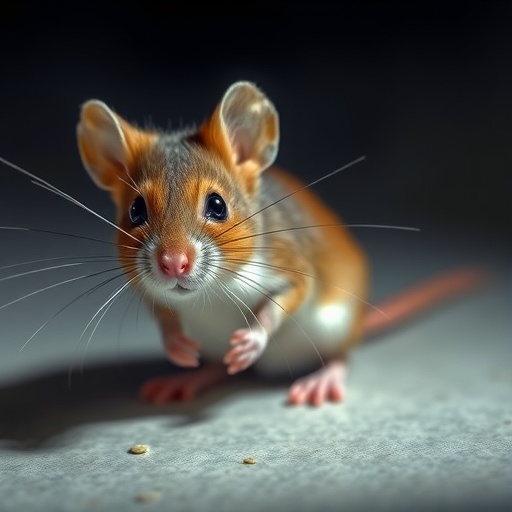
In a groundbreaking study published in the journal Animal Cognition, researchers Y. Hataji and K. Goto explore the cognitive behaviors of mice, specifically focusing on information-seeking strategies in a visual discrimination task. This research delves into how Mus musculus, a species widely used in cognitive neuroscience, navigates complex environments to discern visual stimuli. The findings provide profound insights into animal cognition, particularly in relation to how rodents process visual information amidst distractions.
The study utilized a novel distractor elimination paradigm, allowing researchers to examine the information-seeking behaviors of mice in controlled conditions. By systematically varying the visual distractors, the researchers assessed how these small yet highly intelligent creatures prioritized information to make discriminative choices. This method sheds light on the cognitive processes underpinning visual discrimination, a fundamental skill observed not only in animals but also across various species, including humans.
At its core, the experiment sought to understand the balance between attention and distraction. Mice were presented with different visual cues, and the goal was to determine their ability to focus on relevant stimuli while ignoring irrelevant ones. Given the significance of visual processing in survival, understanding these dynamics offers broader implications for how creatures, including humans, engage with their environments. The findings call into question common assumptions about the cognitive limitations of smaller animals.
The results demonstrate a remarkable adaptability among mice when faced with potential distractions. Though often perceived as simple creatures, the study reveals a sophisticated level of decision-making and information filtering. Mice exhibited varying strategies depending on the nature of the distractor, showcasing their ability to devise methods to enhance their performance on the visual discrimination tasks. This adaptability echoes findings in other species, suggesting that the cognitive traits common to animals may share evolutionary roots.
The use of the distractor elimination paradigm also played a pivotal role in isolating variables, allowing researchers to dissect the complexities of information-seeking behavior. By methodically introducing and removing certain visual elements, Hataji and Goto were able to observe changes in mouse behavior that directly correlated with their decision-making processes. This level of analysis contributes significantly to the understanding of cognitive flexibility in rodents, paving the way for further studies on animal intelligence and behavior.
Another key aspect of this research was the incorporation of neurological perspectives. By linking behavioral outcomes with underlying neural mechanisms, the study offers a comprehensive view of how information is processed within the brain of Mus musculus. This duality of approach not only enriches the existing literature on cognitive abilities in rodents but also opens avenues for further neurological investigations.
As we delve deeper into the results, it becomes evident that the choices made by mice are not merely instinctual; rather, they reflect a complex interplay between learned experiences and adaptive behaviors. The researchers noted that mice often relied on prior visual experiences to mitigate distractions, suggesting a form of learned strategy that enhances their chances of success. This phenomenon bears resemblance to human cognitive strategies, where prior knowledge plays a role in decision-making.
Additionally, the study’s implications extend into the realm of evolutionary biology. As researchers examine the cognitive capabilities of various species, special attention should be given to how these skills have evolved in response to environmental challenges. The ability to discern relevant information from distractions could be considered a vital survival tactic, emphasizing the importance of such cognitive abilities in the natural world.
The findings from this study also carry significant potential for applications beyond basic science. With implications for understanding mental processes in humans, this research contributes to ongoing discussions in fields ranging from psychology to artificial intelligence. By studying the innate strategies of mice, researchers may glean insights applicable to developing more advanced algorithms that mirror natural decision-making processes.
Moreover, the ongoing exploration of animal cognition aligns with a growing interest in conservation efforts. Understanding how different species process information may inform strategies to protect vulnerable populations. As environmental changes continue to pose threats, the knowledge gleaned from cognitive studies can guide efforts in wildlife management and protection.
In conclusion, the research conducted by Hataji and Goto sheds light on a previously underexplored aspect of cognitive behavior in mice. Their work not only provides a deeper understanding of information-seeking strategies but also opens new dialogues in comparative cognition, bridging gaps between literature on animal learning, behavior, and neurological studies. As our comprehension of animal intelligence evolves, we inch closer to unraveling the complexities of cognition shared among species, offering broader implications for the science of perception and decision-making.
This study represents an exciting frontier in understanding animal cognition and behavior. As interest grows, it is likely to inspire additional research that seeks to challenge and expand our current narratives regarding intelligence in non-human animals. This body of work stands as a testament to the significance of continued investigation into the cognitive landscapes of our animal counterparts, further emphasizing the profound interconnectedness of life on our planet.
Subject of Research: Information-seeking behavior in mice during visual discrimination tasks.
Article Title: Correction: Information-seeking in mice (Mus musculus) during visual discrimination: study using a distractor elimination paradigm.
Article References:
Hataji, Y., Goto, K. Correction: Information-seeking in mice (Mus musculus) during visual discrimination: study using a distractor elimination paradigm.
Anim Cogn 28, 69 (2025). https://doi.org/10.1007/s10071-025-01990-x
Image Credits: AI Generated
DOI:
Keywords: rodent cognition, visual discrimination, distractor elimination, animal behavior, information-seeking strategies.


