

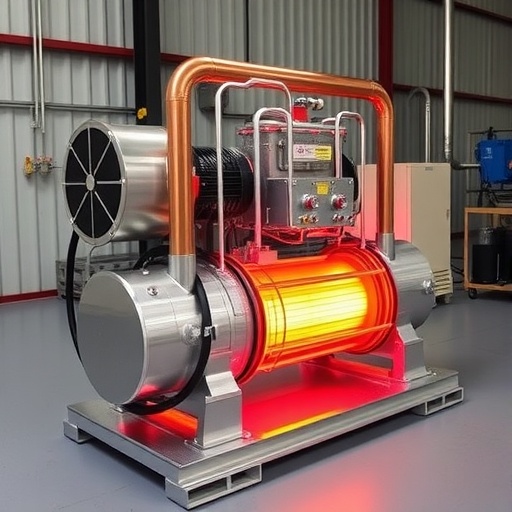
In a groundbreaking advancement set to revolutionize hydrogen technology, researchers have unveiled a metal hydride compressor concept that ingeniously employs hydrogen as a heat transfer fluid. This novel approach promises to address some of the long-standing challenges associated with hydrogen compression, a critical process for the efficient storage and utilization of hydrogen fuel in various industries, including clean energy, transportation, and chemical manufacturing.
At the heart of this innovation is the integration of metal hydrides—compounds formed between hydrogen and metals—with a thermal management system that leverages hydrogen’s exceptional heat transfer properties. Traditional hydrogen compressors often rely on mechanical methods that are energy-intensive and vulnerable to wear and tear, limiting their operational efficiency and longevity. The metal hydride compressor circumvents these issues by utilizing reversible hydrogen absorption and desorption reactions within metal hydrides to compress hydrogen gas thermodynamically.
The fundamental principle relies on the fact that metal hydrides can absorb hydrogen at lower temperatures and release it at elevated temperatures. By controlling the temperature of the metal hydride bed, the system can effectively “pump” hydrogen, increasing its pressure without mechanical moving parts. In this new design, hydrogen itself acts as the medium that transfers heat into and out of the metal hydride material, streamlining the energy exchange process and enhancing system compactness and reliability.
One of the intriguing technical challenges overcome by the researchers was optimizing the heat transfer dynamics between the hydrogen gas and the metal hydride bed. Hydrogen’s high thermal conductivity facilitates efficient heat exchange, but ensuring uniform temperature distribution across the hydride material bed was critical to achieve homogeneous hydrogen absorption and desorption cycles. Advanced computational modeling coupled with experimental prototypes allowed the team to fine-tune thermal gradients and flow dynamics, maximizing compression efficiency.
The compressor concept also incorporates sophisticated thermal management strategies such as regenerative heat exchange, where the heat expelled during hydrogen desorption is partially recycled to preheat the hydride material for subsequent cycles. This approach significantly reduces the external heating requirements and improves overall energy efficiency. Moreover, the compact design eliminates the need for bulky external heat exchangers traditionally required in metal hydride compression systems.
In terms of materials, the research highlights the use of advanced metal hydrides exhibiting rapid kinetics and high hydrogen storage capacities. These metal hydrides provide quick response times during absorption and desorption, enabling the compressor to operate at higher cycling frequencies without degradation. The selection of hydride materials was guided by balancing thermodynamic stability, mechanical robustness, and cost considerations to ensure practical viability.
This technology holds immense promise for green hydrogen infrastructure, particularly for decentralized hydrogen production sites where space constraints and energy efficiency are pivotal. By eliminating mechanical compression components, maintenance costs and downtime can be greatly reduced, paving the way for more resilient hydrogen supply chains. Additionally, the quiet operation and lower vibration levels present opportunities for integration in sensitive environments such as urban fueling stations.
Beyond stationary applications, the new metal hydride compressor concept could transform hydrogen storage onboard vehicles. Traditional high-pressure tanks require complex and heavy mechanical compressors for hydrogen refueling. The thermally driven compressor using the on-board waste heat could potentially enable more compact and lightweight hydrogen storage systems, enhancing vehicle range and performance while reducing refueling times.
The environmental benefits of this technology further underscore its potential impact. By harnessing a thermochemical cycle powered by renewable electricity or excess heat sources, hydrogen compression can become a low-carbon process. This aligns seamlessly with global decarbonization goals and burgeoning investments in the hydrogen economy worldwide. Moreover, the inherently safer design avoids issues related to high-speed rotating machinery commonplace in conventional compressors.
Collaboration among multidisciplinary teams of materials scientists, mechanical engineers, and chemical engineers was vital in bringing this concept to fruition. Recent advances in hydride synthesis, additive manufacturing, and thermal system integration collectively enabled rapid prototyping and validation of the compressor units. These efforts underscore the importance of converging expertise to tackle complex energy challenges.
Scaling up this technology from laboratory demonstrations to industrial-scale deployment remains a key focus area. Challenges such as long-term cycling stability, cost reduction through material optimization, and integration with existing hydrogen infrastructure are actively being addressed. Pilot projects are envisaged to validate operational performance in real-world conditions and explore economic feasibility under various use cases.
The metal hydride compressor concept also opens avenues for complementary innovations in hydrogen liquefaction, purification, and distribution. Leveraging similar thermal cycling principles could yield compact and energy-efficient devices tailored to specific applications across the hydrogen value chain. This holistic approach may accelerate the transition toward a fully renewable hydrogen economy.
Perhaps most excitingly, this development signifies a paradigm shift in how hydrogen compression is conceived. Moving away from purely mechanical methods to thermally mediated hydride chemistry introduces design flexibility and operational advantages that could redefine industry standards. As interest in hydrogen as a clean energy carrier surges globally, such breakthroughs will be critical in overcoming infrastructural bottlenecks.
In summary, this pioneering metal hydride compressor concept utilizing hydrogen itself as a heat transfer fluid offers a compelling route to more efficient, compact, and sustainable hydrogen compression. With promising implications spanning energy, transportation, and environmental sectors, it exemplifies the transformative power of innovative materials science coupled with intelligent thermal system design. The coming years will be crucial in demonstrating its full potential and catalyzing its adoption on a commercial scale.
Subject of Research: Metal Hydride-Based Hydrogen Compression Using Hydrogen as a Heat Transfer Medium
Article Title: A Metal Hydride Compressor Concept using Hydrogen as a Heat Transfer Fluid
Article References:
Fleming, L., Passing, M., Puszkiel, J. et al. A Metal Hydride Compressor Concept using Hydrogen as a Heat Transfer Fluid. Commun Eng (2026). https://doi.org/10.1038/s44172-026-00615-6
Image Credits: AI Generated


