

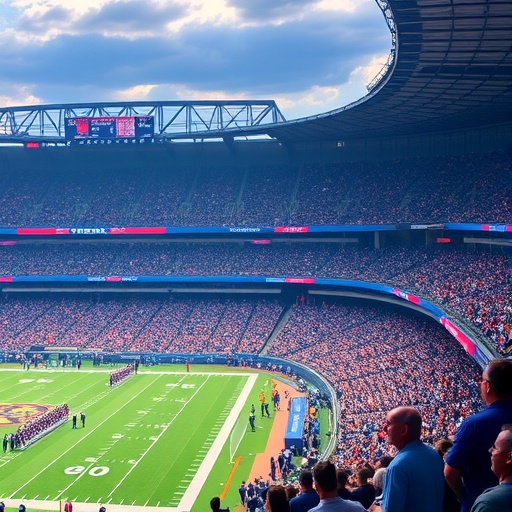
In a groundbreaking investigation into the physiological impacts of live sports attendance, researchers at Bielefeld University have unveiled remarkable insights into how football environments can dramatically influence the human cardiovascular response. The study, entitled “Measuring football fever through wearable technology,” was published in the esteemed journal Scientific Reports, shedding light on how attendance at live matches intensifies fans’ physical and emotional experience in ways never before quantified with such precision.
The investigation focused on the German football club DSC Arminia Bielefeld during the 2025 DFB-Pokal (German Football Association Cup) final held at Berlin’s iconic Olympic Stadium. Utilizing cutting-edge wearable technology—specifically Garmin smartwatches—researchers monitored and collected continuous biometric data from 229 football supporters over a twelve-week span, including the match day itself. By leveraging this unprecedented dataset, the scientists were able to dissect variations in heart rate and inferred stress levels connected to different viewing environments: in-stadium attendance, television spectatorship, and public-viewing venues.
Data analysis revealed that football fans physically present inside the stadium registered significantly elevated average heart rates compared to those watching through screens. While the stadium attendees reached an average of 94 beats per minute, TV viewers exhibited a notably lower average heart rate of 79 bpm, and those in public-viewing contexts showed an even more subdued pulse averaging 74 bpm. This stark differential highlights the physiological amplification driven by real-time, immersive sporting environments where proximity to the action, shared crowd energy, and sensory intensity converge.
Most strikingly, moments of emotional climax within the match—such as the scoring of goals—triggered dramatic cardiovascular responses among stadium-goers. After DSC Arminia Bielefeld netted their first goal, heart rates surged to an average of 108 bpm for the in-stadium group, marking a substantial 36% increase compared to the reactions of fans watching on television. This surge, examined in the context of psychophysiological theories, underscores the potent combination of anticipatory tension, sensory overload, and collective euphoria elicited within the live audience.
Professor Dr. Christiane Fuchs, co-author and head of the Data Science Group at Bielefeld University’s Faculty of Business Administration and Economics, emphasized the unique nature of physical presence in modulating emotional and physiological responses. She noted that the “being there” factor—a convergence of crowd dynamics, shared social identity, and in-the-moment stimuli—appears to elevate cardiovascular strain substantially, an effect that is less pronounced in more passive viewing settings.
Interestingly, the study also identified significant fluctuations in stress markers unrelated to live match conditions, notably the regular spike in stress observed on Saturdays regardless of match schedules. Researchers interpreted these baseline increases as characteristic of heightened leisure-day activities and the psychological anticipation associated with weekends. On the actual day of the cup final, however, stress levels soared far beyond the typical weekend baseline, peaking dramatically throughout the day and sustaining elevated levels well into the post-match hours.
This diurnal pattern of stress activity highlights how the buildup of excitement, anticipation, and social engagements around major sporting events progressively escalates physiological arousal. Starting as early as 6 a.m., nearly fourteen hours before the 8 p.m. kickoff, fans demonstrated measurable deviations from normal baseline values. Professor Dr. Christian Deutscher, a key collaborator from the Faculty of Psychology and Sports Science, remarked on this phenomenon, illustrating how the collective psychological engagement begins long before the first whistle and lingers afterward.
Further complicating these physiological responses is the role of alcohol consumption, which was prevalent among the cohort especially for those attending the stadium. Approximately 65% of stadium fans indulged in alcohol during the match, and this behavioral factor compounded cardiovascular strain. On average, alcohol use raised heart rates by 5.3%, a figure that expanded dramatically—up to 11.7%—during moments of peak emotional intensity such as goal celebrations. These findings raise concerns about the synergistic effects of stadium excitement and alcohol on the heart, particularly given prior evidence associating major sporting events with increased risk of cardiac arrhythmias.
Despite its novel contributions, the study acknowledges certain limitations in causally explaining the phenomenon colloquially termed “stadium fever.” While proximity to the playing field, acoustic reverberations, visual stimulus density, and emotional contagion are posited as underlying factors driving cardiovascular escalation, the precise mechanistic pathways remain elusive. The authors propose that the layering of these sensory and psychological elements in a live setting generates a unique stress cocktail that is attenuated when the experience is mediated through television or public viewing.
The undertaking is intimately linked with Bielefeld University’s Focus Area QUAMU, which concentrates on quantifying and managing uncertainty in complex systems. Incorporating interdisciplinary expertise in data science, psychology, and sports physiology, the Football Fever Study represents a model of how wearable technology can be utilized to decode human biometrics in naturalistic social settings.
The historical significance of the 2025 DFB-Pokal final also added layers of emotional complexity to the study. Arminia Bielefeld, competing for the first time in the club’s history at this stage, faced a challenging 2:4 defeat against VfB Stuttgart. Yet even in the dying moments of the match, with victory slipping away, fans’ heart rates spiked sharply following two late goals, demonstrating the persistence of affective engagement independent of winning prospects.
By providing empirical evidence at the nexus of sport, emotion, and health, this research not only advances academic understanding of fan physiology but also underscores potential public health implications. The amplified cardiovascular load combined with behavioral risk factors, like alcohol intake, may necessitate targeted interventions, especially among vulnerable groups. The football fever encapsulated in this study is therefore much more than a metaphor; it is a measurable physiological state with real consequences.
Ultimately, the study offers a revealing lens into the human experience of sport as a multisensory, socially charged phenomenon. Beyond the scoreboard, the stadium becomes a crucible of collective excitement, psychosomatic stress, and biomechanical upheaval. This new understanding points to the transformative power of in-person attendance on the body and mind—a world apart from the static confines of living rooms and public-viewing squares.
Subject of Research: People
Article Title: Measuring football fever through wearable technology
News Publication Date: 5-Feb-2026
References:
Scientific Reports – DOI:10.1038/s41598-026-36182-1
Image Credits: Wissenswerkstadt Bielefeld/Sarah Jonek
Keywords: football fever, sports physiology, wearable technology, heart rate variability, cardiovascular strain, emotional contagion, live sports attendance, psychophysiology, stress levels, alcohol consumption, DFB-Pokal final, Arminia Bielefeld


