

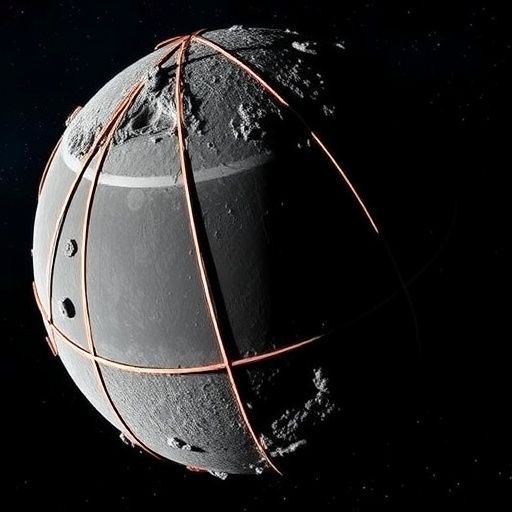
Even two centuries after the discovery of asteroid 16 Psyche, the celestial body continues to mystify astronomers with unresolved questions about its formation and structural composition. Located in the main asteroid belt between Mars and Jupiter, Psyche stands as the tenth most massive asteroid within this populous region, yet it is distinguished further by its status as the largest metallic asteroid known to science. With a staggering diameter measuring approximately 140 miles, Psyche’s enigmatic nature makes it a prime target for scientific inquiry. NASA’s Psyche mission, scheduled for arrival in 2029, aims to unravel the secrets held by this metallic giant and shed light on the processes underlying planetary formation in the early Solar System.
Psyche’s origins have long been debated within the astronomical community, centering around hypotheses that oscillate between its classification as a planetary building block and a remnant of catastrophic planetary differentiation. One prevailing theory suggests that Psyche could be a vestige of an early planet’s core, exposed after violent collisions stripped away its rocky mantle, leaving behind a metallic heart. Alternatively, Psyche may represent a more complex amalgamation of silicate rock and metal, the product of multiple disruptive impacts that thoroughly mixed these components together. Each of these scenarios offers profound implications for our understanding of planetary formation, as Psyche potentially serves as a preserved relic from stages of the Solar System otherwise inaccessible through direct observation.
Researchers at the University of Arizona’s Lunar and Planetary Laboratory (LPL) have leveraged computational simulations to model the formation of a sizeable crater near Psyche’s north pole, hoping to reconcile these competing hypotheses through impact analysis. Published in the peer-reviewed Journal of Geophysical Research: Planets, their study employs advanced 3D modeling techniques built upon the best available shape data for Psyche derived from telescope observations. By recreating the formation of the approximately 30-mile-wide and three miles deep concavity observed on Psyche’s surface, the team has been able to simulate collision scenarios that probe the asteroid’s internal structure. Through these efforts, the researchers intend to equip the scientific community with predictive frameworks that will be essential for interpreting the data NASA’s spacecraft collects upon arrival.
A key insight from these simulations is the critical role played by porosity—the volume fraction of voids or empty space within Psyche’s interior—in influencing crater morphology following impacts. Despite being often overlooked in such models due to its inherent complexity, porosity dramatically alters how kinetic energy from impacts is dissipated and consequently, how craters form and ejecta dispersal patterns emerge. Porous materials exhibit a crushable nature that absorbs impact energy more efficiently than solid rock or metal, leading to deeper craters with steeper walls and less material expelled onto the surrounding surface. These subtle nuances in crater geometry and ejecta deposition patterns serve as direct fingerprints of Psyche’s subsurface composition and mechanical properties.
The simulations also reveal that a moderate-sized impactor approximately three miles across traveling at asteroid belt typical velocities—about three miles per second—would suffice to create a crater matching the dimensions of the observed concavity. Intriguingly, both hypothesized internal configurations of Psyche—a layered structure with a differentiated metallic core and rocky mantle, and a homogeneous mixture of metal and silicate—can plausibly reproduce the crater’s dimensions, though with distinct morphological signatures. This duality highlights the necessity of high-fidelity observations from the spacecraft to differentiate between internal layering and material mixing, which bear directly on Psyche’s formation narrative.
The nature of Psyche as a predominantly metallic asteroid sets it apart from the majority of main belt objects, fewer than 10% of which are metal-rich. Determining the spatial distribution of this metal within Psyche is a vital scientific objective. Should Psyche prove to possess a differentiated core, it would not only confirm prevailing models of planetary differentiation on small scales but also provide rare access to a primordial planetary core. Conversely, a mixed interior would suggest a more tumultuous collisional history, possibly akin to metal-rich meteorites found on Earth, which are thought to represent fragmented, collisionally processed ancestral bodies.
One of the noteworthy challenges faced in modeling Psyche’s cratering is the asteroid’s complex shape and irregular surface topography, born of a violent collisional past. The LPL team’s approach involves constructing a comprehensive 3D target model that incorporates shape and porosity variations, allowing simulation of impacts under realistic conditions. This methodology represents a significant breakthrough in asteroid modeling, enabling more accurate predictions of impact outcomes tailored to Psyche’s unique characteristics. Such rigor in simulating asteroid-specific dynamics marks a pivotal advancement over previous generic impact models that often neglect porous internal structures.
Beyond crater morphology, the Psyche mission encompasses investigations into the asteroid’s gravity and magnetic fields, alongside surface composition analysis, offering a multifaceted approach to understanding the object’s makeup. The simulations predict that impact events produce discernible patterns in density variations resulting from internal compression and complex distributions of metal-rich ejecta scattered across the surface. These signals, when combined with spacecraft instrumentation data, may permit the deconvolution of Psyche’s interior layering or mixing state and constrain its mechanical properties more precisely than ever before.
The analogy employed by the research team likens their investigation to entering an abandoned pizza parlor, examining the leftover ovens, dough scraps, and toppings to reconstruct the processes that created the pizzas. This metaphor elegantly encapsulates the scientific endeavor: while direct access to planetary cores remains impossible, asteroids like Psyche provide natural laboratories offering glimpses into the early stages of planetary evolution. By studying Psyche, scientists potentially hold a key to decrypting the violent formative processes that governed the solar system’s primordial epochs, inaccessible through other means.
As NASA’s Psyche spacecraft approaches its rendezvous, the synergy between geochemical analysis, geological observation, and dynamic modeling stands to revolutionize our understanding of asteroid interiors and planetary formation frameworks. The modeling work conducted ahead of time equips mission scientists with essential contextual knowledge, serving as a conceptual roadmap for interpreting the imminent trove of data. This collaborative fusion of theoretical simulation and direct spacecraft exploration exemplifies modern planetary science at its best, where computational foresight and empirical observation converge to unravel cosmic mysteries.
In summary, unraveling Psyche’s formation and internal structure promises to not only enhance comprehension of a singular celestial body but also shed light on broader questions concerning the origins of planets and the Solar System’s evolutionary history. Insights gleaned from this metallic asteroid could reshape theories of how planetary cores evolve, the role of collisions in sculpting early Solar System bodies, and how metal and rock interact under extreme conditions. The upcoming Psyche mission, bolstered by sophisticated ground-based simulations, heralds a new era in asteroid science, bridging observational technology and computational prowess to explore one of space’s most compelling enigmas.
Subject of Research: The formation and internal structure of asteroid 16 Psyche, including crater formation processes influenced by porosity and composition.
Article Title: [Not explicitly provided in the source content]
News Publication Date: [Not explicitly provided in the source content]
Web References:
– NASA Psyche mission: https://psyche.ssl.berkeley.edu/
– University of Arizona Lunar and Planetary Laboratory: https://lpl.arizona.edu/
– DOI of the study: https://doi.org/10.1029/2025JE009231
References:
Baijal, N., Asphaug, E., Denton, A., et al. (2025). Simulations of Crater Formation on a Metallic Asteroid: Implications for Psyche’s Internal Structure. Journal of Geophysical Research: Planets. https://doi.org/10.1029/2025JE009231
Image Credits: Not specified in the provided content.
Keywords
Asteroid 16 Psyche, metallic asteroid, planetary formation, porosity, crater formation, asteroid belt, NASA Psyche mission, planetary core, asteroid composition, impact simulations, Lunar and Planetary Laboratory, Solar System evolution


