

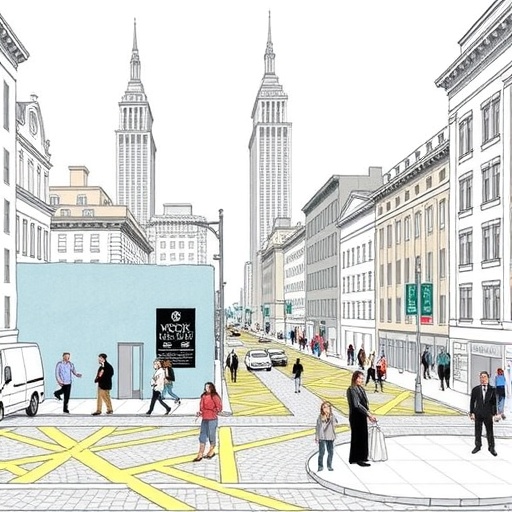
In the intricate tapestry of urban mobility, walking stands out as the most fundamental yet paradoxically underappreciated mode of travel. Despite its ubiquity, pedestrian movement has been notably absent from systematic city-wide measurement, especially during critical peak travel periods. A groundbreaking study recently published offers a transformative perspective by introducing the first comprehensive foot-traffic model for New York City—a metropolis that epitomizes urban complexity and diversity. This research not only maps the spatial distribution of pedestrian volumes but also illuminates the socio-economic and safety implications of such foot traffic patterns, opening new vistas for more equitable urban planning.
New York City’s vast expanse and distinct borough composition make it an ideal laboratory for examining pedestrian dynamics. The study’s methodology harnesses advanced data integration techniques, combining city-wide pedestrian counts, street classification datasets, and traffic accident records to forge a nuanced model capable of estimating foot traffic volumes across thousands of street segments. This granular approach allows for an unprecedented, high-resolution view of how pedestrians move through the city’s multifaceted urban landscape during peak hours, revealing subtle patterns previously obscured by traditional vehicular traffic analysis.
One of the most striking revelations from this model is the discrepancy between foot traffic intensity and the city’s official street classifications that guide infrastructure investment. While Manhattan, the city’s commercial and financial heart, predictably exhibits high pedestrian volumes, numerous thoroughfares in the outer boroughs exhibit foot traffic levels comparable to those Manhattan streets deemed pedestrian-prioritized. Yet, these outer borough streets remain under-recognized in terms of pedestrian infrastructure and safety prioritization. This mismatch highlights latent inequities in urban resource allocation, suggesting that boroughs traditionally seen as peripheral are experiencing pedestrian demands on par with, or even exceeding, those of the city center.
By integrating pedestrian volume data with pedestrian injury and crash statistics, the researchers unveil a disturbing pattern: intersections with the greatest pedestrian injury risk frequently lie outside Manhattan. When accident rates are normalized for exposure—accounting for the number of pedestrians traversing these intersections—the outer boroughs manifest disproportionate risk levels. This factor of ‘exposure-adjusted danger’ acts as a critical metric, underscoring how existing infrastructure and traffic management strategies may be inadequate—or even harmful—in protecting the safety of pedestrians in less centrally located areas.
The study’s findings have profound implications for urban planners and policymakers crafting the future of New York City’s streetscape. Traditional approaches to urban design often prioritize vehicle traffic and central business districts, inadvertently sidelining the needs of pedestrians in outer boroughs where spatial inequalities and socio-economic challenges are most acute. By providing a detailed, data-driven map of pedestrian flow, the foot-traffic model lays a rational foundation for rethinking infrastructure investment, potentially shifting resources toward neighborhoods that have been historically underserved.
Crucially, the usage of foot traffic volume as a baseline for hazard analysis represents an evolution in urban safety evaluation. Previously, pedestrian safety interventions largely relied on reactive measures, implemented post-accident or based on rough heuristics of vehicle traffic. This proactive framework, however, integrates pedestrian exposure directly into risk assessments, allowing for targeted interventions in high-risk areas before accidents occur. Such an anticipatory model aligns with emerging principles of Vision Zero and other global pedestrian safety initiatives, positing data-driven infrastructure improvements as the linchpin of urban resilience.
The study’s technical backbone involves the synthesis of Big Data sources—including anonymized smartphone location data, municipal pedestrian counters, and detailed crash reports—filtered through advanced statistical and machine learning algorithms. These computational techniques facilitate real-time estimation of pedestrian volumes and enable the identification of spatial patterns that defy traditional expectations. By leveraging geospatial analytics, the research transcends the limitations of manual counts and small-scale surveys, presenting a scalable solution adaptable to other metropolitan contexts.
In addition to spatial equity concerns, the research underscores the potential for pedestrian volume models to enhance urban accessibility. Many streets with high foot traffic in the outer boroughs coincide with communities reliant on walking as a primary mode of transportation due to limited access to private vehicles or public transit. By mapping demand hotspots, the model can inform investments in sidewalk maintenance, lighting, street crossing facilities, and traffic calming measures, thereby improving not only safety but also mobility and quality of life for marginalized populations.
The integration of pedestrian volume data into the city’s Official Street Classification system presents both challenges and opportunities. The entrenched classification framework, historically designed for vehicle prioritization, lacks granularity regarding pedestrian needs. The study proposes recalibrating these classifications to reflect actual pedestrian flows, promoting a more balanced and inclusive urban mobility blueprint. This recalibration would involve redefining ‘pedestrian-prioritized’ streets to encompass those with demonstrable foot-traffic demand, regardless of their traditional commercial or vehicular status.
From a policy perspective, the findings invite a paradigm shift away from car-centric urban planning towards what scholars call ‘pedestrian-first’ design principles. The reallocation of street space, including the expansion of pedestrian-only zones, curb extensions, and improved traffic signal timing, can be strategically guided using the foot-traffic model. Such interventions promise to reduce pedestrian injuries, encourage sustainable travel behaviors, and contribute to broader climate resilience goals by promoting non-motorized transit modes.
Moreover, the research illuminates the socio-political dimensions of pedestrian infrastructure. The underinvestment in outer borough pedestrian environments reflects broader systemic disparities rooted in historical planning decisions and economic disparities. By providing empirical evidence of foot traffic demand and risk, the model empowers community advocates and urban professionals to make data-backed arguments for more equitable resource distribution. This evidence-based advocacy could catalyze transformative change, ensuring that urban design serves the needs of all city residents.
The implications of this research extend beyond New York City, serving as a blueprint for cities worldwide grappling with pedestrian safety and infrastructure equity. Urban environments marked by spatial segregation, varying infrastructural quality, and diverse mobility patterns stand to benefit from similar foot-traffic modeling. The transferability of the methodology underscores the universal importance of integrating pedestrian data into urban mobility planning, a step that has been historically overlooked in the prioritization of motorized traffic.
In the context of emerging smart city technologies, this research fits neatly within broader trends of data-driven urban management. Real-time monitoring and dynamic modeling of pedestrian flows have potential applications in adaptive traffic signals, emergency response planning, and event management. Embedding pedestrian volume data into these systems can optimize urban responsiveness, ensuring streets function safely and efficiently even under fluctuating conditions.
The researchers also highlight possible extensions of their model, including temporal expansions beyond peak hours and integration with environmental sensors capturing air quality and noise pollution. Such multidimensional modeling could provide a holistic understanding of pedestrian experience, informing urban designs that promote health and well-being while also addressing safety and accessibility.
Finally, the study exemplifies the critical role of interdisciplinary collaboration, blending urban planning, data science, and public health perspectives to tackle complex urban issues. It showcases how leveraging computational advances and rich urban datasets can overcome longstanding blind spots in understanding pedestrian mobility, ultimately crafting cities that are safer, fairer, and more inclusive.
As cities worldwide continue to grow and transit dynamics evolve amidst shifting social and environmental challenges, pioneering efforts like this New York City foot-traffic study illuminate the path forward. Systematic, data-informed pedestrian analysis is poised to become an indispensable tool for urban planners and policymakers seeking to balance mobility, safety, and equity on the crowded streets of modern metropolises.
Subject of Research: Spatial distribution and modeling of pedestrian foot traffic in New York City with applications to urban planning and pedestrian safety.
Article Title: Spatial distribution of foot traffic in New York City and applications for urban planning.
Article References:
Sevtsuk, A., Basu, R., Liu, L. et al. Spatial distribution of foot traffic in New York City and applications for urban planning. Nat Cities (2026). https://doi.org/10.1038/s44284-025-00383-y
Image Credits: AI Generated
DOI: https://doi.org/10.1038/s44284-025-00383-y
Keywords: Urban mobility, pedestrian traffic modeling, New York City, pedestrian safety, urban equity, infrastructure investment, spatial analysis, exposure-adjusted risk, urban planning, data-driven design.


