

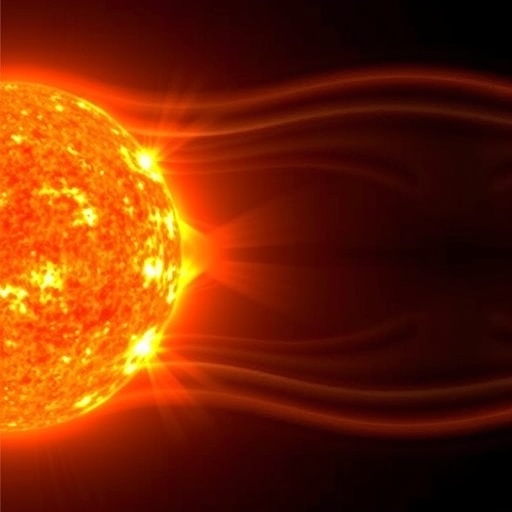
In a groundbreaking advancement in solar physics, researchers have unveiled compelling evidence for the existence of magnetically influenced inertial waves within the Sun, shedding new light on the elusive processes driving the solar cycle. Using sophisticated helioseismic techniques and high-resolution data obtained from NASA’s Helioseismic and Magnetic Imager (HMI), scientists have identified large-scale global oscillations that are modulated by the Sun’s magnetic fields, offering a fresh perspective on solar magnetism. This discovery not only deepens our understanding of the solar interior but also holds promise for improving predictions of solar activity that impact space weather and technology on Earth.
The study focuses on detecting what are known as magnetized inertial waves—oscillatory modes influenced by the Coriolis force and magnetic fields within the solar interior. These waves, theorized but not firmly observed before, manifest as large-scale motions inside the Sun that could modulate the solar dynamo—the engine powering the cyclical generation of magnetic fields and solar activity. By analyzing nearly continuous observations from the HMI instrument aboard the Solar Dynamics Observatory, which tracks oscillations of the solar surface caused by internal waves, the team leveraged helioseismology to peer beneath the Sun’s turbulent outer layers.
Importantly, researchers identified two distinct types of inertial wave modes. One corresponds to a slow mode, characterized by relatively lower frequency oscillations, while the other is a weaker, retrograde mode potentially consistent with a fast inertial wave predicted in magnetohydrodynamic theories. Both modes exhibit frequencies that align closely with theoretical models that factor in large-scale toroidal magnetic fields—bands of magnetic flux that wrap around the Sun’s interior, believed to play a critical role in magnetic field generation and sunspot formation.
These newly detected oscillations appear confined to regions within the solar layers at about 98% or less of the solar radius. This suggests that the waves reside predominantly in the Sun’s subsurface layers, where density plays a significant role. Based on the data, the amplitude of the inferred magnetic field varies with depth, represented by an effective magnetic strength scaling as approximately five times the square root of the local density relative to the surface density. Given that the surface density is notably low at about 4 × 10⁻⁷ grams per cubic centimeter, this scaling leads to magnetic field strengths matching those expected deep within the convection zone.
To contextualize these values, the convection zone base has a much higher density around 0.44 grams per cubic centimeter. Applying the observed scaling, the team estimates that the toroidal magnetic fields located there could reach intensities of roughly 5000 Gauss. This magnitude is consistent with previous helioseismic measurements and other indirect assessments of internal solar magnetic fields, reinforcing the validity of the findings and their profound implications for solar physics.
The detection of these global-scale magnetically modified Rossby waves—large inertial oscillations altered by the magnetic field—provides an insightful window into the Sun’s magnetic architecture. Historically, Rossby waves have been observed in the solar atmosphere and are known to influence weather patterns on Earth. Within the solar interior, however, their magnetically modified counterparts form a crucial link in understanding how magnetic fields evolve and interact with plasma flows over the 11-year solar activity cycle.
Beyond the fundamental scientific curiosity, these discoveries have tangible relevance for technology and society. Solar activity, driven by magnetic field evolution, impacts space weather phenomena such as solar flares and coronal mass ejections. These events can disrupt satellite communications, navigation systems, power grids, and pose risks to astronauts. By capturing signatures of these previously hidden inertial waves and associating them with magnetic structures, the research paves the way toward earlier and more accurate forecasts of solar storms and long-term activity trends.
Technically, this advance was made possible through helioseismology, a technique somewhat analogous to terrestrial seismology but applied to the Sun. By studying waves on the solar surface caused by subsurface disturbances, researchers effectively map out internal properties such as fluid flow and magnetic field strength. The HMI instrument, equipped to capture velocity signatures of surface oscillations, provided the extensive dataset needed to detect subtle variations associated with magnetically modified inertial modes.
The characterization of these waves involved comparing observed frequencies and amplitudes to theoretical magnetohydrodynamic (MHD) models that incorporate the effects of rotation, stratification, and magnetic fields on wave propagation. These models predict the coexistence of slow and fast inertial modes, with magnetic fields exerting pivotal influence by altering wave speeds and resonant frequencies. The match between observation and theory strongly supports the physical interpretation that the Sun’s internal magnetized fluid supports such global oscillatory modes.
Interestingly, while Rossby waves in the Sun’s convection zone had been observed previously, their magnetic counterparts remained elusive. This research clarifies that these magnetically influenced inertial waves have smaller amplitudes compared to purely hydrodynamic Rossby waves but are nonetheless detectable with sensitive observations. The fact that these modes emerge only within specific subsurface depths underscores the stratified nature of the solar interior and highlights the complex interplay between plasma density, rotation, and magnetic fields.
The theoretical significance extends further: the modulations imposed by these magnetized modes could feed back into the solar dynamo process. The solar dynamo is believed to rely on the cyclical conversion of poloidal to toroidal magnetic fields and back, driven by convective motions and differential rotation. By modulating these flows, inertial waves influenced by magnetic fields could serve as regulators or drivers of the temporal variations in solar magnetism and activity levels.
Moreover, the inferred field strengths and their spatial confinement provide critical boundary conditions for dynamo simulations. Many challenges in dynamo theory stem from uncertainties about magnetic field distribution and intensity at various solar depths. These new empirical constraints will help refine existing models, offering more accurate representation of magnetic feedback mechanisms within the convecting solar plasma.
From an observational perspective, these findings mark a new era of magnetoseismology—the study of how magnetic fields affect oscillatory modes inside stars. As observational tools and data analysis techniques improve, future studies may extend these insights to other stars, enriching our knowledge of stellar magnetism and its broader astrophysical implications.
In summary, the identification of global-scale magnetically modified Rossby waves represents a major leap forward in solar physics. The discovery bridges long-standing gaps in understanding the magnetic dynamics within the Sun, highlights novel wave phenomena modulated by internal magnetic fields, and opens promising avenues for improved solar activity forecasting. As the Sun remains a dynamic and sometimes unpredictable driver of the space environment, integrating these observations into models offers hope for mitigating the adverse effects of space weather on technological systems and human activity.
This research exemplifies the power of combining precise helioseismic measurements with advanced theoretical models to unlock the Sun’s hidden magnetic layers. It is a testament to how modern observational techniques can unravel complex plasma physics phenomena occurring far beneath our star’s surface. The potential for translating this fundamental knowledge into practical predictive tools underscores the critical importance of continued investment in solar research and space observatories.
Looking ahead, the challenge will be to monitor these waves continuously over solar cycles to reveal their evolution and correlation with solar activity phases. Understanding whether and how these magnetized inertial waves influence the onset and progression of solar maxima and minima could revolutionize our predictive capabilities. Furthermore, exploring their interactions with other known solar oscillations may illuminate new dimensions of magnetohydrodynamic dynamics within the Sun.
Ultimately, these discoveries invite a re-examination of the solar interior as a complex arena where flow, magnetic fields, and waves interlace intricately. As our star governs the near-Earth environment, unraveling these mysteries not only advances astrophysics but also enhances our preparedness against the disruptions posed by its magnetic temper tantrums. The era of probing the Sun’s magnetized seismic symphony has truly arrived, promising deeper insight and broader horizons.
Subject of Research: Solar interior dynamics and magnetically influenced global-scale inertial waves (magnetized Rossby waves).
Article Title: Evidence for global-scale magnetically modified Rossby waves in the Sun.
Article References:
Hanasoge, S., Hanson, C. Evidence for global-scale magnetically modified Rossby waves in the Sun. Nat Astron (2026). https://doi.org/10.1038/s41550-026-02794-w
Image Credits: AI Generated


