

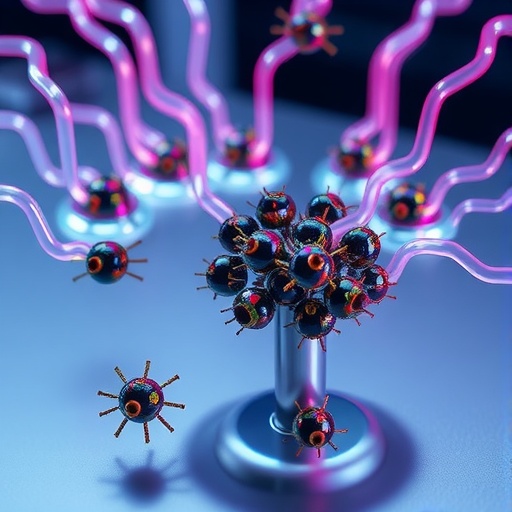
In a groundbreaking advance in the field of microrobotics, researchers from the Max Planck Institute for Intelligent Systems (MPI-IS), alongside collaborators from the University of Michigan and Cornell University, have developed a novel mechanism enabling swarms of magnetic microrobots to manipulate objects without any physical contact. This research, recently published in Science Advances, ushers in a new paradigm for precision control at microscale dimensions, leveraging the subtle yet powerful forces generated through fluid dynamics rather than direct mechanical interaction.
The cornerstone of this innovation lies in the fluidic torque generated by coordinated rotation of microrobot collectives under external magnetic fields. Each tiny microrobot, measuring approximately 300 micrometers in diameter, spins rapidly and collectively to induce controlled flow fields within the surrounding fluid medium. These flow patterns exert torque on nearby objects, causing them to rotate, shift, or reorient in a programmable way without the robots ever physically touching them. This indirect contactless manipulation marks a significant leap from conventional micromanipulation techniques which typically rely on direct pushing, pulling, or gripping.
The team meticulously demonstrated that by tuning critical parameters such as the spin frequency, the number of microrobots in the collective, and their spatial arrangement, the fluid-generated forces can be precisely controlled and amplified. Torque magnitudes achieved in these experiments reached up to 3.6 × 10⁻⁹ newton-meters, powerful enough to move objects thousands of times larger and heavier than a single microrobot. These results highlight not only the scalability of the system but also its potential versatility in handling a wide range of microscale manipulation challenges.
One of the most striking proofs of concept involved using these microrobot swarms to rotate gear wheels. By strategically positioning the spinning microrobots inside or near the gears, the researchers were able to direct the rotation either clockwise or counterclockwise, effectively programming mechanical motion from afar. This programmable fluidic torque circumvents the need for mechanical linkages or physical contact, enabling smoother, less invasive operation in delicate systems.
Beyond simple gear rotation, the microrobot collectives achieved more complex tasks such as actuating entire gear trains and rotating three-dimensional objects whose masses exceeded that of individual robots by over 45,000 times. Remarkably, these collective behaviors were not hardcoded but emerged from hydrodynamic interactions and swarm coordination. Such adaptability reflects the promise of microrobot swarms in performing sophisticated assembly or reconfiguration tasks in microscale manufacturing environments.
The discovery builds on previous understandings of hydrodynamic drag forces but takes them a step further by harnessing fluid-mediated interactions as a tool for remote actuation. Steven Ceron, a lead author and assistant professor at the University of Michigan, emphasizes how this approach “opens an avenue of remote manipulation at small scales, turning the fluid environment from a hindrance into an asset.” This paradigm shift paves the way for microrobots to function in environments that are otherwise inhospitable to traditional mechanical actuators, such as inside biological tissues or microfluidic devices.
Intriguingly, the research also documented emergent, adaptive collective behaviors in these microrobot swarms. Depending on operational parameters, swarms could switch from dispersed rotation patterns to crawling-like motions along object surfaces. Such versatility permits the robots not only to manipulate objects but to alter their own configurations dynamically, optimizing performance according to task demands or environmental conditions. This self-organizing capability mirrors biological systems, suggesting future microrobotic platforms might exhibit even more autonomous and intelligent behaviors.
Looking forward, the implications of this technology are profound. Traditional microscale fabrication or manipulation methods often risk damaging delicate components due to direct physical contact or limited programmability. The fluidic torque mechanism overcomes these challenges by providing a fully contactless means of exerting finely tuned mechanical forces. This could revolutionize fields as diverse as biomedical engineering, where microrobots might transport and assemble cellular or molecular components within the body, and microscale manufacturing where high-precision assembly of miniature machines becomes possible.
Metin Sitti, former head of the Physical Intelligence Department at MPI-IS and current President of Koç University, highlights the broader vision: “By understanding and controlling fluidic torque, we are moving toward programmable microrobot systems capable of complex, coordinated tasks.” This vision resonates deeply in the context of the emerging field of physical intelligence, where intricate behaviors emerge from the interplay of simple robotic agents with their environment.
To summarize, this pioneering study reveals how swarms of magnetic microrobots, spinning collectively within fluid media, generate controllable and scalable hydrodynamic torques that enable contactless manipulation of macroscale objects from microscale agents. The applications of this discovery extend far beyond laboratory curiosity—they portend a future where tiny, coordinated robots execute complex manufacturing or biomedical tasks with unprecedented precision and delicacy.
The continuing evolution of such microrobotic collectives holds exciting prospects for both scientific discovery and practical innovation. As the team refines control methodologies and explores new fluid-structure interactions, these microrobot swarms could become vital tools in environments where traditional robotic manipulation is impossible or inefficient. This research not only pushes forward the frontiers of miniaturization but also lays foundational principles for a new class of fluidically actuated robotic systems.
Subject of Research: Not applicable
Article Title: Fluidic Torque-Enabled Object Manipulation by Microrobot Collectives
News Publication Date: 25-Feb-2026
Web References:
Science Advances Article DOI
References:
Steven Ceron, Gaurav Gardi, Kirstin Petersen, Metin Sitti. “Fluidic Torque-Enabled Object Manipulation by Microrobot Collectives.” Science Advances, DOI: 10.1126/sciadv.aea9947.
Image Credits: MPI-IS
Keywords
Magnetic microrobots, fluidic torque, contactless manipulation, microrobot swarms, hydrodynamic interactions, microscale assembly, programmable motion, biomedical applications, microscale manufacturing.


