

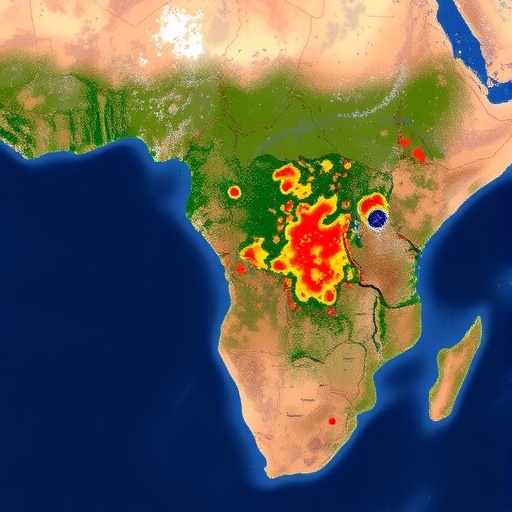
In recent years, the issue of deforestation has gained unprecedented attention across the globe, emerging as one of the most pressing environmental challenges of our time. The intricate interplay of human activities, economic development, and ecological degradation forms a complex web that is particularly evident in regions like Somalia. A groundbreaking study led by Osman, Hassan, and Hassan has shed light on this multi-faceted dilemma, employing advanced machine learning techniques and two-stage least squares (2SLS) econometric methods to analyze the drivers of deforestation in Somalia.
In the context of this research, deforestation refers not only to the physical loss of trees but also to the comprehensive degradation of forest ecosystems that serve as vital resources for both biodiversity and human sustenance. Somalia, a country that has faced chronic instability, environmental challenges, and economic hardships, presents a unique case study. The findings of this research will be pivotal in formulating effective strategies aimed at curtailing deforestation through data-driven insights.
A significant finding of this study highlights the correlation between economic growth and deforestation rates. As countries strive for development, the demand for land for agriculture, infrastructure, and urbanization tends to rise. In Somalia, the resulting deforestation can have detrimental impacts on local communities that rely on forest resources for their livelihoods. The study articulates how economic aspirations, if not managed sustainably, can lead to an ecological crisis that reverberates throughout society.
Moreover, the research emphasizes the role of population dynamics as a critical factor driving deforestation. Population growth puts intensified pressure on natural resources, as more people require food, shelter, and energy. The authors argue that understanding demographic trends is essential for predicting future deforestation patterns. This vital piece of information allows policymakers to devise plans that balance human needs with ecological preservation.
Interestingly, the study incorporates the aspect of renewable energy usage as a double-edged sword in the deforestation equation. While promoting renewable energy has the potential to reduce dependence on fossil fuels and slow down deforestation, there are caveats related to how renewable energy projects are implemented. If improperly managed, these projects can inadvertently lead to habitat destruction and resource depletion. The authors call for careful planning to ensure that renewable energy initiatives contribute positively to environmental sustainability.
Globalization emerges as a compelling factor influencing deforestation in Somalia. The authors note that globalization can facilitate the flow of capital, technologies, and even environmental policies across borders. However, it can also lead to unsustainable practices, particularly when multinational corporations exploit local resources without sufficiently considering environmental ramifications. The study illustrates how globalization, while having the potential to foster development, can simultaneously undermine local ecological integrity when not approached with caution and responsibility.
Machine learning has become a game-changer in the ecological research arena. The innovative use of this technology in this study allowed for nuanced analysis of vast datasets that traditional methods might overlook. By leveraging algorithms capable of identifying patterns and correlations among socio-economic variables, the researchers could pinpoint specific predictors of deforestation. This methodological advancement underscores the power of technology in developing targeted strategies for conservation.
The dual approach of utilizing machine learning alongside 2SLS econometrics provided a robust framework for analyzing causal relationships between the various drivers of deforestation in Somalia. The study adeptly navigated complex statistical models to arrive at conclusions that are not only statistically significant but also highly relevant to the ongoing discourse on sustainable development. The 2SLS method allowed the researchers to control for endogeneity, ensuring that the relationships highlighted are indeed causal rather than spurious.
For stakeholders, including policymakers and conservationists, the implications of these findings are profound. The study advocates for the implementation of integrated policies that address economic growth, population dynamics, and energy transitions concurrently. This multi-dimensional approach is necessary to create a resilient framework capable of mitigating the adverse effects of deforestation while promoting sustainable development.
The authors also emphasize community engagement as a cornerstone of any effective conservation strategy. Local communities are often the frontline defenders of forests; therefore, their inclusion in decision-making processes around resource management is crucial. The study argues that empowering local populations through education, resources, and decision-making authority can greatly bolster conservation efforts and sustainable practices.
Additionally, the research draws attention to the relationships between climate change, deforestation, and local livelihoods. As global temperatures rise, the degradation of forest ecosystems exacerbates the vulnerability of communities that depend on these environments for survival. The cyclical nature of environmental degradation and human poverty demands urgent collective action to address these intertwined issues.
In conclusion, the pioneering study by Osman and colleagues serves as a clarion call for urgent action to combat deforestation in Somalia through a nuanced understanding of its underlying drivers. By employing modern analytical tools and advocating for integrated solutions, the research opens a pathway for sustainable interventions. The need for a balanced approach that considers economic, social, and environmental dimensions has never been more vital.
As we forge ahead, the lessons gleaned from this research will not only enhance our understanding of the deforestation crisis in Somalia but also resonate in broader contexts worldwide. Without a comprehensive strategy that incorporates machine learning analytics, sustainable practices, and community engagement, the threat of deforestation will only continue to escalate, further endangering our planet’s future.
Subject of Research: Deforestation Drivers in Somalia
Article Title: Analyzing deforestation drivers in Somalia using machine learning and 2SLS with economic growth, population dynamics, renewable energy, and globalization.
Article References:
Osman, B.M., Hassan, A.Y., Hassan, A.M. et al. Analyzing deforestation drivers in Somalia using machine learning and 2SLS with economic growth, population dynamics, renewable energy, and globalization. Discov Sustain (2026). https://doi.org/10.1007/s43621-025-02570-2
Image Credits: AI Generated
DOI: 10.1007/s43621-025-02570-2
Keywords: Deforestation, Somalia, Economic Growth, Population Dynamics, Renewable Energy, Globalization, Machine Learning, Environment, Sustainability.


