

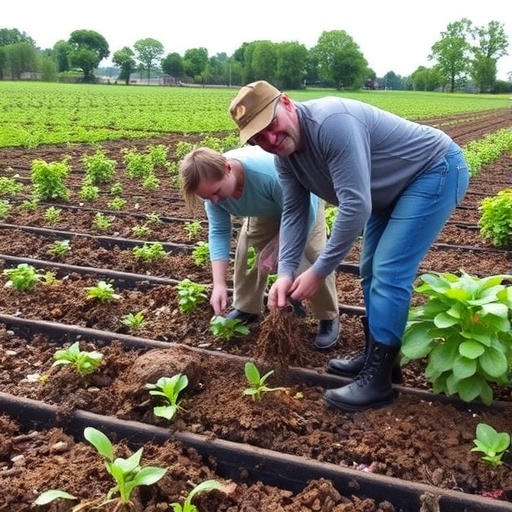
In a groundbreaking study poised to reshape our understanding of soil ecology and sustainable agriculture, researchers from across Europe have unveiled compelling evidence that low-intensity agricultural management significantly enhances the soil priming effect in European agroecosystems. This revelation carries profound implications for designing future farming practices aimed at optimizing soil health, carbon cycling, and crop productivity in the face of global environmental change.
The soil priming effect, a dynamic process in which the input of fresh organic matter stimulates the decomposition of existing soil organic carbon, has long been recognized as a critical driver of nutrient availability and carbon turnover in terrestrial ecosystems. However, the interaction between agricultural management intensity and priming processes has remained poorly understood. The multi-institutional team spearheaded by Dong, Vera, and Patiño integrated comprehensive field data, advanced soil biochemical assays, and cutting-edge ecological modeling to uncover how varying intensities of land management modulate this effect within diverse European agroecosystems.
At its core, the priming effect hinges on the metabolic responses of soil microbial communities to fresh carbon inputs, such as root exudates, crop residues, or organic amendments. Under intensified management regimes characterized by heavy tillage, high synthetic fertilizer inputs, and frequent soil disturbance, the microbial communities often become destabilized or shift in composition, potentially dampening their capacity for soil organic matter decomposition. Contrastingly, low-intensity regimes, which employ reduced tillage, cover cropping, and minimal chemical inputs, appear to foster a more resilient and active microbial consortium, capable of stimulating priming to a greater extent.
The researchers conducted an extensive survey across a gradient of agricultural practices spanning Mediterranean, temperate, and boreal European regions. By combining isotopic tracing techniques with measurements of CO2 efflux and soil organic carbon content, they were able to quantify the magnitude of priming effects in situ. Their findings consistently demonstrated that low-intensity management systems exhibited up to 40% higher priming activity compared to high-intensity conventional agriculture, underscoring the pivotal role of management regimes in regulating soil carbon dynamics.
One of the most striking observations pertained to the influence of reduced tillage systems. The mechanical disturbance of soil disrupts fungal hyphal networks and bacterial biofilms, which are integral to the efficient decomposition of organic matter. By minimizing tillage, these structural microbial assemblages remain largely intact, facilitating enhanced enzymatic breakdown of soil carbon sources when fresh substrates are introduced. This biological preservation underpins the amplified priming effects documented in the study.
Moreover, the incorporation of cover crops and organic amendments in low-intensity systems provides a continuous supply of diverse carbon inputs that fuel microbial metabolism and stimulate the mineralization of older, more stable soil organic matter pools. This not only improves soil fertility by releasing nutrients otherwise locked in recalcitrant compounds but also may accelerate the turnover of soil carbon, potentially affecting long-term soil carbon sequestration capacity.
Importantly, the authors caution that enhanced priming is a double-edged sword. While it can improve nutrient availability and crop productivity in the short term, the accelerated decomposition of soil organic carbon could ultimately lead to carbon losses if not managed carefully. The balance between beneficial nutrient cycling and soil carbon conservation hinges on an intricate interplay of microbial activity, plant inputs, and environmental conditions.
The study further explored the microbial community composition underlying these mechanistic processes through metagenomic sequencing and enzymatic activity profiling. Low-intensity managed soils harbored significantly higher abundances of fungal taxa known for their lignocellulosic degradation capabilities and exhibited elevated activities of soil hydrolases and oxidases. These functional traits contribute to the enhanced capacity for breaking down complex soil organic molecules, fueling the observed priming phenomena.
Another key contribution of the research lies in its ecological modeling framework that integrates microbial physiology, soil chemistry, and agricultural management data. This model enables predictions of priming responses under various environmental scenarios, highlighting robust priming under low-intensity regimes even in the face of climate variability such as drought or rising temperatures. These insights are crucial for anticipating the resilience of soil processes under ongoing global change.
The implications of this work extend beyond academic curiosity, offering practical guidelines for farmers and land managers seeking to balance productivity with sustainability. Low-intensity management practices, by promoting soil priming, could enhance nutrient cycling efficiency and reduce reliance on synthetic fertilizers, thereby lowering the environmental footprint of agriculture. However, the potential risk to long-term soil carbon stocks necessitates integrative management strategies that include crop rotations, organic inputs, and minimal disturbance to sustain soil health over time.
Policy frameworks may also be influenced by these findings, as incentivizing low-impact farming methods aligns with objectives to mitigate greenhouse gas emissions, improve soil quality, and promote biodiversity. Agricultural extension services could incorporate these insights into advisory programs, facilitating the adoption of practices that harness natural microbial processes for soil fertility maintenance.
As the authors acknowledge, further research is needed to unravel how specific components of low-intensity management—such as cover crop species diversity, organic amendment types, and timing of soil disturbance—interact to modulate the priming effect across different soil types and climates. Longitudinal studies monitoring net ecosystem carbon balance in response to these practices will be crucial to fully assess their sustainability and carbon sequestration potential.
In sum, this landmark study provides a comprehensive, mechanistic understanding of how agricultural management intensity shapes the soil priming effect within Europe’s varied agroecosystems. By elucidating the microbial and biochemical pathways involved, the research sets the stage for designing farm systems that synergize with soil ecological functions, fostering sustainable food production while safeguarding vital soil carbon reservoirs. The knowledge generated here paves the way for transformative approaches that integrate ecology and agronomy in service of global environmental stewardship.
With mounting concerns over soil degradation, climate change, and food security, these findings underscore the urgency and promise of rethinking agricultural practices through the lens of soil microbial ecology. Embracing low-intensity management that maximizes the natural priming effect could represent a powerful strategy to enhance soil fertility, reduce chemical inputs, and contribute to climate mitigation goals. As the global community navigates an uncertain environmental future, such science-driven innovations in agroecosystem management are both timely and essential.
This innovative research not only advances fundamental scientific understanding but also provides actionable insights for a wide range of stakeholders—from scientists and policymakers to farmers and conservationists—uniting them in the common goal of nurturing healthy soils for a resilient and productive agricultural landscape. The road ahead will demand collaborative efforts across disciplines and sectors to scale these approaches and unlock their full potential for sustaining the planet’s vital soil resources.
Subject of Research: The influence of low-intensity agricultural management on the soil priming effect and microbial dynamics within European agroecosystems.
Article Title: Low-intensity management promotes the soil priming effect in European agroecosystems
Article References: Dong, X., Vera, A., Patiño, M. et al. Low-intensity management promotes the soil priming effect in European agroecosystems. Nat Commun (2026). https://doi.org/10.1038/s41467-026-71255-9
Image Credits: AI Generated


