

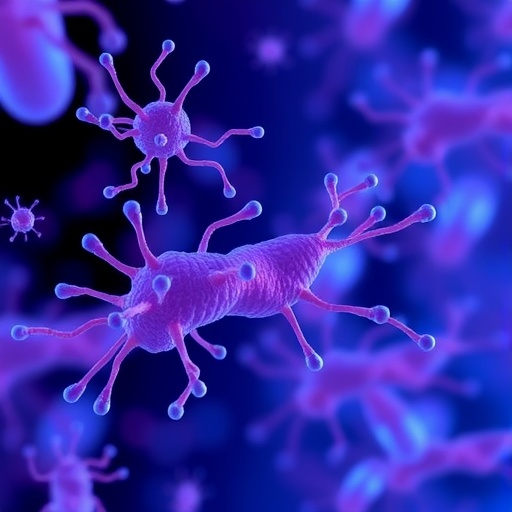
University of Tennessee Knoxville’s Professor Frank Loeffler, holding the prestigious Goodrich Chair of Excellence in Civil Engineering, and his research team have propelled the scientific community forward with their groundbreaking study published recently in Nature Microbiology. Their work uncovers a remarkable biological phenomenon involving polyfluoroalkyl carboxylates—a subclass of the notorious Per- and Polyfluoroalkyl Substances (PFASs)—demonstrating that certain bacteria can covalently incorporate these persistent environmental contaminants into their membrane lipids. This discovery offers tantalizing new insights into microbial adaptations to synthetic chemicals and opens new horizons for environmental biotechnology.
PFASs have long been recognized for their extraordinary resistance to degradation, hence their infamous label as “forever chemicals.” These synthetic molecules have been extensively employed across numerous industrial and consumer products, from stain-resistant textiles and nonstick cookware to aqueous film-forming foams (AFFFs) used in emergency firefighting. Unfortunately, their persistence coupled with emerging evidence for adverse effects—including carcinogenicity and immunotoxicity—has rendered them a significant concern for public health and environmental integrity worldwide. Despite extensive study into their fate and transport, understanding how living organisms interact with these recalcitrant compounds has remained elusive.
At the molecular level, membrane lipids constitute critical structural and functional components of cells, governing permeability, fluidity, and signaling across cellular boundaries. The canonical fatty acid structures incorporated into lipid bilayers are derived from biological synthesis pathways finely tuned over billions of years. Loeffler’s research reveals that bacteria challenged with polyfluoroalkyl carboxylates can disrupt this canonical pattern by substituting traditional fatty acid tails with fluorinated analogs. Importantly, this substitution occurs via covalent bonds, firmly embedding PFAS moieties into the bacterial membrane architecture. This modification potentially alters membrane dynamics and may influence both bacterial physiology and environmental biogeochemical cycling of these pollutants.
The implications of bacterial PFAS incorporation are profound. Until now, the prevailing assumption has been that PFAS biodegradation or transformation was negligible due to these compounds’ stable carbon-fluorine bonds. Loeffler’s findings suggest an alternate pathway where bacterial communities can sequester PFAS molecules physically within membranes, potentially reducing their bioavailability and mobility in ecosystems. Such microbial ‘biouptake’ challenges the fatalistic view of PFAS as entirely immutable contaminants and raises exciting possibilities about microbial roles in mitigating environmental PFAS burdens.
Conducted through a multidisciplinary approach, the research synergized cultivation-based microbiology with state-of-the-art genetic, biochemical, and meta-omics analyses. Through controlled laboratory cultivation of bacterial isolates exposed to defined polyfluoroalkyl carboxylate substrates, the team utilized mass spectrometry techniques to trace incorporation of fluorinated chains into identified lipid species. Metagenomic sequencing further illuminated the genetic basis for enzymatic machinery enabling this covalent attachment. Computational modeling provided mechanistic insights into enzyme-substrate interactions, underscoring the evolutionary significance of this adaptation in polluted environments.
Despite these advances, the challenge of how to safely dispose of or degrade PFAS compounds after microbial sequestration remains. The incorporation of toxic PFASs into bacterial membranes could pose unknown risks in terms of bioaccumulation and trophic transfer up the food chain. Consequently, the elucidation of downstream fate processes and the potential for coupling with innovative PFAS degradation strategies are essential next steps. Loeffler’s team envisions that further unraveling microbial interactions with PFAS can inform development of integrated bioremediation technologies to address persistent chemical pollution.
This paradigm-shifting research not only enhances molecular-level understanding but also resonates with pressing environmental policy questions. As governments globally grapple with regulating PFAS usage and contamination legacies, uncovering natural attenuation mechanisms carried out by microbial consortia is vital. Professor Chris Cox, Chair of the University of Tennessee’s Department of Civil and Environmental Engineering, endorses the study’s significance, emphasizing that it advances comprehension of how synthetic pollutants intersect with living systems at foundational biological levels.
From an environmental engineering perspective, harnessing microbial incorporation of PFAS into membranes may facilitate bioaugmentation techniques where pollutant sequestration is the first step towards eventual degradation or containment. It opens possibilities for engineered microbial strains tailored for enhanced PFAS binding or transformation. However, the broader ecological consequences, including microbial fitness costs and ecosystem impacts of widespread incorporation, warrant careful ecological risk assessments.
Moreover, this research adds to the growing body of knowledge that certain bacteria possess remarkable metabolic and structural plasticity, enabling adaptation to novel anthropogenic compounds previously believed impervious to biological interaction. From a biochemical standpoint, elucidating the enzymatic processes that catalyze these covalent modifications sheds light on novel biochemical pathways potentially evolutionary driven by chemical pollution.
In sum, the Loeffler lab’s discovery reframes our understanding of the environmental fate of PFAS and points toward innovative microbial strategies for mitigating one of the most persistent contamination challenges of modern industrial society. Their pioneering integration of microbiological, chemical, and computational tools exemplifies the multidisciplinary approaches needed to tackle complex environmental issues, underscoring the dynamic interplay between human-made chemicals and biological systems on Earth.
Subject of Research: Environmental microbiology focusing on bacterial incorporation of polyfluoroalkyl carboxylates into membrane lipids.
Article Title: Bacteria covalently incorporate polyfluoroalkyl carboxylates into membrane lipids
News Publication Date: 27-Mar-2026
Web References: https://www.nature.com/articles/s41564-026-02301-x
Image Credits: University of Tennessee
Keywords: Environmental issues, Cell structure, Chemical decomposition, Biodegradation


