

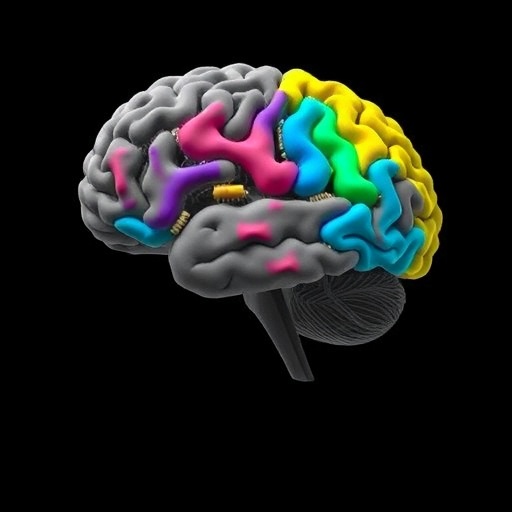
A groundbreaking study published in Nature unveils new insights into the lifelong dynamics of the human neocortex’s functional hierarchy by linking cortical microstructure to principal functional connectivity (FC) gradients. The research team employed advanced individual-specific structural gradient analyses derived from multivariate affinity matrices of cortical features, pioneering a novel framework to understand how microstructural properties align with functional brain organization across different stages of life.
The investigators constructed detailed morphometric similarity networks (MSNs) incorporating multiple cortical indices such as thickness, myelination, and microstructural metrics. They then applied embedding techniques to extract structural gradients that serve as a map of microstructural organization. Crucially, these structural gradients were meticulously aligned to functional gradients derived from resting-state FC data, achieving a careful correspondence despite inherent differences in their respective topographies.
Analysis revealed only modest spatial correlations between structural and functional gradients, with the strongest association observed along the superior–anterior (SA) functional axis, while ventral–superior (VS) and medial–rostral (MR) axes showed diminished correspondence. These findings imply that while microstructural architecture underpins functional organization to an extent, the relationship is far from perfectly isomorphic, reflecting a complex interplay between anatomical substrate and emergent brain function.
The research further quantified structure–function coupling using cosine similarity metrics between paired gradients, tracked longitudinally with generalized additive mixed models (GAMMs) to characterize age-dependent trajectories. Findings highlighted a nonlinear decline in coupling with age, with a steep initial drop during infancy and early childhood observed for the SA and MR axes. In contrast, the VS coupling showed relative stability in early life before undergoing a milder decline in older age.
Beyond coupling measures, the study delved into the developmental evolution of gradient range — essentially the diversity or scale of gradient values across the cortex — revealing distinct age-related patterns for each axis. This suggests that the differentiation of microstructural properties through life does not simply mirror functional differentiation, but instead follows its own unique developmental cadence with potential implications for cognitive maturation and aging.
Focusing specifically on the SA gradient, comparisons with individual microstructural variables illuminated differential contributions of multiple cortical features over time. Myelination exhibited consistent alignment with the SA functional hierarchy throughout the lifespan, supporting its role as a key substrate for functional specialization. Cortical thickness also tracked positively, particularly in association cortex, reflecting anatomical regions known for their involvement in integrative cognitive processes.
Intriguingly, some microstructural metrics demonstrated developmental sign changes, indicating that the biological features correlating with SA functional organization are not fixed but vary across developmental epochs. This dynamism underscores the complexity of brain maturation and suggests that the neurobiological basis of functional hierarchy evolves in a context-dependent manner, influenced by both genetic programming and environmental factors.
The gradual decoupling of structure and function observed with age aligns with emerging theories of neurocognitive aging, which propose that cortical microstructure becomes less predictive of functional dynamics in older adults. This decoupling may relate to compensatory mechanisms or reorganization that support cognitive resilience despite microstructural decline, offering fertile ground for future investigations into healthy and pathological aging.
Methodologically, this study demonstrates the power of integrating multimodal neuroimaging and sophisticated computational models. The use of Procrustes alignment to harmonize individual structural and functional gradients represents a methodological advance, allowing refined comparisons that respect individual variability while enabling group-level inferences. Through this approach, the researchers captured nuanced developmental trajectories spanning infancy to late adulthood.
The implications of this work extend beyond descriptive mapping. By elucidating how structural gradients intertwine with functional hierarchies, the findings contribute to a more comprehensive model of brain organization, one that accommodates the evolving relationship between anatomy and dynamics. These insights hold promise for translational applications, including biomarkers for neurodevelopmental and neurodegenerative disorders where structure–function relationships may be disrupted.
Moreover, the study sparks intriguing questions about causality and mechanisms. Does microstructural change drive shifts in functional hierarchy, or do functional demands reshape microstructure through activity-dependent plasticity? Longitudinal and interventional studies will be vital to unpack these complex feedback loops and to harness structural gradients as tools for monitoring brain health and tailoring personalized interventions.
In conclusion, this landmark investigation enhances our understanding of the human neocortex’s lifelong functional architecture. By deftly combining structural and functional perspectives, it paints a dynamic portrait of the brain’s hierarchical organization as it unfolds through development, matures in adulthood, and adapts in aging. This work sets a new benchmark for neuroimaging research and heralds future avenues for unraveling the intricacies of brain function across the human lifespan.
Subject of Research: Lifespan dynamics of human neocortical functional hierarchy and its relationship to cortical microstructure.
Article Title: Functional hierarchy of the human neocortex across the lifespan.
Article References: Taylor, H.P., Huynh, K.M., Thung, K.H. et al. Functional hierarchy of the human neocortex across the lifespan. Nature (2026). https://doi.org/10.1038/s41586-026-10219-x
Image Credits: AI Generated
DOI: https://doi.org/10.1038/s41586-026-10219-x
Keywords: cortical microstructure, functional connectivity gradients, structural gradients, morphometric similarity networks, lifespan development, aging, structure–function coupling, neuroimaging, brain hierarchy, myelination, cortical thickness, brain plasticity


