

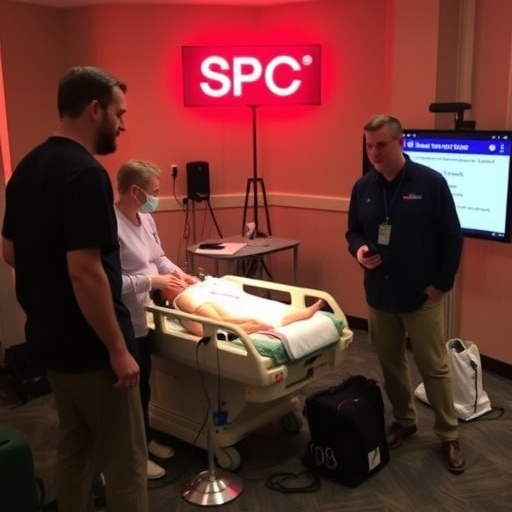
In an era defined by rapid technological advancements and evolving educational paradigms, the American Heart Association (AHA) and Laerdal Medical have unveiled a transformative approach to resuscitation training that promises to reshape how lifesaving skills are acquired and maintained. This pioneering initiative, termed Self-Guided Learning™, offers unprecedented flexibility and accessibility for healthcare and emergency response professionals worldwide, disrupting the traditional instructor-led training model.
Resuscitation training, crucial for medical personnel, first responders, and workplace safety officers, has historically been constrained by rigid scheduling, geographical limitations, and reliance on in-person instruction. The new Self-Guided Learning™ format directly addresses these hurdles by empowering learners to complete HeartCode® Complete courses at their convenience, combining digital online modules with hands-on skill verification using advanced simulation technology.
The significance of this innovation lies not only in its flexibility but also in its scientific rigor. The American Heart Association, revered globally for shaping resuscitation science and establishing guidelines adopted in over 90 countries, ensures that this model upholds the highest educational and clinical standards. Their collaboration with Laerdal Medical—a leader in immersive healthcare simulation—brings together decades of expertise to deliver a comprehensive, evidence-based training experience.
Self-Guided Learning™ offers modular courses covering Basic Life Support (BLS), Advanced Cardiac Life Support (ACLS), and Pediatric Advanced Life Support (PALS). Learners engage with self-paced, interactive online content that can be accessed across various devices, allowing deep mastery of core principles before transitioning to practical skill validation. This skills verification is conducted at CPR Verification Station™ centers, where learners practice and demonstrate competencies using sophisticated simulation manikins equipped with real-time audiovisual feedback.
The CPR Verification Station™ represents a technological leap in resuscitation education. Unlike traditional skill assessments conducted by human instructors, this station employs objective data metrics analyzed instantly to evaluate compression depth, rate, ventilation techniques, and other critical parameters accurately. Such automation minimizes subjective bias, ensures consistent standards, and fosters learner confidence through immediate corrective feedback, enhancing skill retention and proficiency.
This multifaceted training delivery broadens the American Heart Association’s global footprint that already includes instructor-led classes and blended learning formats. The addition of Self-Guided Learning™ addresses the modern learner’s need for adaptability without compromising on scientific credibility or skill mastery. It embodies a paradigm shift, responding to the growing demand for convenient, personalized education pathways in high-stakes clinical domains.
The critical objective driving this model stems from a compelling public health mission: to double cardiac arrest survival rates by 2030. Expanding access to high-quality resuscitation training across diverse geographic regions, including remote and rural healthcare settings, is essential to achieving this goal. Facilitating timely skill acquisition and certification through Self-Guided Learning™ optimizes readiness among frontline professionals who may otherwise face training barriers.
Currently operational in 47 states with imminent nationwide expansion, the Self-Guided Learning™ program leverages CPRFinder™, a web-based locator tool, to connect learners with nearby CPR Verification Station™ learning centers. This digital ecosystem provides seamless course enrollment, resource access, and skill validation scheduling, exemplifying how integrated technology infrastructure can support decentralized, learner-centric education.
The partnership between the American Heart Association and Laerdal Medical encapsulates a shared vision: harnessing innovative technologies and data-driven insights to elevate healthcare training quality globally. Laerdal’s mission to save lives through education aligns perfectly with the Association’s relentless dedication to equitable health. Together, they set new standards by combining authoritative medical content, immersive simulation, and digital convenience.
Self-Guided Learning™ holds particular promise for diverse audiences, including healthcare professionals seeking continuous certification, students balancing clinical rotations, allied health providers expanding their competencies, and emergency medical services personnel requiring flexible renewal options. By tailoring training delivery to individual needs, the model fosters widespread competency and preparedness across the healthcare ecosystem.
Beyond immediate skills acquisition, this method encourages ongoing engagement with resuscitation science through dynamic feedback and data transparency. Learners can identify areas for improvement in real-time, reinforcing behavioral changes essential to effective resuscitation. Moreover, the scalability of this platform supports the rapid dissemination of updated guidelines, thereby ensuring curricular content remains aligned with evolving evidence and best practices.
This technological and educational innovation comes at a pivotal moment, as healthcare systems worldwide confront workforce shortages, resource constraints, and increasingly complex patient needs. Self-Guided Learning™ exemplifies how multidisciplinary collaboration, guided by scientific rigor and technological ingenuity, can overcome longstanding barriers to critical skills training, ultimately saving more lives.
As the American Heart Association and Laerdal Medical expand their Self-Guided Learning™ network, the healthcare community stands to benefit from a resilient, adaptable, and scientifically robust training infrastructure. This model not only democratizes access to lifesaving education but also signals a future where resuscitation competence is maintained with precision, agility, and measurable impact—bringing us closer to a world where prompt, expertly performed CPR becomes universally available.
Subject of Research: Resuscitation training methodologies and simulation-based learning innovations.
Article Title: Revolutionizing Resuscitation Education: The Launch of Self-Guided Learning™ by the American Heart Association and Laerdal Medical.
News Publication Date: March 4, 2026.
Web References:
– American Heart Association Resuscitation Science Guidelines: https://cpr.heart.org/en/resuscitation-science/cpr-and-ecc-guidelines/executive-summary
– CPRFinder™: https://cprfinder.com/
– AHA Instructor-led and blended training options: https://atlas.heart.org/
– Laerdal Medical: https://laerdal.com/
Keywords: Resuscitation, HeartCode Complete, Basic Life Support, Advanced Cardiac Life Support, Pediatric Advanced Life Support, Self-Guided Learning, CPR Verification Station, Medical Simulation, Healthcare Education, Emergency Response, Cardiac Arrest Survival, Simulation Technology.


