

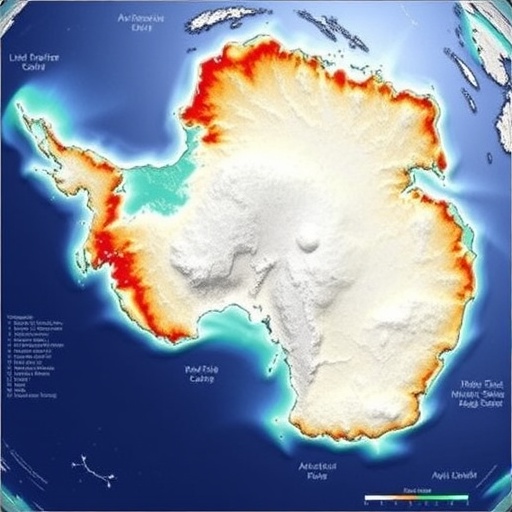
In a groundbreaking study, researchers led by Creac’h and his colleagues dive into the crucial dynamics of the Antarctic ice sheet during the late Oligocene epoch. This significant period, which occurred approximately 23 to 34 million years ago, is pivotal for understanding the long-term climate and environmental conditions of our planet. The research, recently published in Commun Earth Environ, highlights the complex interactions between the ice sheets and surrounding climatic factors, thereby shedding light on how past glacial systems influence current and future ice sheet stability.
The team employed advanced modeling techniques to simulate the Antarctic ice sheet’s behavior during this particular epoch. By integrating various climate scenarios and paleoenvironmental data, they reconstructed the ice sheet’s dynamics, revealing patterns that suggest substantial fluctuations in ice mass and volume. These findings provide compelling evidence that the ice sheet was far more responsive to climatic shifts than previously thought, indicating a period of significant instability.
Central to this analysis is the investigation of temperature variations and their direct impact on ice sheet dynamics. During the late Oligocene, global temperatures experienced notable changes that likely influenced Antarctic ice formation and melting processes. The research indicates that warmer climates could have led to accelerated ice loss, while cooler periods may have allowed for enhanced accumulation of snow and ice. This delicate balance between accumulation and ablation is crucial for understanding the behaviors of ice sheets.
The study also discusses the role of oceanic conditions in shaping the ice sheet’s dynamics. The authors emphasize that warmer ocean waters reaching the ice shelf areas can significantly increase melting rates, further contributing to ice sheet reduction. This interplay highlights the necessity of considering both atmospheric and oceanographic factors when studying past ice sheet behaviors and their implications for present-day climate scenarios.
Moreover, the researchers focus on geological evidence gathered from sediment cores in nearby marine environments. These cores provide invaluable insight into past ocean temperatures, salinity levels, and ice-rafted debris. Analyzing this evidence allows scientists to gauge the extent of glacial retreat and advance over millions of years, contributing essential data to the study of ice sheet resilience in the face of climate change.
The paper also draws parallels between the dynamics observed during the late Oligocene and those projected for the coming decades under current climate models. The implications are startling; as the climate continues to warm, the stability of the Antarctic ice sheet may be threatened, leading to accelerated sea-level rise that could significantly impact coastal communities worldwide. Understanding these historical trends allows scientists to make more informed predictions about future changes in ice dynamics.
Importantly, the research doesn’t only address the Antarctic ice sheet in isolation but rather situates it within a broader climatic framework. The authors suggest that the findings could be applicable to other glacial regions and highlight the interconnectedness of Earth’s climate systems. By recognizing that changes in one area can influence glacial dynamics elsewhere, researchers are better equipped to model global climate responses.
As the paper emphasizes, the historical context provided by studying ancient ice sheets allows us to gauge potential outcomes of contemporary climate behavior. By re-evaluating the late Oligocene conditions, the researchers underscore the importance of long-term data in comprehending ongoing climatic shifts. Such information becomes imperative in developing mitigation strategies and policies aimed at reducing greenhouse gas emissions.
Predictably, this research has drawn a great deal of attention from the scientific community, with many looking to further validate and expand upon the findings. Collaborations between glaciologists, climatologists, and oceanographers are anticipated, as they endeavor to build comprehensive models that can accurately simulate both past and present ice sheet dynamics. Understanding the nuances of these interactions will be crucial for anticipating where the planet may be headed in terms of climate stability and sea-level rise.
Additionally, this research may influence public policy and awareness regarding climate change. By presenting compelling evidence of historical climatic impacts on ice sheets, the study offers a tangible warning of the potential consequences of continued warming. As scientists work to communicate these findings to policymakers and the general public, the hope is that this alarm will motivate action toward sustainability and climate mitigation initiatives.
As the study gains traction, it may also inspire a renewed interest in the Oligocene epoch among researchers and educators. Greater focus on this significant time period may lead to increased funding and research for studying its complexities, thus enriching our understanding of Earth’s climatic cycles. More detailed investigations into the drivers of glaciation and de-glaciation during this era could unlock further secrets about our planet’s history.
In conclusion, the research presented by Creac’h and his team serves as an important reminder of the fragility of ice sheets in the face of climate change. By revealing the dynamic nature of the Antarctic ice sheet during the late Oligocene, this study sets the stage for more intensive research into past and future climate scenarios. The implications of these findings resonate with the need for immediate action to combat the ongoing climate crisis, emphasizing that the past can indeed inform our future.
These findings contribute to the growing discourse on climate adaption and resilience, reiterating that our understanding of historical events is not merely academic; it is essential for navigating the challenges of today and tomorrow. As the global community reflects on this urgent issue, studies like this pave the way for informed discussions and proactive strategies for planetary health.
Subject of Research: Antarctic Ice-Sheet Dynamics during the Late Oligocene
Article Title: Short-term Antarctic Ice-Sheet Dynamics During the Late Oligocene
Article References:
Creac’h, L., Brzelinski, S., Lippold, J. et al. Short-term Antarctic ice-sheet dynamics during the late Oligocene.
Commun Earth Environ (2026). https://doi.org/10.1038/s43247-026-03217-4
Image Credits: AI Generated
DOI: 10.1038/s43247-026-03217-4
Keywords: Antarctic, ice sheet, Oligocene, climate change, sea level rise, glaciology, climate dynamics, historical climate, oceanography, research findings.


