

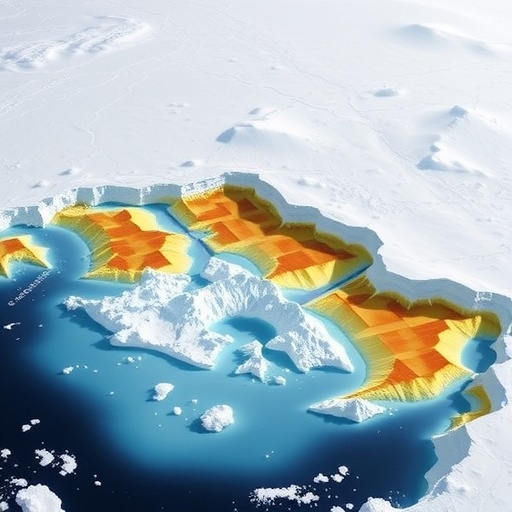
Antarctica has long been a critical indicator of Earth’s climatic shifts, serving as both a bellwether and a predictor of global environmental transformations. In a compelling new study published in Nature Communications, researchers have unveiled significant insights into the dynamics of fast ice along the Northern Victoria Land coast during the Late Holocene. This extensive investigation employs innovative methodologies and multi-proxy data to decode the history and fluctuations of fast ice—sea ice that remains attached to the coastline or the seafloor—over the last several millennia, shedding light on the intricate interplay between climate variability and Antarctic cryosphere dynamics.
The study’s focal point is the fast-ice system that fringes the Northern Victoria Land coast, an area highly sensitive to atmospheric and oceanic changes. Fast ice plays a crucial role in moderating coastal ecosystems, influencing local heat budgets, and acting as a natural barrier that governs ice shelf stability. By reconstructing the past behavior of this fast ice, the researchers provide unprecedented context for understanding how Antarctic sea ice might respond to ongoing and future climate change scenarios. The paper integrates sediment cores, geochemical proxies, and ice modeling techniques to present a multifaceted picture of the regional ice history.
Underlying this research is the Late Holocene period, approximately the last 4,000 years—a timeframe marked by notable climatic fluctuations including the Medieval Climate Anomaly and the Little Ice Age. Through meticulous sedimentological analyses, the team identifies variations in the extent and duration of fast ice, revealing periods of rapid advance and retreat. These fluctuations are intricately tied to regional temperature oscillations and changes in oceanic circulation patterns that have, until now, remained poorly understood due to limited empirical data from this subpolar region.
What makes this study groundbreaking is its innovative use of sediment core analyses paired with novel geochemical markers indicative of sea ice presence, such as diatom assemblages and biomarkers. These proxies offer refined temporal resolution that enables the team to discern changes at decadal to centennial scales. Crucially, the data reveal that fast-ice cover was not stable but underwent dynamic transitions suggesting increased sensitivity of the Antarctic coastal environment to climatic drivers that may parallel future trends.
The authors also highlight the interactions between fast-ice dynamics and katabatic winds descending from the Antarctic Ice Sheet, a factor often overlooked in previous studies. These katabatic winds are essential in maintaining fast ice by driving the freezing of sea water close to the coast and suppressing oceanic mixing. Shifts in wind intensity linked to broader climate patterns appear to coincide with the observed ice fluctuations, pointing to a complex interplay of atmospheric forces and cryospheric response.
By situating their findings within the context of global climate systems, the research extends its significance beyond Antarctica. The rapid changes in fast-ice extent noted in the Late Holocene align with known variations in Southern Hemisphere westerly winds and El Niño Southern Oscillation (ENSO) events. This cross-disciplinary connection implies that Antarctic fast ice could act as an important integrative environment reflecting broader climatic teleconnections, offering a new dimension to climate reconstructions and predictive models.
The implications of this study are profound, particularly regarding the future stability of Antarctic ice shelves. Fast-ice acts as a stabilizing agent that buttresses ice shelves—structures that slow the discharge of continental ice into the ocean. Should fast-ice regimes become increasingly unstable, as evidenced by millennial-scale precedents, ice shelves might face accelerated thinning and potential collapse, contributing to sea-level rise. Hence, the detailed Late Holocene record serves as an analog for understanding vulnerability pathways in a warming world.
Technically, the research presents a sophisticated methodological framework that combines sedimentology, isotope geochemistry, and paleoceanography. The use of biomarkers such as IPSO25, a sea ice proxy lipid, alongside diatom population shifts, allows for the quantification of fast-ice presence with unprecedented accuracy. The temporal framework is bolstered by radiocarbon dating of foraminifera and terrestrial inputs, providing a robust chronological anchor for correlating ice changes with known climatic episodes.
The multidisciplinary team, spanning expertise in geoscience, biology, and atmospheric science, leveraged advances in sediment core drilling technologies and molecular analytical techniques to achieve these results. The integration of regional ice modeling offers a mechanistic understanding of the sediment record, validating geochemical interpretations and simulating ice behavior under different reconstructed climatic forcings.
Additionally, the research highlights the potential for future investigations to expand upon this baseline. The findings urge the scientific community to increase monitoring of Antarctic fast ice using remote sensing technologies integrated with core sampling to build a more comprehensive temporal and spatial map of ice behavior. Such datasets are essential for improving climate models that currently underrepresent Antarctic sea-ice complexity and its global feedback mechanisms.
Environmental and ecological ramifications are also addressed. Fast ice serves as habitat for microbial communities and influences nutrient cycling in coastal waters, thereby impacting the Antarctic marine food web. Understanding its historical dynamics provides a context for anticipating biological responses to ongoing environmental changes and informs conservation strategies for Antarctic biodiversity hotspots.
In conclusion, this study reshapes our comprehension of Antarctic fast-ice dynamics during the Late Holocene, offering a detailed timeline of change driven by atmospheric and oceanic variability. It underscores the sensitivity of polar cryospheric elements to global climate patterns and establishes critical baselines for projecting future scenarios under anthropogenic warming. By pioneering a multi-faceted analytical approach, the research opens new pathways for decoding the Antarctic’s past and anticipating its future.
This landmark investigation not only enriches paleoenvironmental science but also equips policymakers and climate strategists with empirical insights vital for assessing polar ice resilience. As the Antarctic fast ice continues to fluctuate amidst rapid global changes, studies like this affirm that understanding past behavior is indispensable for safeguarding future stability in this vulnerable yet globally consequential region.
Subject of Research: Late Holocene fast-ice dynamics around the Northern Victoria Land coast, Antarctica
Article Title: Late Holocene fast-ice dynamics around the Northern Victoria Land coast, Antarctica
Article References:
Tesi, T., Weber, M.E., Muschitiello, F. et al. Late Holocene fast-ice dynamics around the Northern Victoria Land coast, Antarctica. Nat Commun 17, 604 (2026). https://doi.org/10.1038/s41467-025-67781-7
Image Credits: AI Generated


