

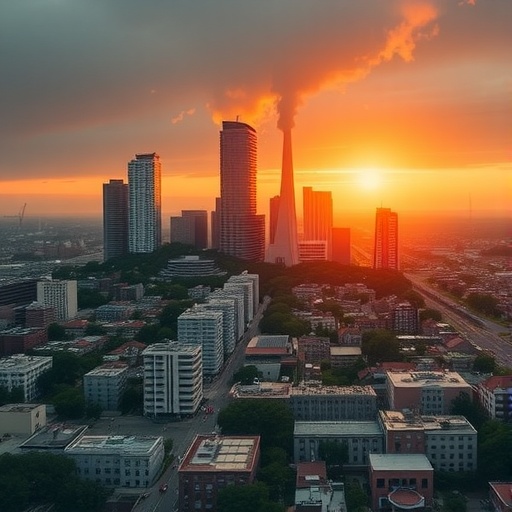
Europe’s continued reliance on fossil fuels has emerged as a multifaceted crisis, revealing not only economic and geopolitical vulnerabilities but also profound, escalating threats to public health. The 2026 Europe Report of the Lancet Countdown on Health and Climate Change, soon to be presented by co-directors Professor Joacim Rocklöv of Heidelberg University and Professor Cathryn Tonne from the Barcelona Institute for Global Health, delivers a comprehensive and alarming portrayal of this intersection. The report elucidates how climate-induced air pollution, heatwaves, and the burgeoning spread of infectious diseases are converging to impose an unprecedented burden on European populations.
Originating from an interdisciplinary consortium of sixty-five experts affiliated with research institutions and United Nations bodies, the Lancet Countdown Europe initiative was established in 2021 as a regional branch of the global Lancet Countdown network. This collaboration systematically monitors the intricate interdependencies between climate change and health outcomes across five critical domains: health risks and impacts, adaptation and mitigation strategies, economic and financial considerations, and the extent of societal engagement on climate and health issues. The forthcoming third Europe Report, published in “Lancet Public Health,” encapsulates 43 detailed indicators to map the trajectory of these challenges within the continent.
Professor Rocklöv emphatically states that climate change, predominantly driven by fossil fuel consumption, constitutes a mounting health hazard for an expanding segment of the European population. His expertise as an epidemiologist and statistician underscores the urgency of the data, revealing that the adverse health effects of climate change are no longer hypothetical future scenarios but current realities. Nonetheless, he highlights encouraging instances of effective climate action and health protection measures, showcasing national and local initiatives that mitigate environmental harm and improve public health resilience.
The report’s launch event, scheduled for April 22, 2026, at Heidelberg University’s historic Great Hall, promises to be a pivotal moment for public discourse and policy advocacy. Opening remarks will be delivered by Professor Michael Boutros, Dean of Heidelberg Medical Faculty, followed by detailed presentations from the report’s directors. The event will feature discourse from prominent figures including Aleksandra Kazmierczak, coordinator of the European Climate and Health Observatory, and Francesca Racioppi, head of WHO’s European Centre for Environment and Health, who will illuminate success stories in climate-health initiatives.
A salient concern addressed in the report is climate-related infectious diseases, which have seen a rapid surge in Europe over recent years. Experts from Germany’s Robert Koch Institute, Austria’s Competence Centre for Climate and Health, and France’s Agence Nationale de Santé Publique are slated to discuss adaptive responses. Their presentations focus on enhanced disease surveillance, integrative public health strategies, and rapid response protocols to counteract the new epidemiological patterns shaped by changing climate conditions.
The panel discussion involving policy-makers at federal, state, and local levels aims to translate the report’s findings into actionable strategies. The debate will emphasize the implementation of integrated policies designed to concurrently advance climate mitigation and health protection, reflecting a growing consensus that tackling these issues synergistically can yield amplified societal benefits.
Scientific analysis within the report rigorously quantifies the health impacts of air pollution, principally particulate matter and ozone precursors, which are exacerbated by fossil fuel emissions. These pollutants contribute to cardiopulmonary diseases, stroke, and premature mortality. The coupling of emission data with epidemiological modeling demonstrates an alarming upward trend in attributable deaths and disability-adjusted life years (DALYs) linked to environmental degradation, underscoring an urgent need to phase out carbon-intensive energy sources.
Heat stress and the incidence of heat-related morbidity and mortality form another critical focus of the report. Using high-resolution climate models, researchers have identified significant warming trends across European regions, correlating with an increase in heatwaves. Vulnerable populations, including the elderly and those with chronic illnesses, face disproportionate risks. The findings advocate for robust urban planning measures such as green infrastructure, cooling centers, and public awareness campaigns to alleviate heat exposure risks.
From a mechanistic perspective, the climate-driven alteration of ecosystems fosters the expansion of vectors such as mosquitoes and ticks, facilitating the spread of diseases like Lyme disease, West Nile virus, and tick-borne encephalitis into previously unaffected areas. This epidemiological shift necessitates enhanced vector surveillance, cross-border information exchange, and adaptive healthcare systems to respond to emerging threats.
Economically, the report emphasizes the significant costs imposed by climate-related health impacts, including healthcare expenditures, lost productivity, and social welfare burdens. These costs essentially internalize some of the externalities of fossil fuel consumption, providing a compelling financial imperative for transitioning to sustainable energy systems that confer co-benefits for climate and health.
The Lancet Countdown Europe’s meticulous tracking of adaptation and mitigation policies reveals varying degrees of progress across countries. While some nations have adopted ambitious climate action plans that integrate health considerations, others lag due to sociopolitical, infrastructural, or resource constraints. This disparity underscores the necessity for coordinated European-level governance to harmonize efforts and share best practices.
Societal engagement emerges as a crucial dimension, with the report underscoring the role of community organizations, healthcare professionals, and media in fostering public awareness and advocating for policy change. Inclusive stakeholder participation amplifies the efficacy of climate-health interventions and ensures that vulnerable groups receive targeted protections.
Despite the formidable challenges detailed in the report, the overarching message remains cautiously hopeful. The documented success stories and ongoing research initiatives provide a roadmap for mitigating the worst health outcomes of climate change. Intensified collaboration among scientists, health practitioners, policy-makers, and the public is paramount to advancing these goals.
The 2026 Europe Report serves as a clarion call—illuminating how intertwined climate and health crises necessitate integrated responses to secure a sustainable future for Europe. The event’s live stream and simultaneous interpretation accommodate broad accessibility, encouraging an informed and engaged audience capable of driving transformative change.
Subject of Research: Health impacts of climate change in Europe and policy responses
Article Title: Europe’s Fossil Fuel Dependence Fuels Health Crisis, Warns 2026 Lancet Countdown Report
News Publication Date: April 22, 2026
Web References: Heidelberg University announcement (for event registration and information)
Keywords: Climate change, Europe, Public health, Infectious diseases, Air pollution, Heat stress, Vector-borne diseases, Climate adaptation, Climate mitigation


