

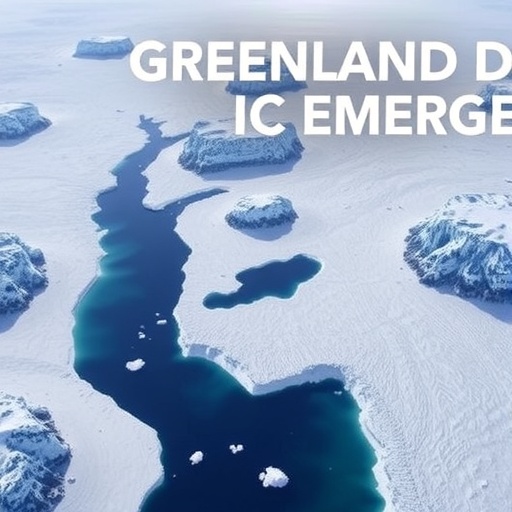
A rapidly intensifying phenomenon at the margins of Greenland’s vast ice sheet is now commanding serious scientific attention, as new research reveals that meltwater lakes forming beside glaciers are substantially accelerating their flow. This discovery has profound implications for our understanding of ice sheet dynamics and the resulting contribution to global sea-level rise, which is one of the most pressing climate challenges in the twenty-first century.
For decades, scientists have tracked the alarming rates of ice loss from Greenland, where warming atmospheric and oceanic temperatures have caused the ice sheet to shed approximately 264 gigatons of ice annually since 2002. This trend contributes to a consistent global sea-level rise estimated at nearly 0.8 millimeters per year. However, the nuanced mechanisms driving glacier acceleration and destabilization remain incompletely understood. The recent study conducted by researchers at the University of Leeds sheds light on a previously underappreciated agent in this complex system: ice-marginal lakes (IMLs).
Ice-marginal lakes are freshwater bodies that accumulate in the depressions exposed as glaciers retreat from the ice sheet edges. These lakes can expand to immense sizes, with surface areas reaching up to 117 square kilometers. Far from being inert features, the study reveals that these lakes actively modulate glacier dynamics. Their presence correlates with marked increases in glacier velocity, potentially tripling glacier front speeds compared to glaciers terminating on land. This rate of acceleration is not merely confined to the immediate glacier margin but extends inland up to 3.5 kilometers, indicating a deeper systemic influence on ice flow behavior.
The crux of this dynamic hinges on the interaction between the meltwater lakes and the marginal ice fronts. When glaciers terminate in these lakes, a flotation effect can develop, wherein the buoyancy of the water partially lifts the glacier front. This process diminishes basal friction, which typically serves as a controlling brake on glacier movement. Concurrently, underwater melting at the glacier base intensifies, weakening the structural integrity of the ice front and facilitating calving events. These processes collectively contribute to increased glacier velocity and enhanced ice mass loss rates.
Methodologically, the research team harnessed satellite observations, including high-resolution maps of ice-marginal lake distributions and ice surface velocities across Greenland. Their integrative approach allowed for a comprehensive assessment of spatial relationships between lake presence and glacier speed. Prior studies from mountain glacier systems, such as those in the Himalayas, documented similar acceleration phenomena associated with proglacial lakes, but this investigation is among the first to establish the widespread significance of this effect at a continental scale in Greenland.
The implications of these findings are far-reaching. Ice sheet models employed for projecting future sea-level scenarios have historically emphasized ocean-terminating glaciers and surface melting but often underrepresent or omit lake-induced dynamical effects. As climate warming escalates, the areal extent of these ice-marginal lakes is expected to increase sharply, potentially amplifying glacier acceleration trends. Neglecting the mechanical influence of IMLs may thus lead to underestimates of ice loss rates and sea-level contributions in forecasting models.
The study’s lead author, Connie Harpur, a doctoral researcher specializing in glaciology and earth system science, emphasizes the critical nature of accounting for such processes. Her team’s findings illuminate a feedback mechanism where lake formation not only results from melting but also serves as a catalyst for further ice disintegration. This feedback loop accelerates ice flux toward the ocean or lake basins, the latter of which enhances calving and basal melting, thus destabilizing the ice sheet margin with greater intensity.
Supporting these insights, co-author Professor Mark Smith highlights the necessity of integrating lake-glacier hydrodynamics in predictive frameworks. Without such inclusion, projections of Greenland’s ice sheet response to future warming scenarios remain incomplete and risk substantial inaccuracy. Understanding the physical interactions at the ice-lake interface is imperative for refining models that inform global climate policy and adaptation strategies.
Furthermore, the current presence of ice-marginal lakes along about 10% of Greenland’s ice sheet boundary underscores the inevitability of their growing prevalence. As warming trends continue, not only do more depressions become exposed and filled with meltwater, but lake depths and volumes may increase, further intensifying their mechanical impact on glacier dynamics. This phenomenon could produce localized hotspots of rapid ice mass loss that propagate inland, complicating prediction efforts.
In essence, these findings contribute to the evolving scientific narrative that the Greenland Ice Sheet is not a static mass but a highly responsive and dynamic system intricately linked to climatic and hydrological changes. The revelation that freshwater lakes adjacent to glaciers serve as active agents speeding ice flow challenges prior assumptions and calls for urgent revision in sea-level rise modeling and risk assessments.
As scientists endeavor to forecast the trajectory of global climate impacts, incorporating the nuanced but significant role of ice-marginal lakes will enhance the resolution and reliability of crucial predictions. These advancements also provide pathways for targeted observational campaigns and refined remote sensing methodologies that track lake expansion and glacier response with greater precision.
This pioneering research, published in Communications Earth and Environment, embodies a significant stride forward in cryosphere science. It highlights the compelling need for interdisciplinary approaches that blend glaciology, hydrology, remote sensing, and climate dynamics to unravel the complexities of Earth’s rapidly changing polar systems. The ongoing dialogue between field observations and modeling efforts promises to sharpen our understanding of how ice sheet-lake interactions influence the planet’s future.
Subject of Research: Not applicable
Article Title: Ice-marginal proglacial lakes enhance outlet glacier velocities across Greenland
News Publication Date: 1-Apr-2026
Web References:
https://www.nature.com/articles/s43247-026-03363-9
References:
Harpur, C., & Smith, M. (2026). Ice-marginal proglacial lakes enhance outlet glacier velocities across Greenland. Communications Earth and Environment. https://doi.org/10.1038/s43247-026-03363-9
Image Credits:
Photos by Connie Harpur and satellite imagery processed by the University of Leeds researchers
Keywords:
Climate change effects, Greenland Ice Sheet, glacier flow acceleration, ice-marginal lakes, proglacial lakes, sea-level rise, glacier dynamics, ice sheet modeling, meltwater lakes


