

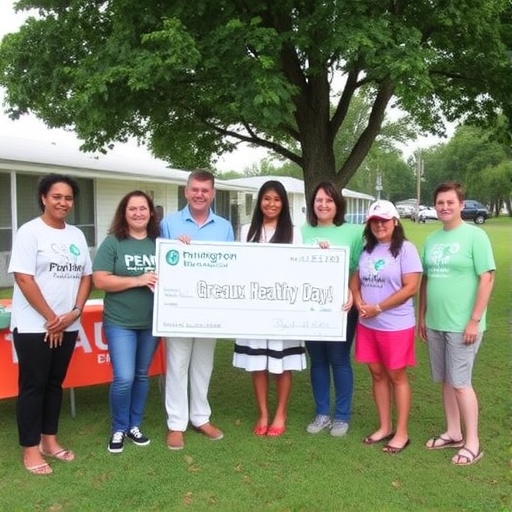
In an urgent and profoundly significant stride towards confronting one of the most pressing public health emergencies in the United States, local government leaders and community advocates assembled on March 5th at Lake Charles Memorial Hospital to spotlight the pioneering Greaux Healthy initiative. Spearheaded by LSU’s Pennington Biomedical Research Center, this ambitious program operates in strategic alliance with the State of Louisiana to combat the escalating epidemic of childhood obesity within the region. Childhood obesity in Louisiana has alarmingly surpassed national averages, demanding innovative, research-driven, and community-engaged solutions, which Greaux Healthy aims to deliver through rigorous scientific grounding and cross-sectoral collaboration.
March 5th was formally designated “Greaux Healthy Day” in Lake Charles by a proclamation presented by Mayor Marshall Simien, Jr., emphasizing the municipal commitment to this public health agenda. The declaration underscores the recognition by city officials of childhood obesity as a critical determinant of long-term health outcomes, not just in Louisiana but nationwide. This event also marked a significant milestone in Greaux Healthy’s dynamic Road Sheaux campaign—a statewide initiative dedicated to mobilizing resources, raising awareness, and implementing evidence-based strategies across all nine Louisiana Department of Health regions. This approach is designed to foster an integrated network of prevention and care tailored to diverse local populations.
The prevalence of childhood obesity in Louisiana is stark, with over one-third of children categorized as overweight or obese, positioning the state among the highest ranks nationally for metabolic disorders linked to excess weight. This statistic is not merely a health challenge but a multifaceted social and economic crisis that portends increased incidence of comorbid conditions such as type 2 diabetes, cardiovascular disease, and psychosocial difficulties in affected youth. Research highlights that within the state, parents and residents identify childhood obesity as a paramount concern, eclipsing other critical health issues such as tobacco use, mental health disorders, and hypertension, reflecting a collective awareness that necessitates immediate intervention.
Melissa Martin, Director of Greaux Healthy, articulated the initiative’s scientific and policy imperatives: “Our children’s health is too precious to wait. Childhood obesity is a nationwide healthcare crisis demanding urgent action.” Greaux Healthy operationalizes this mandate by deploying a multi-dimensional framework that encompasses community engagement, educational outreach, healthcare provider support, and the distribution of scientifically validated tools. The intended outcome is to empower families and professionals with actionable knowledge to modify behaviors and environments that contribute to unhealthy weight gain from infancy through adolescence.
Fundamentally, Greaux Healthy synthesizes over 35 years of biomedical research conducted at Pennington Biomedical Research Center into actionable public health interventions. This extensive research foundation is leveraged to develop tailored programs addressing four distinct population cohorts: expectant families and parents of infants, preschool-aged children, school-aged children, and adolescents transitioning to young adulthood. Such segmentation reflects an understanding of the developmental and behavioral nuances influencing obesity risk and facilitates the customization of interventions that are both age-appropriate and context-sensitive.
Dr. Jennifer Rood, Interim Senior Vice Chancellor and Executive Director of Pennington Biomedical, highlighted the translational impact of Greaux Healthy: “For more than 35 years, Pennington Biomedical has translated research into real-world solutions.” The initiative is emblematic of translational research in metabolic health, wherein evidence generated through controlled scientific studies is effectively transformed into community-based programs that generate measurable health benefits. The collaboration with municipal authorities, educators, healthcare professionals, and community organizations represents a model for how translational science can be operationalized at a population health level.
The Greaux Healthy framework incorporates evidence-based methodologies, including behavioral interventions targeting diet and physical activity, environmental modifications to improve access to nutritious foods, and the integration of health promotion within educational curricula. The initiative also emphasizes the role of healthcare providers through training and dissemination of clinical guidelines to support early identification and management of overweight and obesity in children, underscoring a comprehensive approach that bridges prevention and treatment.
The Road Sheaux campaign exemplifies an innovative dissemination strategy, physically embedding Greaux Healthy teams within diverse communities to provide direct engagement, culturally competent education, and localized resource navigation. This grassroots outreach recognizes the variability of social determinants of health across Louisiana’s regions and seeks to tailor solutions that respect and integrate local contexts, thereby enhancing program efficacy and sustainability.
Moreover, Greaux Healthy challenges the prevailing narrative that childhood obesity is an intractable problem by spotlighting the efficacy of multi-sectoral partnerships and informed, science-based interventions. The initiative also serves as an educational platform, equipping families with knowledge about healthy development, nutritional needs, and the significance of physical activity, while simultaneously empowering educators and clinicians with innovative tools to embed obesity prevention within their day-to-day practices.
This convergence of biomedical research, public policy, and community mobilization encapsulated by Greaux Healthy not only addresses the current obesity crisis but sets a precedent for similar translational public health initiatives nationwide. Its comprehensive, evidence-based approach offers a blueprint for mitigating pediatric obesity’s health and economic impacts through sustained, collaborative efforts rooted in rigorous science and responsive to community needs.
Stakeholders and those interested in contributing to or benefiting from this initiative are encouraged to explore further resources, evidence-based guidelines, and community support mechanisms available through the program’s dedicated website at www.greauxhealthy.org. This platform provides accessible information tailored to families, health practitioners, educators, and policymakers committed to fostering healthier futures for Louisiana’s children.
In sum, the Greaux Healthy initiative represents a paradigm shift in addressing childhood obesity within Louisiana by merging decades of scientific research from Pennington Biomedical Research Center with active community engagement and local government partnerships. The program’s comprehensive focus on prevention and treatment across the lifespan—from infancy through young adulthood—embodies a rigorous, evidence-based approach to public health that aspires to reverse alarming trends in childhood obesity and enhance the well-being of future generations.
Subject of Research: Childhood obesity prevention and treatment based on translational biomedical research
Article Title: (Not provided)
News Publication Date: (Not provided)
Web References: www.greauxhealthy.org
References: (Not provided)
Image Credits: PBRC
Keywords: Childhood obesity, obesity, metabolic disorders, adolescents, children, infants, young people, educational facilities, educational institutions, colleges, universities, research universities, scientific facilities, scientific organizations, translational research, laboratories, medical research facilities


