

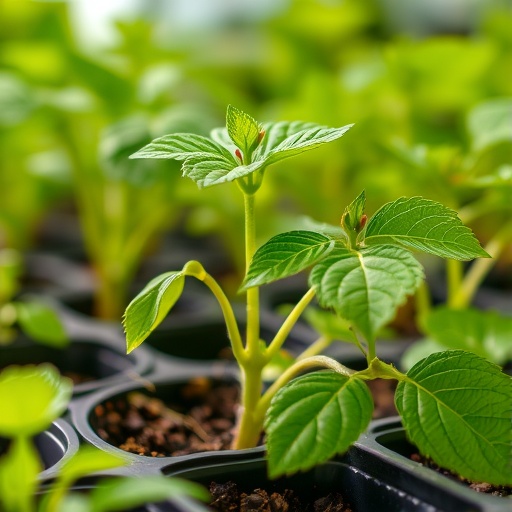
Groundbreaking Insights into Plant Resilience Amidst Abiotic Stress: The Role of Biostress Regulators
In the ever-evolving realm of agricultural science, the quest for bolstering plant resilience against abiotic stressors has garnered immense attention. Recent studies, particularly one conducted by Rasheed, Saleem, Abbas, and colleagues, shed light on potent biostress regulators that can significantly impact how plants manage environmental adversities. This research is timely and essential, considering the escalating pressures of climate change and its detrimental effects on agriculture worldwide.
Abiotic stress encompasses a variety of environmental factors, including drought, salinity, temperature extremes, and heavy metal accumulation, all of which can lead to substantial declines in crop yield. The implications are dire, as these stresses affect not just plant health and productivity, but also food security and economic stability. The global agricultural community is in urgent need of solutions that can bolster plant defenses against these unyielding challenges, a need that Rasheed and his team address head-on.
Their research identifies key biostress regulators—molecules that enhance plant responsiveness to various stress conditions. These regulators play a crucial role in modulating physiological and biochemical pathways in plants, enabling them to withstand and adapt to adverse conditions. Through a series of meticulous experiments, the researchers have demonstrated how these biostress regulators induce protective responses at the cellular level, enhancing stress tolerance in various crops.
One of the most interesting aspects of their findings revolves around the concept of signaling pathways within plants. The intricate network of signaling pathways acts as a communication system that transmits stress-related information swiftly throughout the plant. Upon encountering abiotic stress, plants activate these pathways, resulting in a cascade of protective mechanisms, including the synthesis of stress-responsive proteins and the production of reactive oxygen species that can mitigate damage. By targeting these pathways with biostress regulators, researchers are now exploring innovative ways to enhance crop resilience further.
Furthermore, Rasheed and his collaborators highlight the importance of timing in the application of these biostress regulators. The study reveals that the efficacy of these compounds is significantly influenced by when they are administered. Early application during the onset of stress can prime the plants, allowing them to gear up their defense systems proactively. In contrast, late-stage application may not yield the desired resilience, as the stress may have already caused irreversible damage by that time.
The research also delves into the molecular mechanisms underpinning the action of these biostress regulators. By examining gene expression profiles, the team was able to pinpoint specific genes that are upregulated in response to treatment. This understanding offers a pathway for genetic engineering efforts, where crops could be tailored to express enhanced levels of these protective genes, thereby naturally equipping them with superior stress resilience.
As the implications of their findings continue to unfold, the potential applications are vast. Agriculture, particularly in regions prone to extreme weather patterns and soil degradation, stands to benefit immensely. The utilization of biostress regulators could pave the way for breeding programs aimed at developing new cultivars that can thrive under challenging environments, reducing dependence on chemical fertilizers and enhancing sustainability in farming practices.
Importantly, Rasheed and his team’s results are supported by extensive field trials, lending credence to the viability of these biostress regulators in real-world agricultural settings. The transition from greenhouse studies to field applications presents an essential step toward practical implementation. Farmers and agronomists are closely observing these developments, anticipating the integration of these findings into their practices.
However, the journey does not end with application. There is a pressing need for further research to understand the long-term effects of using biostress regulators in agriculture. Continuous application over multiple seasons may alter soil composition, microbial communities, and even plant health itself. Longitudinal studies will be crucial to elucidate these interactions and ensure sustainable farming practices moving forward.
In conjunction with the emerging technologies in biotechnology, such as CRISPR and RNA interference, biostress regulators could be deployed effectively in conjunction with traditional breeding practices. This integration not only serves to develop stress-resilient crops but also exhaustively examines plant genomics to ensure the desired traits are preserved across generations.
In conclusion, Rasheed et al.’s research marks a pivotal advancement in our understanding of plant resilience against abiotic stress. Their identification and characterization of effective biostress regulators herald new possibilities for enhancing agricultural productivity in the face of mounting environmental challenges. As the global population continues to rise, and arable land grows scarcer, the innovation of biostress regulators could prove indispensable. The quest for sustainable and efficient agricultural practices has never been more critical, and the pathway illuminated by this research holds promise for a future where food security is no longer a fragile hope, but a robust reality.
This breakthrough not only adds a vital piece to the puzzle of climate resilience but also emphasizes the collaborative efforts needed across scientific disciplines to tackle complex agricultural challenges. The results from this research provide a foundation upon which the future of plant science and agricultural practices can be built, ensuring that crops are fortified against the uncertainties of tomorrow.
Subject of Research: Potent biostress regulators for abiotic stress management in plants
Article Title: Potent biostress regulators for abiotic stress management in plants
Article References: Rasheed, S., Saleem, M., Abbas, S. et al. Potent biostress regulators for abiotic stress management in plants. Discov. Plants 2, 367 (2025). https://doi.org/10.1007/s44372-025-00450-7
Image Credits: AI Generated
DOI: https://doi.org/10.1007/s44372-025-00450-7
Keywords: Biostress regulators, abiotic stress, plant resilience, agriculture, climate change, food security, signaling pathways, gene expression, sustainability.


