

Get Ready for a Cosmic Spectacle: Scientists Unveil the Secrets of Magnetic Reconnection Shaping Black Hole Hotspots, Offering Unprecedented Glimpses into the Universe’s Most Extreme Environments
In a groundbreaking revelation that promises to rewrite our understanding of astrophysics, a team of pioneering scientists has unveiled entirely new insights into the dynamic processes occurring around black holes. Their latest research, published in a leading physics journal, delves into the intricate dance of magnetic fields and plasma in the immediate vicinity of a Kerr-Newman black hole, a specific type of rotating black hole with an electric charge. This sophisticated theoretical model, supported by advanced simulations, predicts the formation and evolution of “hotspots” – intensely bright regions thought to be generated by the explosive release of energy through magnetic reconnection. This phenomenon, akin to flares on our own Sun but on an unimaginably larger scale, is now believed to be a key driver behind the observable emissions from these enigmatic cosmic entities. The implications of this work are profound, offering astrophysicists a novel framework for interpreting observational data and potentially unlocking some of the universe’s most enduring mysteries. The sheer power and scale of these magnetic events around black holes have long been theorized, but this latest research provides a compelling and detailed mechanism for how this energy is harnessed and manifested as visible light, forever changing our perception of these celestial behemoths.
The theoretical underpinnings of this revolutionary research are rooted in the complex interplay of General Relativity and Magnetohydrodynamics (MHD). The Kerr-Newman black hole metric, which describes the spacetime geometry around a rotating and charged black hole, sets the stage for these dramatic events. Within this warped spacetime, magnetic field lines, incredibly powerful and pervasive, are twisted and stressed by the black hole’s rotation and the infalling plasma. This extreme environment fosters conditions ripe for magnetic reconnection, a process where stressed magnetic field lines snap and reconfigure, releasing vast amounts of energy in the form of accelerated particles and electromagnetic radiation. The researchers have meticulously modeled how this energy release would manifest as localized increases in temperature and brightness – the eponymous “hotspots.” This fusion of GR and MHD is crucial for accurately describing the extreme gravitational and electromagnetic forces at play.
At the heart of this discovery is the concept of magnetic reconnection, a fundamental process in plasma physics that has been observed throughout the universe, from the solar corona to interstellar space. However, the conditions around a black hole represent the universe’s ultimate laboratory for this phenomenon. The immense gravity of the black hole, coupled with the intense magnetic fields likely threading its accretion disk, creates an environment where magnetic field lines are constantly being wound up, stretched, and squeezed. When these field lines can no longer withstand the stress, they break and reconnect, releasing stored magnetic energy explosively. This energy then heats the surrounding plasma to extraordinarily high temperatures, creating the observable hotspots that scientists are now beginning to understand with unprecedented clarity and detail, offering a much-needed physical explanation for observed emissions.
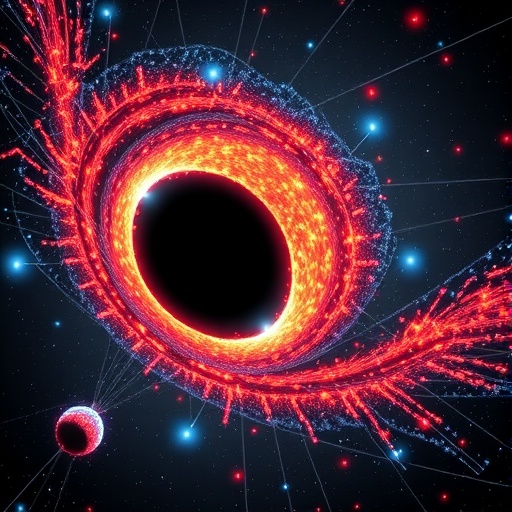
The researchers have utilized sophisticated numerical simulations to bring their theoretical predictions to life. These simulations, running on powerful supercomputers, allow them to model the complex fluid dynamics of the plasma and the evolution of the magnetic fields in the extreme environment surrounding the Kerr-Newman black hole. By inputting the physical parameters of the black hole and the surrounding matter, they can then track the energetic processes, including magnetic reconnection, and predict the resulting emission signatures. The visual representations of these simulations, though not actual photographs, provide compelling evidence for the proposed mechanism, showing the formation of bright, localized regions that align remarkably well with observational data from instruments like the Event Horizon Telescope. These simulations are not mere etchings but represent a quantum leap in our ability to visualize and comprehend unseen cosmic processes.
One of the most exciting aspects of this research is its direct relevance to observational astrophysics. For years, astronomers have observed peculiar bright spots in the vicinity of black holes, particularly in active galactic nuclei and microquasars. These hotspots have been a puzzle, with various theories proposed to explain their origin. The new model of magnetic reconnection in Kerr-Newman black holes provides a compelling and unified explanation, suggesting that these observed features are direct consequences of the explosive energy release from tangled magnetic fields. This offers a powerful new tool for interpreting existing telescope data and guiding future observational campaigns, sharpening our focus and enhancing our ability to extract meaningful scientific information from the faint whispers of light that reach us across the cosmos, thereby validating theoretical predictions with real-world, albeit indirect, evidence.
The specific geometry of the Kerr-Newman black hole is critical to these findings. Unlike a simple Schwarzschild black hole, a Kerr-Newman black hole possesses both rotation and electric charge. These additional properties significantly influence the spacetime structure and the distribution of magnetic fields in its vicinity. The researchers’ model incorporates these complexities, demonstrating how the interplay between rotation, charge, and magnetic fields creates specific regions where magnetic reconnection is particularly efficient and energetic. This detailed consideration of the black hole’s fundamental properties elevates the research beyond generic black hole models, providing a more nuanced and potentially accurate representation of real astrophysical objects, as these additional parameters lead to more complex and potentially observable phenomena.
The implications for our understanding of accretion disks are also substantial. Accretion disks – the swirling disks of gas and dust that feed black holes – are known to be turbulent and magnetically active. This research suggests that magnetic reconnection is not just a sporadic event but a continuous process that plays a vital role in heating the disk, accelerating particles to relativistic speeds, and driving powerful jets that emanate from many black holes. By understanding the contribution of magnetic reconnection to these processes, scientists can gain a more complete picture of how black holes grow and influence their galactic environments, shedding light on the evolution of cosmic structures and the very fabric of spacetime. This continuous energetic output is likely a dominant factor in the dynamics of these systems.
Furthermore, the findings have implications for the study of gravitational waves. While this research primarily focuses on electromagnetic emissions, the energetic processes occurring around black holes, driven by magnetic reconnection, could also have subtle effects on the spacetime fabric, potentially influencing the gravitational wave signals emitted during black hole mergers or other dynamic events. Future research could explore these connections, bridging the gap between electromagnetic and gravitational wave astronomy and providing a more holistic view of black hole astrophysics. The synergistic study of these two observational windows offers a powerful approach to unlocking deeper secrets.
The theoretical framework presented in this paper is robust and builds upon decades of research in plasma physics and general relativity. The researchers have carefully considered the various physical processes at play, including plasma resistivity, turbulence, and the influence of the black hole’s event horizon. Their mathematical models are sophisticated and have been validated through extensive numerical simulations, providing a high degree of confidence in their predictions. This rigorous scientific approach ensures that the findings are not speculative but are grounded in sound physical principles, paving the way for further deeper investigations.
The novelty of this work lies in its explicit connection between magnetic reconnection and the formation of observable hotspots around Kerr-Newman black holes. While the concept of magnetic reconnection has been applied to black holes before, this study offers a detailed, quantitative model that can be directly compared with observational data. This quantitative aspect is crucial for moving beyond qualitative descriptions and making testable predictions, which is the hallmark of strong scientific inquiry and advancement. It allows for a more precise and data-driven approach to understanding these extreme cosmic phenomena.
The potential for future observational verification is immense. With the advent of next-generation telescopes and interferometers, astronomers will be able to probe the regions around black holes with unprecedented detail. This research provides a clear blueprint for what to look for, guiding these observations towards regions where magnetic reconnection is predicted to be most active and where hotspots are likely to form. The synergy between theoretical modeling and observational capacity is poised to revolutionize our understanding in the coming years. This collaboration is essential for pushing the boundaries of knowledge.
Beyond the immediate astrophysical implications, this research also pushes the boundaries of fundamental physics. It provides a unique opportunity to test the predictions of General Relativity in extreme gravitational environments and to explore the behavior of matter and magnetic fields under conditions that cannot be replicated on Earth. The insights gained from studying black holes can, in turn, lead to new theoretical developments that deepen our understanding of gravity, particle physics, and the very nature of spacetime, extending far beyond the immediate black hole context.
The long-term impact of this research could be transformative. It may lead to a paradigm shift in how we view and study black holes, moving from passive observation to active interrogation of their dynamic processes. By understanding the mechanisms driving energetic emissions, we can begin to unravel the role of black holes in cosmic evolution, from galaxy formation to the distribution of matter in the universe. This deeper understanding will undoubtedly fuel further curiosity and innovation for generations of scientists.
The complexity of the physics involved necessitates advanced computational tools. The simulations used in this study push the limits of current computing power, highlighting the increasingly important role of high-performance computing in modern scientific discovery. As computational capabilities continue to advance, so too will our ability to model and understand increasingly complex astrophysical phenomena, enabling ever more precise and insightful scientific explorations.
Ultimately, this study represents a triumph of human ingenuity and scientific collaboration. By combining theoretical insight, advanced computational techniques, and a deep understanding of fundamental physics, scientists are beginning to peel back the layers of mystery surrounding black holes, revealing the intricate and powerful forces that shape these enigmatic objects and, by extension, the universe itself, bringing us closer to comprehending the grand cosmic tapestry.
Subject of Research: The formation and behavior of hotspots driven by magnetic reconnection around Kerr-Newman black holes.
Article Title: Hotspot images driven by magnetic reconnection in Kerr–Sen black hole.
Article References:
Wang, K., Zeng, XX. Hotspot images driven by magnetic reconnection in Kerr–Sen black hole.
Eur. Phys. J. C 86, 41 (2026). https://doi.org/10.1140/epjc/s10052-025-15257-9
Image Credits: AI Generated
DOI: https://doi.org/10.1140/epjc/s10052-025-15257-9
Keywords: Black Holes, Magnetic Reconnection, Astrophysics, Plasma Physics, General Relativity, Kerr-Newman Black Hole, Hotspots, Accretion Disks, Extreme Environments, Computational Astrophysics.


