

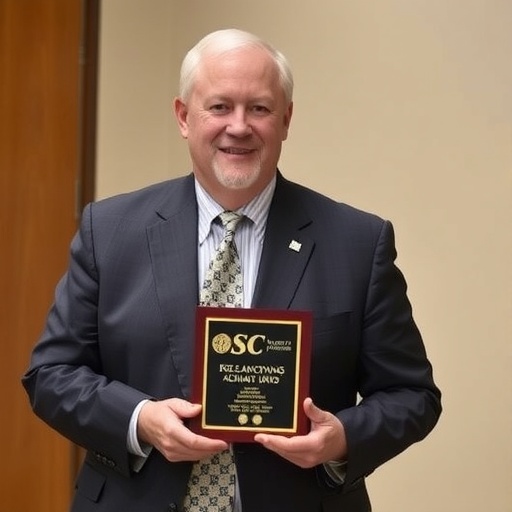
Sergei Kalinin, the Weston Fulton Professor of Materials Science and Engineering at the University of Tennessee, Knoxville’s Tickle College of Engineering, has earned the prestigious 2026 Southeastern Conference (SEC) Faculty Achievement Award. Marking one of the highest honors bestowed by the SEC, this recognition celebrates exceptional accomplishments in teaching, research, and service. Kalinin’s groundbreaking contributions at the confluence of artificial intelligence (AI) and materials science are revolutionizing how new materials are conceptualized, synthesized, and analyzed.
At the heart of Kalinin’s work lies the automation of materials discovery processes. Traditionally, the exploration and validation of novel materials have been painstakingly slow and largely manual endeavors, similar to the practices Kalinin encountered three decades ago. Despite monumental advances in computational predictions fueled by machine learning and big data, experimental workflows have not seen commensurate evolution—until now. Kalinin pioneers the integration of AI not only to predict promising compounds but also to autonomously carry out their synthesis and characterization, thereby dramatically accelerating the research cycle.
Kalinin and his team at the University of Tennessee have constructed some of the nation’s inaugural fully autonomous experimental platforms. These systems include state-of-the-art scanning probe and electron microscopes, engineered to function with minimal human oversight while executing high-throughput characterization tasks. By leveraging advanced algorithms for real-time decision-making and adaptive experimentation, these robotic laboratories exemplify a new frontier in scientific instrumentation. This progress distinguishes UT as one of the few academic institutions in the United States capable of operating such cutting-edge infrastructure.
These breakthroughs are multi-disciplinary achievements, necessitating fluency across materials science, computer science, machine learning, instrumentation engineering, and autonomous systems design. Kalinin emphasizes that the successful development of AI-driven laboratories does not rest on any single expert’s shoulders but rather on synergistic collaboration among domain specialists. This holistic approach has enabled the creation of platforms that are redefining experimental capacity and research productivity across the field.
Beyond technological innovation, Kalinin is deeply committed to cultivating the next generation of scientists and engineers poised to thrive in an AI-augmented research environment. Recognizing a widening skills gap, he has developed new curricula that immerse students in the theory and application of machine learning within materials science. These courses highlight the operational principles behind autonomous experimental setups and reinforce the importance of integrating AI tools with hands-on experimentation. Such interdisciplinary training equips future researchers with rare and highly valued competencies essential for advancing both academic and industrial frontiers.
Kalinin foresees an imminent paradigm shift not only in research methodologies but also in how entire institutions approach science and technology. As federal funding agencies and private industries escalate their investments in AI-fueled materials discovery, universities that build infrastructures linking AI, experimental science, and manufacturing will emerge as central hubs of innovation. UT aims to be at the vanguard of this transformation by establishing an ecosystem where machine learning facilitates seamless translation from laboratory breakthroughs to scalable production.
Central to this vision is the ambition to streamline the pipeline from the computational design of new materials to their real-world manufacturing and deployment. This demands tight integration between autonomous laboratories and advanced fabrication technologies, enabling rapid prototyping and iterative improvement cycles. Kalinin asserts that realizing such cohesive infrastructures will position the University of Tennessee as a global leader in advanced materials innovation, strengthening its intellectual and economic impact.
Kalinin’s work resides at the intersection of several critical technological domains, including AI, machine learning, microelectronics, civil engineering applications, and adaptive systems theory. His research leverages sophisticated algorithms that can actively learn from experimental data, guiding subsequent trials with enhanced precision and efficiency. This feedback-enabled experimentation paradigm represents a stark departure from traditional hypothesis-driven approaches, allowing for a dynamic, data-rich exploration of vast materials spaces previously considered intractable.
The fully autonomous platforms developed under Kalinin’s guidance incorporate state-of-the-art instrumentation capable of nanoscale resolution and manipulation. By coupling electron microscopy with real-time AI analysis, these systems achieve unprecedented throughput in characterizing the structural, electronic, and mechanical properties of newly synthesized compounds. This capability not only expedites discovery but also enriches fundamental understanding by uncovering subtle correlations otherwise masked in manual procedures.
Kalinin’s approach highlights the necessity of cross-disciplinary fluency. He champions educational syllabi that blend experimental design, machine learning frameworks, and controlled instrumentation, fostering a new breed of researchers who can straddle both laboratory and computational domains. This integrative skill set is becoming indispensable as AI technologies permeate every facet of scientific inquiry and industrial innovation, from materials research to manufacturing and quality control.
The SEC Faculty Achievement Award bestowed upon Kalinin reflects a broader institutional recognition of the transformative potential embodied in AI-empowered research. Over the years, this award has honored faculty members who demonstrate excellence and innovation across numerous fields, underscoring the importance of pioneering scholarship that reshapes disciplines. Kalinin’s recognition exemplifies how synergizing AI and materials science is catalyzing a new era in scientific discovery.
In summary, Sergei Kalinin’s visionary integration of artificial intelligence with autonomous experimental platforms is dramatically accelerating materials discovery and expanding the horizons of science and engineering. His work not only expedites the identification and characterization of novel materials but also prepares a skilled workforce equipped to lead future technological breakthroughs. As universities and industries worldwide pivot toward AI-driven innovation, UT’s multifaceted efforts under Kalinin’s leadership are setting a benchmark for the future of materials science.
Subject of Research: AI-driven Autonomous Experimental Platforms in Materials Science
Article Title: Pioneering the Future: Sergei Kalinin’s AI-Powered Revolution in Materials Discovery
News Publication Date: 2026
Web References:
Image Credits: University of Tennessee
Keywords
Materials science, Artificial intelligence, Machine learning, Autonomous laboratories, Scanning probe microscopy, Electron microscopy, Materials discovery, Materials synthesis, Advanced manufacturing, Experimental automation, Interdisciplinary research, AI-driven innovation


