

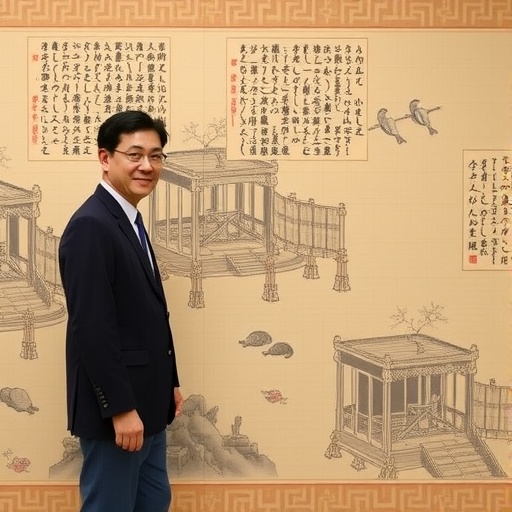
In a landmark acquisition that bridges the domains of contemporary art, technology, and scholarly heritage, the Ashmolean Museum at the University of Oxford has officially incorporated a doctoral thesis by Professor Jinjoon Lee of KAIST into its permanent collection. The work, titled Empty Garden – A Liminoid Journey to Nowhere in Somewhere (2020), represents a paradigm-shifting fusion of digital media artistry and classical East Asian aesthetics reimagined through modern data methodologies. This event marks an unprecedented moment, not only for Korean contemporary art but also within the broader intellectual fabric of Western art historical scholarship.
The Ashmolean Museum, revered as the world’s oldest university museum since its founding in 1683, functions as a nexus for scholarly preservation, research, and public education. Unlike institutions primarily focused on contemporary art markets or national heritage, the Ashmolean operates with a mandate deeply rooted in academic inquiry and long-term cultural stewardship. Its comprehensive collection, boasting over one million artifacts and artworks ranging from Renaissance masterpieces by Raphael and Leonardo da Vinci to ancient East Asian ceramics, positions it uniquely as a critical repository of global intellectual history. The acquisition of Professor Lee’s thesis evidences a crucial integration of Korean philosophical perspectives within this venerable Western canon.
Professor Lee’s doctoral thesis is a media artwork fashioned as a ten-meter-long hanji scroll—a traditional Korean handmade paper medium—immersing the audience in a thoughtful dialogue with Joseon-era scholar aesthetics. Drawing inspiration from the concept of uiwon (意園), an imaginative garden cultivated within the mind, the work has been digitally and materially orchestrated through what Lee terms “data gardening.” This methodological framework utilizes contemporary media languages and data structures to explore the philosophical notion of emptiness, inviting an introspective experience on human perception, memory, and existential thought amidst the increasingly AI-dominated modern world.
What distinguishes Empty Garden is not solely its conceptual framework but its innovative spatial and somatic engagement with the reader. The hanji scroll format necessitates a physical interaction—akin to a meditative promenade through an East Asian garden—exemplifying traditional spatial narrative techniques through modern materiality. The act of unrolling the scroll enacts a performative encounter, demanding patience, physical presence, and contemplative movement that collectively amplify the philosophical inquiry embedded within the text. Notably, one of the nine scrolls developed as part of this thesis was procured by the Ashmolean, wherein it occupies a unique dialogic space between art object and research artifact.
The academic rigor of Professor Lee’s work was emphatically recognized during its DPhil examination at Oxford in 2020 when it received unanimous “No Corrections” approval—a distinguished honor marking the thesis as both original and authoritative, especially given its completion in an accelerated timeframe of two and a half years. This swift and commendable academic journey underscores the thesis’s blend of innovative artistry and scholarly depth, severely challenging traditional boundaries of doctoral research in fine art and media studies.
This acquisition is singular not only because it is housed outside Oxford’s Bodleian Library, where doctoral theses are conventionally archived, but because the Ashmolean’s procurement followed an independent five-year evaluative process. This rigorous review underscored the work’s enduring artistic and intellectual merit and culminated in a formal purchase—a rarity signaling both the museum’s commitment to contemporary cross-cultural scholarship and the exceptional status of Lee’s work as a lineage-defining artifact.
Shelagh Vainker, the Alice King Curator of Chinese and Korean Art at the Ashmolean, articulated profound enthusiasm over the acquisition: she highlighted the work’s groundbreaking material techniques and the sophisticated layering of cultural and intellectual knowledge. Empty Garden represents the first contemporary Korean artwork to enter the museum’s collection—a testament to the increasing global recognition of Korean artistic innovations and their resonance within international scholarly discourse.
Professor Lee’s reflections on his doctoral journey reveal the intimate intertwining of personal experience and artistic conception. Following a severe leg injury that confined him to a wheelchair, Lee’s meditations on movement, stillness, and cognitive processes became integral to his exploration of how physicality intersects with thought in digital media art. His focus on the necessity of embodying data and images in forms capable of temporal endurance confronts contemporary art’s often ephemeral digital tendencies, positing a renewed materiality essential for genuine human connection in the AI age.
Crucially, Empty Garden serves as a conceptual bridge linking East Asian philosophical traditions with emergent cognitive frameworks shaped by artificial intelligence. By embedding Korean cultural and intellectual history within a Western public institution, the thesis opens fertile terrain for cross-disciplinary dialogue that transcends geographic and epistemological boundaries. It repositions Korean aesthetics not merely as cultural artifacts but as active contributors to global understandings of data, perception, and ontology.
This historic inclusion within the Ashmolean’s collection amplifies the role of the arts in technical and humanities scholarship during a transformative technological epoch. Professor Lee, as the first practicing artist appointed as a tenure-track professor at KAIST, simultaneously holds positions across globally renowned research institutions including Exeter College, University of Oxford; Tokyo University of the Arts; and New York University, further embodying the convergence of interdisciplinary inquiry within contemporary academia.
In recent years, Professor Lee’s artistic practice has garnered international acclaim through projects such as Good Morning, Mr. G-Dragon, which analyzed iris data from the iconic K-pop figure G-Dragon to create a space art installation, and Cine Forest: Awakening Bloom, an AI-mediated media symphony staged in South Korea’s Bundang Central Park. These projects underscore Lee’s ongoing commitment to integrating technology, data science, and artistic expression—an ethos that permeates Empty Garden and situates it at the vanguard of 21st-century art research.
Ultimately, the Ashmolean’s acquisition signals a profound affirmation of Korean contemporary art within the annals of Western intellectual institutions. It challenges entrenched hierarchies by positioning a living artist’s doctoral thesis as both an academic and art historical artifact worthy of preservation and critical study. This institutional recognition ensures that Professor Jinjoon Lee’s pioneering inquiries into data, emptiness, and embodied experience will continue to inspire scholarly discourse and public engagement for generations to come, marking a new chapter in the interwoven narratives of East Asian thought and cutting-edge media arts.
Subject of Research: Not applicable
Web References: DOI – 10.5287/ora-zomk1zzvx
Image Credits: KAIST
Keywords
East Asian aesthetics, Korean contemporary art, Ashmolean Museum, doctoral thesis acquisition, data gardening, hanji scroll, multimedia art, AI and art, interdisciplinary research, Joseon scholars, spatial narrative, cultural preservation


