

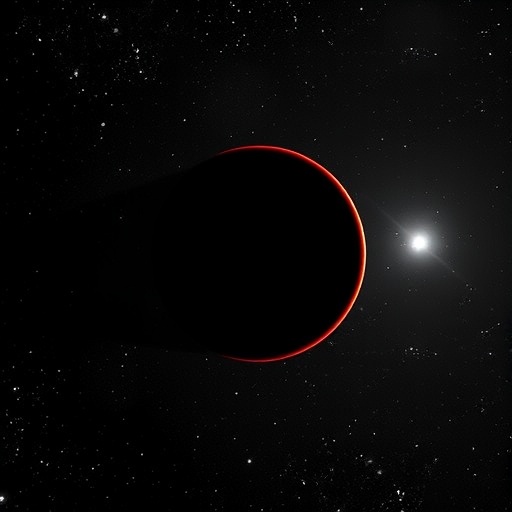
The recent observations of the TRAPPIST-1 system by the James Webb Space Telescope (JWST) have ignited a revolution in our quest to understand the atmospheres of rocky exoplanets orbiting low-mass red dwarf stars. Among these, TRAPPIST-1 b and TRAPPIST-1 c have emerged as intriguing subjects, challenging prevailing theories about atmospheric retention and evolution. Utilizing the unprecedented sensitivity of JWST at a wavelength of 15 microns, scientists have captured thermal phase curves for these two planets, revealing a striking absence of thick atmospheres despite their temperate orbits. This breakthrough carries profound implications for planetary science, exoplanet habitability, and atmospheric physics.
Thermal phase curves represent a powerful observational tool, measuring the planet’s emitted infrared radiation as it orbits its star, thus mapping temperature variations across its surface. For TRAPPIST-1 b, the data paints a vivid picture of an intensely hot dayside with a brightness temperature measured at approximately 490 Kelvin, contrasted by near-zero emission from its nightside. Such an extreme temperature contrast is a hallmark of a body lacking a substantial atmosphere, which would otherwise redistribute heat to the nightside. A lack of phase offset further corroborates the notion of a dark, desolate surface, absorbing stellar radiation without the moderating influence of atmospheric circulation.
In stark contrast, TRAPPIST-1 c displays a somewhat cooler dayside, with temperatures measured around 369 Kelvin alongside an equally frigid nightside. This thermal profile suggests that the planet either possesses a tenuous atmosphere, potentially oxygen-rich but very thin, or alternatively has an airless surface with higher reflectivity. The possibility of a sparse oxygen atmosphere, perhaps a remnant of past atmospheric loss or photodissociation processes, hints at evolutionary divergence from TRAPPIST-1 b, despite their shared stellar environment and similar bulk compositions.
Intriguingly, the data decisively disfavors atmospheric models with surface pressures exceeding approximately one bar for both planets. This threshold, close to Earth’s atmospheric pressure at sea level, is significant, as gases under such conditions would redistribute heat efficiently, smoothing out temperature contrasts and creating measurable phase offsets, which the JWST observations do not detect. This observation forces scientists to reconsider mechanisms by which planets around red dwarfs can lose or fail to accumulate thick atmospheres over geological timescales.
The harsh radiation environment generated by low-mass red dwarfs is well-known to impact planetary atmospheres profoundly. High-energy stellar winds and frequent flares can strip away atmospheric gases, an effect exacerbated by close orbital proximities needed to maintain temperate conditions. TRAPPIST-1 b and c, residing very close to their host star, presumably endure intense stellar activity, which might explain the absence or extreme depletion of robust atmospheres. However, the presence of any oxygen or reflective surfaces on TRAPPIST-1 c opens questions about atmospheric chemistry and planetary surface interactions that merit further exploration.
The implications of these findings ripple across multiple domains of astrophysics and astrobiology. Firstly, the stark contrast with Earth-like thick atmospheres challenges assumptions about habitability around M-dwarf stars. Such stars constitute the majority of stars in the galaxy and are prime targets for searching potentially life-supporting planets. The absence of thick atmospheres on planets like TRAPPIST-1 b and c suggests that habitability criteria must take into account the difficulty of atmospheric retention under intense stellar radiation fluxes, altering priorities for biosignature searches.
Moreover, the data showcases the exceptional capability of JWST’s mid-infrared instruments to probe planetary climates and surface conditions remotely. This method provides not only temperature measurements but also constraints on atmospheric composition and pressure, offering a new lens through which to study exoplanetary atmospheres in exquisite detail. Future observational campaigns will likely exploit these methods for a broader sample of rocky exoplanets, potentially categorizing them by atmospheric presence and evolutionary history.
These discoveries also raise profound questions about the formation and evolution of planets around faint red dwarfs. That two neighboring planets within the same system — possibly having formed from similar primordial material — exhibit such divergent atmospheric states suggests complex evolutionary pathways. Differences could stem from stochastic events such as giant impacts, variable stellar activity phases, or even divergent internal geophysical processes affecting outgassing and atmospheric escape rates.
To understand the absence of thick atmospheres further, scientists rely on atmospheric escape models incorporating hydrodynamic blow-off driven by extreme ultraviolet and X-ray irradiation, combined with photochemical modeling of atmospheric constituents like oxygen, carbon dioxide, and water vapor. The observed constraints on surface pressure imply that either these models need refinement or that other unaccounted-for processes, such as magnetic field shielding, replenishment cycles, or planetary magnetospheres, play significant roles in shaping atmospheric fate.
The lack of observable phase offset in TRAPPIST-1 b’s thermal emission is particularly telling. In planets with substantial atmospheres, especially those with zonal winds and heat transport, the hottest region tends to be displaced eastward of the substellar point, generating a measurable phase shift in the infrared light curve. The zero phase offset measured here reiterates the conclusion of an airless or nearly airless world, casting light on the thermal dynamics of these distant terrains.
For TRAPPIST-1 c, the possibility of a reflective surface or a tenuous atmosphere adds an exciting dimension. Surface reflectivity can be influenced by high-albedo materials such as silicates or ice, which might exist given the planet’s cooler dayside temperature relative to TRAPPIST-1 b. Alternatively, oxygen-rich but rarefied atmospheres may represent a late evolutionary stage, where volatile loss has stripped away lighter species, leaving behind residual oxygen produced by photodissociation, a phenomenon that complicates the interpretation of oxygen as a bioindicator.
The comparison between planets within the same system underlines the dynamic complexity that awaits characterization in exoplanetary science. TRAPPIST-1 remains a cornerstone system for these inquiries, as its proximity, favorable inclination, and the number of Earth-sized planets provide unmatched opportunities for comparative exoplanetology. Upcoming JWST observations and next-generation telescopes will likely deepen this understanding and explore potential atmospheres on its more distant, potentially habitable worlds.
Ultimately, these findings redefine current paradigms about atmospheric survival in extreme environments, pushing the envelope of our understanding of exoplanet habitability. They highlight the necessity to integrate observational data with advanced modeling of stellar-planet interactions, atmospheric chemistry, and planetary interiors. As we accumulate more data from TRAPPIST-1 and similar systems, we continue to refine the conditions under which rocky planets can sustain atmospheres and, by extension, life.
Intriguingly, the study also emphasizes the importance of context when interpreting atmospheric signatures. The mere detection or absence of an atmosphere does not unambiguously indicate habitability or biological potential but must be situated within a framework that considers stellar characteristics, orbital dynamics, and planetary properties. TRAPPIST-1 b and c exemplify worlds where similar starting conditions can yield dramatically different present states, challenging the notion of “Earth-like” planets based solely on size and location.
This pioneering research utilizing JWST thermal phase curves stands as a testament to the transformative power of cutting-edge space telescopes in exoplanetary science. It sets the stage not only for more refined studies of TRAPPIST-1 but also for extensive surveys of rocky planets around nearby red dwarfs, ultimately enhancing our grasp on planet formation, atmospheric evolution, and the potential for life beyond our solar system.
As humanity’s search for understanding moves forward, the barren, dark surface of TRAPPIST-1 b and the enigmatic, cool TRAPPIST-1 c remind us that each exoplanet possesses a unique narrative shaped by complex cosmic forces. Only by unraveling these stories through meticulous observation and innovative analysis can we piece together the intricate puzzle of planetary atmospheres and the prospects for life in the cosmos.
Subject of Research: Atmospheric characterization of rocky exoplanets TRAPPIST-1 b and TRAPPIST-1 c using JWST thermal phase curve observations.
Article Title: No thick atmosphere around TRAPPIST-1 b and c from JWST thermal phase curves.
Article References:
Gillon, M., Ducrot, E., Bell, T.J. et al. No thick atmosphere around TRAPPIST-1 b and c from JWST thermal phase curves. Nat Astron (2026). https://doi.org/10.1038/s41550-026-02806-9
Image Credits: AI Generated


