

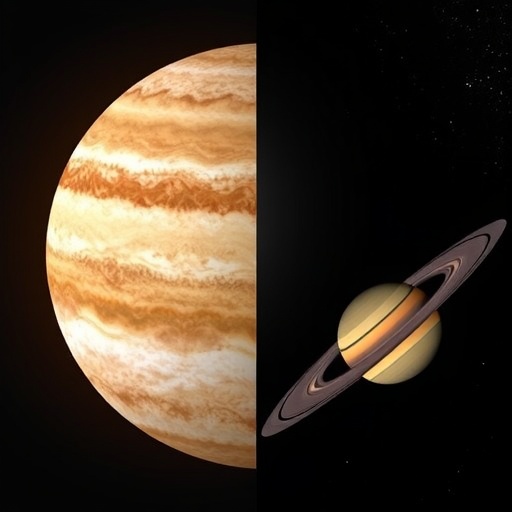
The strikingly different architectural patterns of the Jovian and Saturnian satellite systems have long puzzled astronomers. While Jupiter boasts a tightly packed arrangement of four large moons, three of which are locked in a celestial dance known as the Laplace resonance, Saturn presents a contrasting configuration dominated by a single giant moon, Titan, orbiting at a more remote distance. This fundamental divergence has remained an enigma, resisting comprehensive theoretical explanation. Recent groundbreaking research, however, proposes a compelling magnetohydrodynamic mechanism that may finally illuminate the origin story behind these contrasting satellite systems.
The key to understanding the disparity lies in the interaction between young gas giants and the circumplanetary disks from which their moons coalesce. Specifically, the formation of a magnetospheric cavity—an evacuated region carved out within the disk by the planet’s magnetic field—emerges as a powerful sculptor of satellite systems. In the case of Jupiter, a strong surface magnetic field, maintained by sustained magnetic activity in its deep interior, exerts a formidable influence on the surrounding disk. This magnetic field effectively expels disk material from the innermost regions, establishing a cavity that exerts critical control over the orbital evolution and eventual resonance entrapment of newly formed satellites.
In contrast, Saturn’s magnetic field strength and structure differ significantly. Observations and interior modeling indicate that Saturn’s magnetic dynamo—the engine generating its planetary magnetic field—occupies a relatively narrow, deep interior layer. This constraint results in a weaker surface magnetic field insufficient to carve out a substantial cavity in the circumplanetary disk. Consequently, the protosatellites form and migrate within a disk environment devoid of the magnetic cavity feature, altering their ultimate orbital arrangement drastically.
The research team employed advanced N-body simulations, incorporating the complex physics of disk-planet-moon interactions under magnetic effects, to elucidate how these processes influence satellite system architectures. Their models demonstrate that the formation of the magnetospheric cavity near the young Jupiter analog induces a migration trap for emerging moons. This trap facilitates the capture of moons into the Laplace resonance, a three-body gravitational interaction that locks their orbital periods in a precise ratio, maintaining long-term dynamical stability.
Beyond Jupiter, the simulations show that in a Saturn-like environment, without the magnetic cavity providing a migration halt, protosatellites tend to spiral inward through the disk due to type I migration. This inward drift culminates in the rapid accretion of these moons onto the planet’s surface, resulting in a stark paucity of surviving inner satellites. Only moons that form at sufficiently wide orbital distances, beyond the effective radial migration zone, can escape this fate. Titan, with its orbit substantially farther from Saturn, exemplifies such a survivor, benefiting from what the authors call a “safety zone” beyond the planet’s magnetospheric influence.
This magnetospheric cavity theory bridges longstanding gaps in our understanding of satellite system formation. It accounts for how variations in planetary magnetic field properties directly feed back into the disk dynamics, thereby setting the stage for different satellite architectures. This insight also implies that magnetic field strength and dynamo layer properties are fundamental parameters influencing moon system outcomes, supplementing traditional concepts emphasizing disk mass and temperature profiles.
Moreover, this framework offers predictive statements for exomoon systems around distant stars. The study anticipates that massive gas giants akin to Jupiter, with robust magnetic fields, will frequently host compact moon systems exhibiting resonances analogous to the Laplace resonance. In contrast, Saturn-sized gas giants, less magnetically influential, are more likely to harbor a small number of distant moons, mirroring the Titan scenario. This prediction opens an exciting avenue for future observational campaigns aiming to characterize the diversity of moon systems beyond our solar system.
These findings integrate magnetohydrodynamic theory and robust numerical modeling to provide a convincing explanation of why the Jovian and Saturnian satellite systems look so fundamentally different. They highlight the magnetospheric cavity as a previously underappreciated but vital component in moon system dynamics. Such cavities modulate satellite migration pathways and set resonance boundaries that shape the final orbital architectures.
This work not only deepens our comprehension of moon formation but also enriches our broader understanding of planetary system evolution. Magnetospheric influences, as revealed here, should be incorporated into future models of circumplanetary disk evolution and moon formation scenarios. The planetary magnetic field, a dynamic entity influenced by internal dynamo processes, rises as a key factor steering satellite outcomes.
The research methodology notably bridges multidisciplinary perspectives, incorporating planetary magnetism, disk physics, gravitational dynamics, and planetary interior structure modeling. The cross-disciplinary approach was essential to unravel the coupled phenomena affecting satellite system architectures. Astrophysicists and planetary scientists alike will find these insights crucial for refining theoretical models and interpreting upcoming exomoon detections.
In terms of observational implications, the study suggests specific characteristics to look for with forthcoming telescopes and observational platforms. Compact, resonantly locked exomoon systems around massive gas giants should be detectable signatures consistent with strong planetary magnetic fields carving cavities in their disks. Conversely, lone or sparsely populated distant moon populations could signal Saturnian-type systems with weaker magnetospheric impacts.
Ultimately, this study provides a cohesive, physically grounded explanation for the divergent satellite system architectures of Jupiter and Saturn, a question that has challenged planetary science for decades. The interplay between magnetic cavity formation and satellite orbital dynamics offers a powerful lens through which to reinterpret our solar system and extrapolate to distant planetary systems.
As exomoon discoveries accelerate, the magnetospheric cavity model offers a testable theoretical framework. Confirming predicted configurations through future observations will reinforce the critical role of magnetic fields in shaping the architecture of moon systems, transforming our understanding of such cosmic neighborhoods. The era of integrating magnetohydrodynamics into planetary system formation theory has truly arrived.
The identification of magnetic cavity formation as a determinant in satellite architectures marks a paradigm shift, positioning planetary magnetism as an active agent—not merely a passive environment—in sculpting circumplanetary environments. This conceptual leap heralds new research directions into magnetically mediated moon formation and migration processes, inspired by detailed numerical simulations and observations across the solar system.
Going forward, this paradigm will likely drive efforts to characterize planetary dynamos and their magnetic footprints more precisely, linking internal planetary physics with external disk and moon dynamics in unprecedented detail. The magnetic connection between planet and disk emerges as a linchpin of evolutionary pathways that govern the diversity of moon systems observed, both near and far.
In summary, the magnetic environment of a young gas giant plays a decisive role in carving the ultimate architecture of its suite of moons. Jupiter’s strong magnetic field carves a cavity that traps moons into resonant orbits, preserving a complex and stable satellite system. Saturn’s comparatively weaker field fails to create such a cavity, resulting in inward migration and loss of satellites, save for distant survivors like Titan. This discovery, with its powerful implications, opens a new chapter on how magnetic phenomena shape planetary systems beyond the planets themselves.
Subject of Research: The role of magnetospheric cavity formation in shaping the satellite system architectures of gas giants Jupiter and Saturn.
Article Title: Different architecture of Jupiter and Saturn satellite systems from magnetospheric cavity formation.
Article References:
Fujii, Y.I., Ogihara, M. & Hori, Y. Different architecture of Jupiter and Saturn satellite systems from magnetospheric cavity formation. Nat Astron (2026). https://doi.org/10.1038/s41550-026-02820-x


