

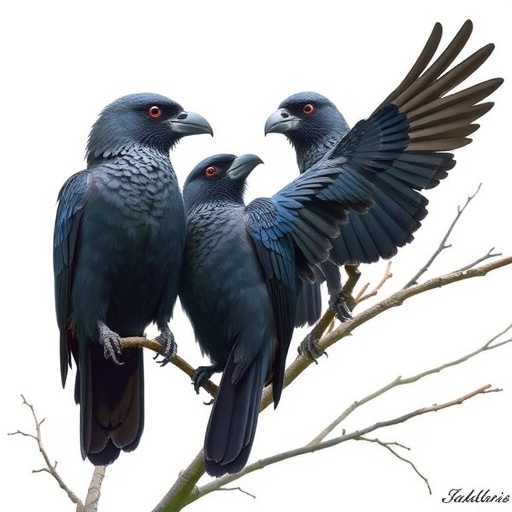
In a groundbreaking study set to be published in 2025, researchers have unveiled fascinating insights into the vocal recognition capabilities of wild jackdaws, a species noteworthy for their complex social structures and communicative behaviors. The study, conducted by a team of scientists led by Victoria E. Lee and her colleagues, delves into the remarkable ability of these birds to identify the specific contact calls of their mates, shedding light on their cognitive functions and the evolutionary advantages of such recognition.
Jackdaws, members of the Corvidae family, are known for their intelligence and adaptability. They exhibit behaviors indicative of advanced problem-solving skills, social learning, and some of the most complex forms of vocal communication among birds. This study focuses on the auditory recognition of specific calls, which plays a vital role in their social interactions, especially in mate bonding and offspring rearing.
Vocal communication in jackdaws is multifaceted. Researchers observed that jackdaws produce a variety of sounds, each serving a distinct purpose within their social dynamics. The study specifically examined how jackdaws could use auditory cues to distinguish between calls of their mates and those of unfamiliar conspecifics. This capability is essential for maintaining pair bonds and ensuring the survival of their young.
Through meticulous experimentation, the research team employed a series of playback trials. They presented jackdaws with recorded calls from both their mates and unrelated individuals. Remarkably, the jackdaws consistently demonstrated a marked preference for their mates’ calls, showcasing their ability to differentiate between familiar and unfamiliar voices amid a cacophony of sound. Such findings underscore the nuanced understanding these birds have of their social identities.
Notably, the study reveals that this vocal recognition skill may be less about memorizing sounds and more about social context and experience. Jackdaws appear to integrate their prior interactions with their mates, leveraging experiential knowledge to recognize distinct vocal signatures. This advanced cognitive processing reflects a high level of social intelligence and may evoke comparisons with other vocal learners across the animal kingdom, including primates and cetaceans.
Furthermore, the implications of this research extend into the fields of animal cognition and communication. Understanding how jackdaws navigate their social landscapes opens up avenues for investigating the evolutionary pathways of vocal recognition in birds. These findings may offer insights into how complex communication systems evolve, particularly in social species where cooperative breeding and mate selection are crucial for reproductive success.
The interplay between vocal learning and social dynamics is a compelling topic of discussion in the study of animal behavior. The jackdaw’s ability to recognize mate calls could represent an evolutionary advantage in environments where survival heavily depends on social cohesion and cooperative behaviors. As habitats become more challenging due to environmental changes, the ability to communicate effectively may become even more critical.
In the broader context, examining the vocal recognition abilities of jackdaws also highlights the potential for similar mechanisms in other avian species. Corvids, in particular, have garnered attention for their sophisticated communication skills, and this study adds to the growing body of evidence that these birds engage in complex social interactions mediated by vocal cues. Such research fosters a greater understanding of avian intelligence and the significance of communication in the animal kingdom.
The study’s findings also hold significance for the conservation of jackdaws and other corvids. Recognizing the importance of social bonds in reproductive success may inform strategies to protect these species and their habitats. As environmental pressures mount, conserving social structures could be pivotal in ensuring the continuation of these remarkable birds’ complex behaviors.
Moreover, this research encourages a reevaluation of how we perceive animal communication at large. Traditionally viewed as simplistic, the vocalizations of many species now appear as integral components of complex social systems, signaling a need for deeper exploration into the cognitive abilities of various animals. As our understanding of animal intelligence evolves, so too does our approach to conservation, animal welfare, and our responsibilities toward non-human species.
As we contemplate the implications of these findings, it is essential to recognize the ethical responsibilities involved in studying sentient beings. The nuanced social lives of jackdaws and their ability to recognize individuals through vocal calls emphasize the importance of treating wildlife with respect and consideration, acknowledging their cognitive abilities, and fostering a compassionate approach towards their conservation.
The research conducted by Lee, McIvor, and Thornton represents not just a significant contribution to the field of animal cognition, but also serves as a reminder of the complexities underlying the natural world. In celebrating the extraordinary cognitive abilities of jackdaws, we come to appreciate the intricate tapestry of life on Earth, where communication and recognition form the bedrock of social interaction and survival.
As this study prepares for publication, the excitement surrounding the findings promises to ignite discussions within the scientific community and beyond. The notion that wild jackdaws possess the remarkable ability to identify the calls of their mates highlights the sophistication of bird communication and the depth of avian intelligence. This work lays the groundwork for further research into the cognitive landscapes of other species, while simultaneously urging society to nurture and protect the avian wonders that share our planet.
In conclusion, the recognition of contact calls among wild jackdaws not only underscores their sociocognitive sophistication but also raises essential questions about the evolution of communication in the animal kingdom. The importance of vocal recognition in fostering social bonds and reproductive success is undeniably a topic warranting further exploration, and as researchers continue to investigate, the mysteries of avian communication will likely unravel, revealing even more about the intellect of non-human species that inhabit our world.
Subject of Research: Vocal recognition in wild jackdaws.
Article Title: Wild jackdaws recognise the contact calls of their mate.
Article References:
Lee, V.E., McIvor, G.E. & Thornton, A. Wild jackdaws recognise the contact calls of their mate. Anim Cogn 28, 97 (2025). https://doi.org/10.1007/s10071-025-02020-6
Image Credits: AI Generated
DOI:
Keywords: Vocal recognition, jackdaws, animal cognition, communication, social dynamics.


