

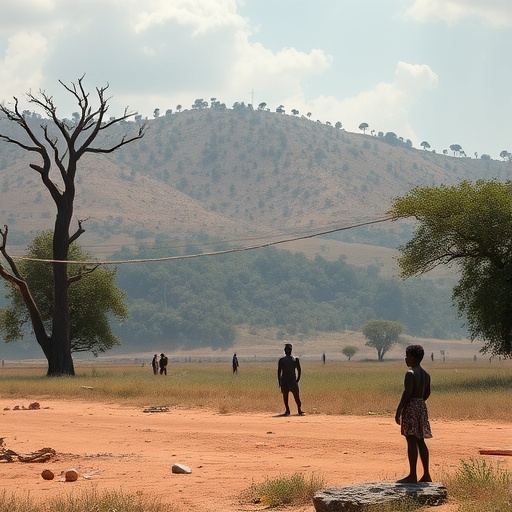
In the rapidly transforming peri-urban environs of Lydiate, Zimbabwe, the practice and discourse surrounding witchcraft—locally termed ufiti—emerge as critical mechanisms of spiritual governance and territorial placemaking. Contrary to common misperceptions that dismiss witchcraft as an irrational survival of tradition, this phenomenon functions as a sophisticated moral and regulatory infrastructure. It upholds social order amid legal ambiguity and spatial precarity, mediating disputes, enforcing territorial boundaries, and regulating interpersonal trust. The significance of witchcraft lies far beyond supernatural belief; it operates as a poignant index of the anxieties, rivalries, and socio-economic tensions engendered by rapid urban migration and economic transformation.
The underpinnings of witchcraft’s power in Lydiate are deeply entwined with modern processes of mobility, inequality, and insecurity. Residents employ ufiti not only as a prism to interpret misfortune and power dynamics but also as a pragmatic tool in managing the hard realities of displaced lives. Many inhabitants lack formal legal title to their land, making the invisible realm the primary battleground for establishing—and defending—ownership and social status. This spiritual mode of governance is deployed as a practical alternative to conventional legal protections absent in these informal urban settlements.
This paradigm, illuminated extensively by scholars like Jean and Ruth Comaroff and Philippe Geschiere, reframes witchcraft from a mere superstition to a form of ‘defensive infrastructure’. In a distinctly nonvisible fashion, witchcraft manifests as what has been termed ‘spiritual frontiers’: unseen protective boundaries established through rituals such as the application of charms, the burial of medicinal substances, or ancestral invocations. These ritualistic acts materialize invisible property lines that deter encroachment and trespassing, enabling residents to claim moral and spiritual sovereignty over their precarious holdings in the absence of state recognition.
One vivid narrative recounts how a community member, Baba Chabwera, invoked such spiritual protection by ceremoniously applying medicine at the corners of his plot and calling on ancestors to guard the land. According to his testimony, this spiritual fencing was so potent that no one dared approach, not even thieves. Here, witchcraft transcends the realm of symbolic expression, becoming an infrastructural architecture of tenure—rendering visible a moral claim where bureaucratic safeguards are vacant. This materialization of the ‘invisible’ reflects a broader trend in African urban peripheries, where spiritual techniques constitute a vital framework for land security and social order.
Yet, this defensive infrastructure is not without its complexities. The dual capacity of witchcraft to protect and to harm fosters an atmosphere saturated with mutual suspicion and ambiguity. Within Lydiate’s social fabric, protective acts can be misinterpreted as hostile intents. This ambiguity crystallizes witchcraft’s ambivalence—it is both a mechanism of social stabilization and a source of destabilization. Anthropologist James Ashforth’s research in Soweto aptly describes the resulting phenomenon as ‘spiritual insecurity,’ a form of moral governance that thrives on constant vigilance and fear of bewitchment, enforcing social discipline through an ever-present spiritual threat.
The moral economy interwoven with ufiti also valorizes a profound sense of moderation and communal reciprocity. Witchcraft accusations often spike amid rising prosperity or conflict, serving as a discourse that critiques sudden accumulation of wealth and social jealousy. These accusations are not merely expressions of envy but serve as community-sanctioned moral checks on unregulated success. Sociologists Jean and John Comaroff characterize such systems as a translation of macroscopic structural inequalities into micro-level interpersonal narratives, where sorcery functions as a language of justice and social recalibration.
An ethnographic case from 2019 recounts how a dispute over a vegetable plot escalated to witchcraft rumors when unexpected crop failure afflicted one family. The collective response was a communal ritual of cleansing, invoking ancestors with offerings of beer and tobacco to restore social harmony. This ritual exemplified witchcraft’s role as a moral mediator rather than an outright instrument of vengeance, emphasizing ritual appeasement over judicial evidence. Here, witchcraft serves as both a social contract mechanism and a venue for expressing culturally rooted principles of fairness and ownership.
Such instances underscore what Geschiere famously termed the ‘politics of the invisible’—the capacity of unseen spiritual forces to shape social contracts and spatial order in ways conventional secular mechanisms cannot. Witchcraft articulates claims about rightful belonging, communal ethics, and land stewardship, fostering local autonomy while simultaneously providing a mode of governance that contests and complements formal state authority.
This inherently ambivalent nature of witchcraft renders it central to the moral topography of Lydiate’s urban margins. Its dual role as a force of protection and a potential source of harm encapsulates a condition defined by constant negotiation through fear and dependence. Residents frequently vacillate between condemning witchcraft as evil while simultaneously acknowledging its crucial role in maintaining order and respect. One Pentecostal woman captured this paradox succinctly, observing that while ufiti is deemed sinister, it remains indispensable for yard protection.
This paradox resonates with broader dynamics in the African urban periphery, where ‘invisible’ spiritual forces buttress fragile social cohesion. Witchcraft acts as an informal regime of risk management, bestowing a palpable sense of control amidst uncertainty. Social vigilance extends beyond ordinary crime to encompass mystical aggression—strange noises, unexplained illnesses, or sudden deaths—heightening a collective state of interpretive labor that transforms everyday life into an ongoing performance of moral scrutiny and defense.
Spatially, this moral surveillance manifests through the inscribing of invisible boundaries onto the landscape. Certain paths, homesteads, or compounds are regarded as ‘hot spots,’ zones imbued with dangerous spiritual energies to be avoided, particularly after dark. These designations produce de facto territorial divisions that organize community settlement patterns and social interaction. As urban geographer AbdouMaliq Simone articulates, such acts of negotiation and avoidance are crucial forms of urban governance in contexts where formal state presence is erratic or ineffective.
The interplay between visible and invisible forms of authority further complicates Lydiate’s spiritual and political landscape. Public authority is enacted through Nyau rituals—highly visible performances that stage and discipline community life—while witchcraft operates as the less visible but deeply potent counterpart. Together, they forge what Achille Mbembe terms ‘convivial authoritarianism,’ a blend of intimacy, spectacle, fear, and coercion that sustains social order.
For customary leaders, witchcraft serves pragmatic governance ends. The fear of spiritual reprisal deters anti-social behavior such as land grabbing, theft, or disrespect without any need for formal policing. As one elder explained, community members behave out of a pervasive fear that ‘the spirits are watching,’ effectively replacing institutional law enforcement with spiritual deterrence. However, this spiritual governance is not without its costs; suspicion often fractures social trust and can precipitate cycles of accusation and violence, as illustrated by an incident in 2020 where a young woman fleeing witchcraft allegations became a victim of communal retaliation.
This volatility highlights the inherent political ambivalence of witchcraft as both a conservative force, reinforcing prevailing moral orders, and a subversive one, contesting official state authority. In contexts marked by weak state legitimacy, spiritual power provides an alternative domain for politics, shaping community perceptions of justice, sovereignty, and social morality. Witchcraft in Lydiate thus embodies this duality, translating invisible fears into enforceable social norms and visible territorial order.
Ultimately, witchcraft in Lydiate operates at the intersection of spiritual belief, socio-political regulation, and spatial governance. Its infrastructural and discursive roles help residents navigate precarious realities of displacement, inequality, and insecurity. By inscribing moral topographies onto the urban landscape, witchcraft serves as a potent, if ambivalent, mechanism for placemaking—transforming invisible fears and ancestral authority into tangible configurations of power, belonging, and survival.
Subject of Research:
Article Title:
Article References:
Bhanye, J. Placemaking through the invisible: Nyau rituals, spiritual citizenship, and the politics of space among migrants in peri-urban Zimbabwe. Humanit Soc Sci Commun 12, 1941 (2025). https://doi.org/10.1057/s41599-025-06254-0
Image Credits: AI Generated


