

The Mediterranean Sea, a dynamic marine ecosystem known for its rich biodiversity and cultural significance, is currently experiencing profound ecological shifts largely driven by climate change and anthropogenic influences. Among the most consequential processes reshaping this marine environment is the influx and establishment of non-indigenous species, particularly those arriving via the Suez Canal, a phenomenon scientifically recognized as Lessepsian migration. This translocation has intensified over recent decades, posing complex challenges to native ecosystems and raising pressing questions about future ecological balances and management strategies.
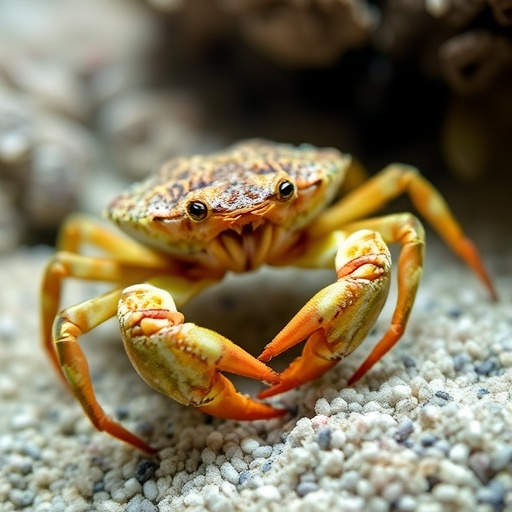
A groundbreaking study recently published in the journal Acta Ichthyologica et Piscatoria presents compelling evidence of the rapid expansion of the Indo-Pacific swimming crab, Gonioinfradens giardi, in the Ionian Sea, off the coast of Italy. This crustacean, originally native to the Indo-Pacific region, was first recorded in Italian waters at Portopalo di Capo Passero in November 2025 with the collection of a single specimen. The subsequent detection of eleven additional individuals over a mere two months underscores a critical transition from isolated appearances to probable establishment within the central Mediterranean marine ecosystem.
The relevance of these new records lies not only in their chronological proximity but also spatially, as these findings represent the species’ westernmost presence in the Mediterranean. This westward expansion suggests that G. giardi is not only surviving but potentially thriving under regional environmental conditions, which may be increasingly conducive to its proliferation. Such expansion could signal the successful local integration of this non-indigenous species, a process that may hold significant ecological ramifications.
This study employed a multifaceted methodological approach combining traditional field observations alongside collaborative monitoring efforts with local artisanal fishers. Utilizing standard fishing gear commonly employed in regional fisheries, researchers were able to enhance species detection capabilities, gathering valuable data that broaden understanding of G. giardi’s distribution dynamics. The cooperation with fishers, who possess invaluable ecological knowledge and continuous sea presence, exemplifies an innovative model for monitoring biological invasions and gathering real-time data crucial for early detection.
From an ecological perspective, the prospective establishment of Gonioinfradens giardi raises important considerations regarding its interactions with native species. Crabs in the Portunidae family are often key predators and competitors within benthic food webs, and the introduction of a new predatory species could disrupt existing trophic relationships. Potential competition for habitat, food resources, and reproductive sites may significantly affect indigenous crustaceans and other marine biota, thereby altering the delicate equilibrium that has historically characterized Mediterranean benthic communities.
Moreover, the rapid incursion of G. giardi into new marine territories exemplifies how climate-induced environmental changes, such as rising sea temperatures and altered salinity regimes, facilitate the success of Lessepsian migrants. These conditions may create suitable niches for species previously excluded due to physiological constraints. The Ionian Sea’s warming trend might be enabling G. giardi to overcome ecological barriers, granting it a competitive advantage over native organisms adapted to historically stable environmental conditions.
The socioeconomic implications stemming from the establishment of non-native crustaceans like G. giardi must also be considered. Fisheries, already vulnerable to overexploitation and habitat degradation, could face additional pressures from the presence of new competitors or predators. Changes in species compositions may influence commercially important stocks, with potential downstream effects on local industries and food security. Understanding these multifaceted interactions is vital for developing adaptive fisheries management strategies that ensure ecosystem resilience.
Early detection and documentation of such biological invasions are imperative steps in navigating the ongoing transformations within Mediterranean marine ecosystems. The study’s emphasis on early-phase establishment detection is particularly valuable, as management interventions are most effective before species become fully entrenched. This opportunity window offers a strategic advantage for implementing monitoring programs, risk assessments, and possibly mitigation strategies tailored to the biological and environmental context.
The study’s authors also underscore the indispensable role of continuous, coordinated monitoring efforts that incorporate inputs not only from scientists but also from fishers and citizen scientists. This integrative approach leverages a broad observational base, enhancing timely data acquisition and enabling informed decision-making processes. Collaborative surveillance stands as a promising avenue for confronting the challenges posed by marine invasive species in a rapidly changing global environment.
Gonioinfradens giardi’s ongoing expansion serves as a critical indicator of the broader biological invasions increasingly reshaping Mediterranean marine biodiversity. This trend is reflective of global patterns where anthropogenic structures and climate variability synergistically alter species distributions, sometimes with profound ecological and economic consequences. The Mediterranean’s unique position as a biodiversity hotspot and a nexus for biogeographical pathways renders its ecosystems especially sensitive to these pressures.
This research notably contributes to the accumulating evidence delineating the complex interplay between human activities, climate change, and species dispersal mechanisms. By providing detailed accounts of new records and early establishment phases of a Lessepsian migrant crab in the Ionian Sea, it not only informs scientific understanding but also advocates for policy frameworks attuned to managing the consequences of biological invasions.
In conclusion, the rapid and ongoing expansion of Gonioinfradens giardi in the Mediterranean exemplifies the profound ecological shifts underway in marine ecosystems subjected to climatic and anthropogenic influences. The findings emphasize the urgency of advancing scientific research, enhancing cross-sector collaboration, and implementing adaptive management practices to safeguard biodiversity and ecosystem services in one of the world’s most ecologically and culturally significant seas.
Subject of Research: Rapid expansion and early establishment of the Lessepsian migrant crab Gonioinfradens giardi in the Mediterranean Sea.
Article Title: Rapid expansion of a Lessepsian migrant crab, Gonioinfradens giardi (Crustacea, Brachyura, Portunidae), in the Ionian Sea: New records and early evidence of establishment.
News Publication Date: 31-Mar-2026
Web References:
DOI link to article
References:
Tiralongo F, Leotta P, Accolla H, Tibullo D, Felici A (2026) Rapid expansion of a Lessepsian migrant crab, Gonioinfradens giardi (Crustacea, Brachyura, Portunidae), in the Ionian Sea: New records and early evidence of establishment. Acta Ichthyologica et Piscatoria 56: 145-149.
Image Credits: Francesco Tiralongo
Keywords: Mediterranean Sea, Lessepsian migration, Gonioinfradens giardi, invasive species, biological invasions, climate change, Ionian Sea, marine biodiversity, ecological establishment, artisanal fisheries, marine ecosystems, non-indigenous species


