

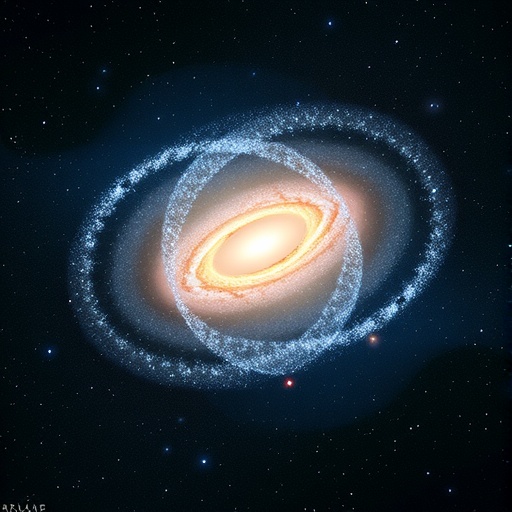
In a monumental advancement for astronomy, an international consortium of researchers led by the Institute of Cosmos Sciences at the University of Barcelona (ICCUB) and the Institute of Space Studies of Catalonia (IEEC) has unveiled REGALADE — the most comprehensive astronomical catalogue ever assembled, encompassing nearly eighty million galaxies across the entire sky. This breakthrough, recently published in the esteemed journal Astronomy & Astrophysics, signals a transformative leap in astronomers’ ability to map and understand the universe with unprecedented precision.
Determining the exact location and distance of astronomical phenomena such as supernovae, black hole mergers, or neutron star collisions is a longstanding challenge. Traditional galaxy catalogues, while invaluable, have often been limited in scope, failing to cover beyond approximately 300 million light-years, thereby leaving significant gaps that restrict the full exploration of our cosmic neighborhood. REGALADE resolves this limitation by synthesizing data across fourteen major catalogues and deep imaging surveys, coupled with rigorous cleansing using Gaia mission data to eliminate stellar contamination.
The meticulous integration of heterogeneous datasets with Gaia’s astrometric precision results in a cosmic map boasting exceptional purity and reliability. Importantly, REGALADE provides precise distance and size measurements for every included galaxy and furnishes stellar mass estimates for the vast majority, parameters crucial for astrophysical modeling and interpreting transient cosmic events. This unified, all-sky resource consolidates previously fragmented information, streamlining data retrieval for researchers worldwide.
“The fragmentation of galaxy information repositories has long posed challenges for the astronomical community,” explains Hugo Tranin, the study’s lead investigator. “With REGALADE, we deliver a singular, coherent platform granting easy access to comprehensive galaxy properties, which dramatically accelerates the process of associating transient phenomena with their host galaxies.” This capability is especially vital as modern observatories detect an ever-increasing number of transient events, demanding rapid classification and follow-up.
REGALADE’s coverage extends beyond mere proximity to encompass galaxies up to six billion light-years away, capturing nearly 10% of the observable universe’s volume. This extensive reach enables astronomers to identify host galaxies for a vast array of cosmic signals across the electromagnetic spectrum—from infrared observations to high-energy X-rays—and revolutionizes strategies for pinpointing sources of gravitational waves. The catalogue’s depth and breadth make it an indispensable tool for multi-messenger astronomy, where coordinated observations across different cosmic messengers are paramount.
One of REGALADE’s standout innovations is its application in real-time transient event localization. When an observatory detects a cosmic flash or ripple, astronomers can now instantly consult REGALADE to locate plausible host galaxies, significantly reducing uncertainty and enabling rapid response. This capability is crucial as facilities like the Vera C. Rubin Observatory prepare to monitor the sky nightly, cataloging millions of transient events that will otherwise overwhelm existing identification methods.
Nadia Blagorodnova, a co-author and seasoned astronomer at ICCUB-IEEC, highlights the transformative impact: “The confluence of a high-fidelity galaxy catalogue like REGALADE with next-generation observatories will usher in a new age of discovery. Phenomena that were previously too rare or fleeting to study systematically—such as luminous red novae, which arise from stellar mergers—will become accessible to detailed investigation, potentially revealing entirely novel classes of cosmic events.”
Beyond aiding specialists, the REGALADE team has democratized access by launching an interactive sky viewer accessible to the public. This innovative tool invites anyone with internet access to explore millions of galaxies effortlessly, bridging the gap between scientific research and education, and fostering public engagement with cutting-edge astronomy.
The technical rigor underlying REGALADE’s creation is noteworthy. Harmonizing data from disparate surveys necessitated overcoming challenges including heterogeneous detection thresholds, varying imaging resolutions, and differing classification criteria. The team utilized Gaia’s precise astrometry to excise stars misclassified as galaxies, a significant source of error in previous compilations, thereby ensuring the integrity of the final catalogue.
Moreover, inclusion of stellar mass estimates provides crucial context for astrophysical interpretation. Stellar mass is a key parameter influencing galaxy evolution, star formation rates, and the likelihood of hosting certain transient events. Having this data uniformly available accelerates statistical analyses and theoretical modeling, enabling scientists to better understand the physical mechanisms behind observed phenomena.
REGALADE’s comprehensive sky coverage and depth mark a pivotal step toward achieving a truly global cosmic inventory—a foundation upon which future observational campaigns and theoretical studies can confidently build. It represents the fusion of meticulous data curation, technological advancement, and collaborative scientific effort, demonstrating the profound benefits of integrating and harmonizing astronomical data sources.
As astronomy enters an era characterized by data deluge from expansive surveys and gravitational wave detections, tools like REGALADE are vital. They enable researchers not only to keep pace but to exploit these torrents of information for new insights into the cosmos’s structure, origins, and dynamic processes. REGALADE stands as a testament to the power of large-scale cooperation and innovation in unlocking the universe’s deepest secrets.
Subject of Research: Not applicable
Article Title: A catalog to unite them all: REGALADE, a revised galaxy compilation for the advanced detector era
News Publication Date: 18-Feb-2026
Web References:
https://blackpearl.blackgem.org/regalade.php
https://doi.org/10.1051/0004-6361/202556896
References:
Tranin, H., Blagorodnova, N., Gómez Muñoz, M. A., Wavasseur, M., et al. (2026). A catalog to unite them all: REGALADE, a revised galaxy compilation for the advanced detector era. Astronomy & Astrophysics. https://doi.org/10.1051/0004-6361/202556896
Image Credits: NSF–DOE Vera C. Rubin Observatory/NOIRLab/SLAC/AURA
Keywords
REGALADE, galaxy catalogue, cosmic transients, astrophysical surveys, Gaia mission, Vera Rubin Observatory, gravitational waves, multi-messenger astronomy, stellar mergers, luminous red novae, cosmic mapping, astrometry


