

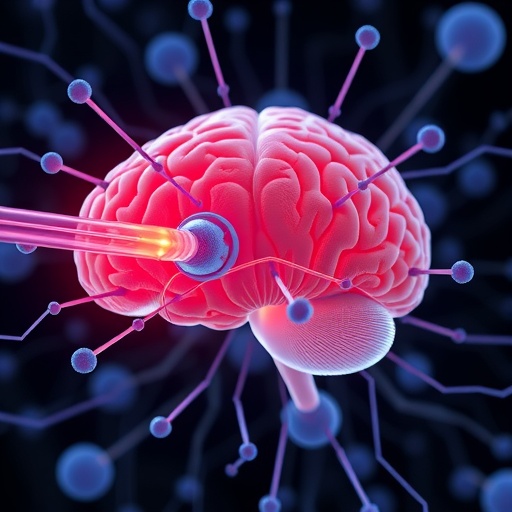
In a groundbreaking development that promises to revolutionize stroke therapy, researchers have engineered an innovative intranasal delivery system capable of bypassing the blood-brain barrier (BBB) to target mitochondria in brain cells affected by ischemic stroke. This pioneering approach employs a bioengineered nanolamellar system designed for sequential delivery, offering unprecedented therapeutic precision and enhanced efficacy in alleviating brain damage caused by stroke. The study, led by Yin, Li, Shu, and colleagues, represents a monumental leap in overcoming one of the most persistent challenges in neuropharmacology—the formidable blood-brain barrier.
The blood-brain barrier has long been a double-edged sword in neuroscience and drug delivery. While it protects the brain from potentially harmful substances, it simultaneously restricts most therapeutics from crossing into the brain parenchyma, particularly large molecules and advanced nanostructures. The innovation detailed in this study involves circumventing the BBB entirely by utilizing the intranasal route, allowing direct access to the central nervous system through the olfactory and trigeminal nerves. This method significantly reduces systemic exposure and leverages the natural anatomical pathways to facilitate rapid brain delivery.
Central to this breakthrough is the design of a nanolamellar structure engineered to sequentially release payloads directly into mitochondria—the powerhouses of the cell and pivotal players in ischemic stroke pathology. Mitochondrial dysfunction is a hallmark of ischemic injury, leading to energy failure and cell death. Targeting mitochondria presents a highly strategic therapeutic avenue, as the restoration of mitochondrial function can halt or reverse the cascade of neuronal damage initiated by stroke.
The nanolamellar system is bioengineered with exquisite precision, incorporating components that navigate the biological milieu of the brain’s extracellular matrix while preserving stability during passage from the nasal epithelium. This system is layered at the nanoscale, with each layer programmed to release therapeutic agents sequentially, facilitating a timed release that mirrors the pathophysiological progression of ischemic injury. This ensures drugs are delivered at the optimal timeframes for maximum neuroprotection and tissue repair.
Intranasal administration, the route chosen for this delivery system, circumvents enzymatic degradation and hepatic first-pass metabolism, common pitfalls in systemic drug delivery. It enables high bioavailability of therapeutic agents directly to the brain. The olfactory nerve pathways provide a direct conduit for nanolamellar particles to reach various brain regions, including the ischemic penumbra— the zone critical for neuroprotection and the potential rescue of neurons.
Technically, the nanolamellar system is fabricated through advanced bioengineering techniques combining lipid-based nanotechnology with mitochondrial targeting ligands. The researchers employed a modular design that integrates hydrophobic and hydrophilic regions, facilitating the encapsulation of diverse therapeutic molecules ranging from antioxidant enzymes to small molecular drugs. The surface of these lamellar structures is functionalized with mitochondria-penetrating peptides, improving mitochondrial membrane permeabilization and subsequent drug delivery within the targeted organelles.
Upon reaching the mitochondria, the controlled release mechanism triggers the sequential liberation of agents aimed at reducing oxidative stress, restoring bioenergetics, and preventing apoptotic signaling cascades. This multi-pronged approach is critical for halting the extensive neuronal death cascade that follows ischemic stroke events. Initial preclinical models demonstrated remarkable reduction in infarct size, improved neurological function, and marked preservation of neuronal morphology compared to conventional treatments.
The implications of this study extend beyond ischemic stroke. The intranasal nanolamellar carrier system presents a versatile platform that could be adapted for a broad spectrum of neurological disorders characterized by mitochondrial dysfunction, including neurodegenerative diseases like Alzheimer’s and Parkinson’s disease. This versatility positions the nanolamellar system as a paradigm shift in central nervous system drug delivery, marrying precision targeting with non-invasive administration.
Crucially, the safety profile of the nanolamellar system was thoroughly evaluated in animal models, revealing excellent biocompatibility and negligible inflammatory response within the nasal mucosa and brain tissues. These findings are vital, given that chronic inflammation can exacerbate neurodegenerative processes and undermine therapeutic efficacy. The bioengineered components are biodegradable, ensuring clearance without accumulation, a common issue with some nanoparticle-based therapies.
The sequential release strategy employed in this nanolamellar system takes inspiration from the complex temporal dynamics of ischemic brain injury. Unlike traditional single-dose therapies, this system administers therapeutics in stages, aligned with distinct phases of ischemic pathology—initial oxidative stress, mitochondrial depolarization, and later apoptotic signaling. This temporal precision offers a sophisticated therapeutic intervention, setting a new benchmark for neuroprotective treatments.
Another exciting facet of this research is the potential for personalized medicine applications. By modifying the nanolamellar layers or the targeting peptides, the system’s payload and release kinetics can be fine-tuned to individual patient profiles, stroke severity, or comorbid conditions. Such customization could revolutionize how stroke therapies are administered, moving away from a one-size-fits-all paradigm toward highly individualized regimens.
The scalability and manufacturability of the nanolamellar system also catch attention. The researchers outlined a reproducible production process amenable to large-scale manufacturing under Good Manufacturing Practice (GMP) standards. This aspect is crucial for translating laboratory success into clinical reality, overcoming common bottlenecks faced by nanomedicine technologies in commercial deployment.
In the broader context of stroke management, timely intervention remains the most critical determinant of patient outcomes. The intranasal nanolamellar delivery system’s rapid brain targeting can potentially extend the therapeutic window, a holy grail in stroke treatment. Early preclinical evidence suggests the system remains effective even when administered hours after ischemic onset, offering hope for patients who present late to medical facilities.
Moreover, this bioengineered system may synergize with current reperfusion therapies, such as thrombolysis or mechanical thrombectomy, by mitigating reperfusion injury—a significant source of additional neural damage following the restoration of blood flow. The ability to support mitochondrial health during this critical phase could enhance recovery and attenuate secondary injury mechanisms.
Looking forward, the translation to human clinical trials will necessitate addressing several challenges, including refining dosing strategies, optimizing delivery devices for consistent intranasal administration, and validating long-term safety and efficacy. Nonetheless, the foundation laid by Yin and colleagues creates a promising pipeline for next-generation stroke therapeutics, marrying cutting-edge bioengineering with translational neuroscience.
This pioneering research underscores the transformative potential of integrating nanotechnology, mitochondrial biology, and innovative delivery routes to tackle previously insurmountable neurological challenges. With ischemic stroke being a leading cause of death and disability worldwide, the global impact of such advances cannot be overstated. This study heralds a new era of targeted neurotherapeutics characterized by precision, efficacy, and patient-centric design.
As the neuroscience community eagerly anticipates further developments, this work serves as a powerful reminder of the critical importance of interdisciplinary approaches in medical innovation. The fusion of molecular engineering, pharmacology, and neuroanatomy demonstrated here exemplifies how fundamental scientific insights translate into therapeutic breakthroughs with the capacity to save millions of lives.
Subject of Research:
Intranasal delivery system to bypass the blood-brain barrier for targeted mitochondrial therapy in ischemic stroke.
Article Title:
Intranasal blood-brain barrier bypass enables sequential mitochondria-targeted bioengineered nanolamellar system for ischemic stroke therapy.
Article References:
Yin, Y., Li, Z., Shu, W. et al. Intranasal blood-brain barrier bypass enables sequential mitochondria-targeted bioengineered nanolamellar system for ischemic stroke therapy. Nat Commun (2026). https://doi.org/10.1038/s41467-025-68024-5
Image Credits:
AI Generated


