

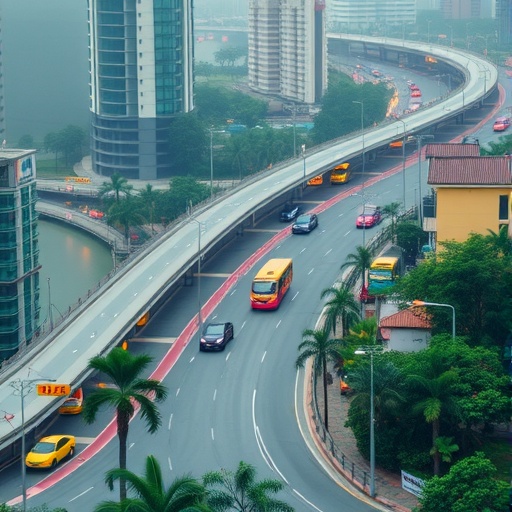
In a groundbreaking study that emerges from the rapidly transforming landscape of Guangdong Province, researchers have unveiled the intricate interplay between transportation infrastructure ecology and population dynamics. This comprehensive analysis is led by an eminent team comprising Yang, Kee, Xuan, and their colleagues, showcasing an unprecedented investigation into how the development of transport networks impacts environmental sustainability and urban population behaviors.
Guangdong Province, a key economic powerhouse in southern China, is known for its sprawling cities, vibrant economy, and burgeoning population. However, with rapid urbanization comes significant environmental and social challenges. The researchers have adeptly harnessed advanced modeling techniques to simulate the interactions between transport infrastructure and ecological parameters, yielding fascinating insights that resonate not only with local stakeholders but also with global urban development agendas.
At the heart of their investigation is the recognition that transportation systems serve as conduits for human activity and ecological processes. The researchers highlight the dual role that transportation can play; while it facilitates economic growth and urban connectivity, it can also disrupt local ecosystems and alter population structures. This paradox presents a pressing need to harmonize infrastructure development with ecological preservation to achieve a sustainable urban future.
The study employed data-driven methodologies, utilizing a robust array of datasets encompassing traffic patterns, wildlife habitats, and demographic distributions. By integrating these variables into their models, the researchers were able to elucidate how transportation infrastructure influences not only human mobility but also animal migration patterns and habitat viability. This level of detail presents a more nuanced understanding of the ecological impacts often overshadowed by economic considerations.
Interestingly, the research revealed that different types of transportation infrastructure, such as highways versus railways, exert disparate influences on ecological and demographic outcomes. For instance, high-density highways often pose greater barriers to wildlife movement, whereas railways might create micro-habitats along their corridors, fostering biodiversity. Understanding these distinctions is crucial for future urban planners who must navigate the complexities of advancing infrastructure while safeguarding ecological integrity.
As urban populations burgeon, the researchers underscored the importance of fostering human-nature coexistence. The synergy between transport systems and ecological health is pivotal for promoting sustainable living environments. The findings suggest that innovative transportation designs, such as green corridors and multi-modal transport options, can mitigate negative ecological impacts while enhancing urban living conditions.
The analysis within this study also points to the potential for community engagement in the design and planning of transportation infrastructure. Local populations can provide invaluable insights into ecological sensitivities and cultural values that should inform development projects. As cities embrace participatory planning approaches, it becomes essential to integrate scientific findings with public input to create inclusive solutions that benefit both people and the environment.
Moreover, demographic trends indicate a shifting population dynamic, with a noticeable migration toward urban centers. This urban migration raises critical questions about resource allocation and environmental strain. The researchers emphasize that by anticipating changes in population density and associated transportation demands, planners can implement proactive strategies to enhance resilience in urban and rural settings alike.
In light of climate change and increasing environmental degradation, the study also delves into the implications of adaptive transport infrastructure. Climate-resilient design can bolster urban areas against the impacts of extreme weather events, which are becoming increasingly frequent due to global warming. By investing in sustainable transport modalities, cities can not only adapt to these challenges but also contribute to broader climate mitigation efforts.
The authors contend that this research lays the groundwork for future studies aimed at exploring additional dimensions of transport ecology and population dynamics. They advocate for continued interdisciplinary collaboration among ecologists, urban planners, and transport engineers to advance a holistic understanding of the interconnections at play. By fostering such collaborations, the potential for innovative solutions to emerge increases exponentially, paving the way for progressive urban management practices.
As policymakers assess infrastructure investments, the study’s findings can serve as a guide to prioritize projects that align with sustainability goals. Moreover, it encourages governments and organizations to invest in research and development of smart transportation technologies that can optimize traffic flows, reduce emissions, and enhance overall urban livability. The ambition should not merely be economic efficiency but also an ecological and social responsibility.
In conclusion, Yang, Kee, and Xuan’s pioneering work on the synergistic evolution of transportation infrastructure and population dynamics offers vital insights for shaping the future of urban ecosystems. As global populations continue to urbanize, the lessons learned from Guangdong Province can inform other regions grappling with similar challenges. The imperative to balance human expansion with ecological stewardship underscores the necessity for innovative research and thoughtful planning in a rapidly changing world.
To truly harness the potential of urban transport systems, stakeholders must commit to an integrated approach that champions sustainability and biodiversity. The future of urban living hinges on our ability to see beyond mere infrastructural expansion and embrace a vision where transportation, ecology, and community dynamics coexist in harmony. This research paints a hopeful picture, suggesting that with informed decision-making, vibrant and sustainable urban futures are within our reach.
Subject of Research: Interrelationship between transport infrastructure and population dynamics in Guangdong Province.
Article Title: Synergistic evolution of transport infrastructure ecology and population dynamics in Guangdong Province.
Article References:
Yang, J., Kee, T., Xuan, Z. et al. Synergistic evolution of transport infrastructure ecology and population dynamics in Guangdong Province.
Discov Sustain (2026). https://doi.org/10.1007/s43621-026-02626-x
Image Credits: AI Generated
DOI: 10.1007/s43621-026-02626-x
Keywords: Transportation infrastructure, ecology, population dynamics, Guangdong Province, sustainable urban planning, climate resilience, urban migration, community engagement.


