

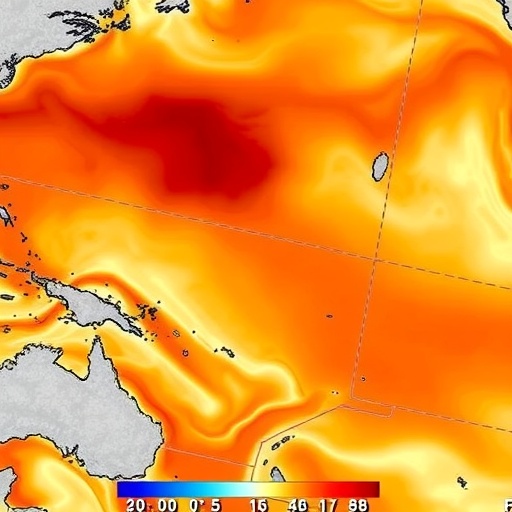
Title: Tropical Atlantic Sea Surface Temperature Intensification: A Catalyst for Enhanced Pacific Cooling
Recent advances in oceanography have unveiled a complex interplay between tropical Atlantic sea surface temperature (SST) patterns and Pacific Ocean temperature fluctuations. A groundbreaking study led by renowned climatologists J. Xu, T. Tozuka, and J.J. Luo, titled “Intensified Annual Cycle of Tropical Atlantic Sea Surface Temperature Regulates Pacific Cooling,” sheds light on the ocean’s influence on global climate systems. This research, set for publication in the journal “Commun Earth Environ” in 2026, promises to reshape our understanding of climate dynamics, adding critical insight into the mechanisms driving temperature variation across oceans.
The tropical Atlantic region has long been recognized for its significant role in global climate regulation. Recent findings indicate that the annual cycle of SST in this area has intensified, leading to more pronounced temperature variations. This intensified cycle can be attributed to several interconnected factors, including climate change dynamics, ocean currents, and atmospheric interactions. The researchers meticulously traced these connections, revealing that disruptions in one ocean can cascade into distant regions, affecting climate patterns elsewhere, particularly in the Pacific Ocean.
Understanding the mechanisms involved in the intensified annual cycle of tropical Atlantic SST is paramount. The study highlights the dual role of increased SST in the Atlantic as both a direct influencer of local weather patterns and an indirect regulator of oceanic systems far beyond its geographical confines. Warmer waters in the tropical Atlantic result in enhanced evaporation rates, subsequently impacting atmospheric moisture and pressure systems. This transformation can lead to altered precipitation patterns across the Pacific, instigating a cooling effect in the region.
Delving deeper into the mechanisms of this cooling effect, the authors employed advanced climate modeling techniques to simulate various scenarios where Atlantic SSTs fluctuated. The outcomes revealed a critical threshold; if SSTs in the Atlantic rise above a certain point, they can trigger significant cooling in the Pacific. This occurred due to the offshore movement of warm ocean waters in response to altered atmospheric currents and upwelling, which brings cold, nutrient-rich waters to the surface.
Furthermore, the findings of the study suggest that this intensified SST cycle is not merely a localized phenomenon. The researchers noted a recursive feedback loop, where the effects of Atlantic temperature rises can reverberate back into the Atlantic, exacerbating the annual cycle further ahead. This cycle raises pressing questions about the long-term sustainability of current oceanic thermal patterns and the potential for feedback mechanisms to alter fundamental climate processes.
Evidence of Pacific cooling linked to abrupt changes in the tropical Atlantic highlights an urgent need for ongoing monitoring. The implications of this relationship extend to ecosystems reliant on stable ocean temperatures, including coral reefs and fisheries. As Pacific cooling progresses, it may disrupt nutrient dynamics, affecting marine biodiversity and the livelihoods of communities dependent on fishing. This underscores the importance of understanding transoceanic interactions in the context of climate change.
Climate data sets from various global monitoring systems were utilized to substantiate the research findings, ensuring a robust analysis. The team found correlations between historical SST anomalies in the Atlantic and subsequent cooling trends in the Pacific, employing statistical methods to reinforce their conclusions. Together, these investigations establish a pressing need for further research on tropical Atlantic influences on global oceanic currents.
The results bolster an emerging consensus among climatologists that interconnected ocean systems cannot be studied in isolation. The research provides a framework for understanding how oceanic temperature changes are intricately linked and highlights the potential for larger climate disruptions. It makes clear that as we grapple with an increasingly warming world, the interactions between oceans demand more attention from all corners of the scientific community.
The broader consequences of intensified SST cycles reach beyond ocean health to touch on global climate patterns, including the regulation of heat distribution across the Earth. An increase in the strength of heating in one area cannot be viewed in a vacuum. With large-scale phenomena like El Niño and La Niña fundamentally altered by changes in Atlantic temperatures, this research sheds light on complexities that could lead to unprecedented weather scenarios.
Educating policymakers about these oceanic interconnections is essential as we navigate climate change. The study advocates for a multi-faceted approach to climate action that considers transoceanic relationships and emphasizes the need for policies that mitigate the effects of changes in SST patterns before they cascade into broader ecological crises.
As the field of climate science continues to unfold, studies like these serve as vital touchpoints for understanding the ocean’s role in climate regulation. Continuous refinement of data collection and analysis will be needed to unravel the implications of these interactions further. Without proactive measures and responsive governance, we run the risk of experiencing more extreme weather events driven by these complex oceanic relationships.
In closing, Xu, Tozuka, and Luo’s research on the intensified annual cycle of tropical Atlantic sea surface temperatures provides crucial insights into the interconnected nature of global climate systems. The findings underscore the pressing need for continued research into these dynamics, urging the scientific community to remain vigilant and responsive to the ongoing challenges posed by climate change. With their work, they pave the way for future studies aimed at understanding climate interactions on a global scale, solidifying the vital link between ocean temperatures and climate complexities.
Subject of Research: The impact of intensified tropical Atlantic sea surface temperature on Pacific cooling.
Article Title: Intensified Annual Cycle of Tropical Atlantic Sea Surface Temperature Regulates Pacific Cooling.
Article References:
Xu, J., Tozuka, T. & Luo, JJ. Intensified annual cycle of tropical Atlantic sea surface temperature regulates Pacific cooling.
Commun Earth Environ (2026). https://doi.org/10.1038/s43247-025-03168-2
Image Credits: AI Generated
DOI:
Keywords: Tropical Atlantic, Sea Surface Temperature, Pacific Cooling, Climate Dynamics, Climate Change.


