

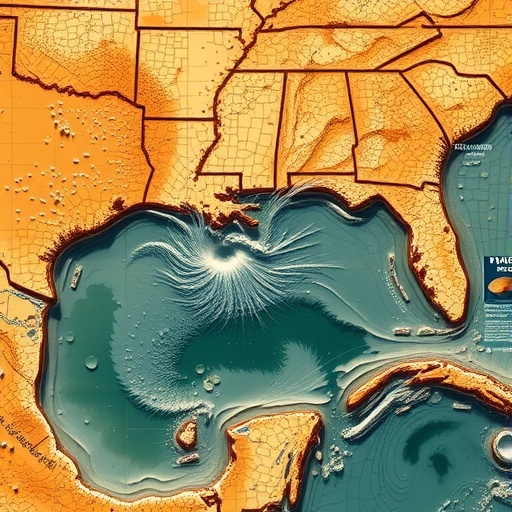
A severe and prolonged drought that gripped the United States in the late 1980s played a pivotal role in triggering one of the most substantial fisheries collapses ever documented in the Gulf of Mexico. This finding emerges from groundbreaking research recently published in the prestigious journal Nature Communications, led by a team from the University of Haifa and the University of Miami’s Rosenstiel School of Marine, Atmospheric, and Earth Science. Their study delves deep into the intricate interplay between terrestrial climate extremes and marine ecosystem productivity, overturning the conventional notion that fishing pressure alone accounts for the decline in fish populations.
At the heart of this ecological cascade lies the Mississippi River, a critical artery delivering nutrients into the Gulf of Mexico. The drought drastically reduced the river’s discharge, leading to a marked decrease in nutrient inflow to coastal waters. This nutrient deficit stifled phytoplankton growth, the foundational producers in marine food webs. When primary productivity falters at such a basal level, the entire trophic pyramid above it is destabilized. The researchers discerned that the diminished river flow compromised the food web’s base, resulting in cascading impacts that significantly diminished fish biomass and fishery yields throughout the region.
Quantitatively, the devastation is stark. The team documented an approximate 42% reduction in total fish biomass following the drought period. Equally alarming was a 34% decline in fisheries catch, signaling direct economic and ecological ramifications. This widespread collapse was pervasive, affecting nearly 90% of the species groups identified in the comprehensive Gulf ecosystem assessment. Such precipitous declines highlight the vulnerability of marine systems to terrestrial climatic anomalies and emphasize the interconnectedness of land and sea.
One species profoundly affected by these changes was the Gulf menhaden (Brevoortia patronus), a forage fish of pivotal importance. Menhaden constitute the backbone of the Gulf’s largest fishery, both in terms of landings and their essential role in supporting predator species including mackerel, tuna, shark species, marine mammals, and seabirds. The decline in menhaden populations sent shockwaves through the food web, diminishing the abundance of their predators and disrupting commercially valuable fisheries dependent on these trophic relationships.
The research further underscores climate change as a paramount driver exacerbating these vulnerabilities. With climate models projecting increased frequency and intensity of drought events, the risk to fisheries and associated coastal economies is poised to escalate. Utilizing a sophisticated ecosystem model spanning the Gulf, the researchers projected that if high greenhouse gas emissions continue unabated, coupled with persistent drought conditions, fisheries biomass could plummet by nearly 60% by mid-century and potentially exceed a 70% decline by the century’s end. These projections paint a grim future for marine food security in the region.
This study represents a paradigm shift in understanding fisheries collapse causality by emphasizing the significant role that terrestrial climate extremes play alongside anthropogenic fishing pressures. By linking drought-driven reductions in riverine nutrient delivery to declines in marine productivity, it places renewed importance on integrated ecosystem management that accounts for cross-ecosystem linkages and the multifaceted impacts of climate variability.
Effective management of fisheries in the Gulf of Mexico’s changing climate must move beyond traditional regulation of fishing effort alone. Adaptive strategies are urgently needed to anticipate and mitigate the consequences of fluctuating river flows, nutrient inputs, and shifts in primary productivity. This holistic approach will be vital to sustaining fisheries production and securing economic livelihoods tied to seafood in the face of escalating climate impacts.
The Gulf of Mexico supports some of the United States’ most productive and economically significant fisheries, serving both domestic markets and international demand. The ongoing declines threaten not only biodiversity but also the stability of food supply chains and regional economies heavily reliant on marine harvests. Recognizing the interdependency of terrestrial climatic phenomena and marine ecosystem health is crucial for devising more resilient fisheries policies.
This comprehensive research effort was conducted by an interdisciplinary team including Igal Berenshtein, head of the Marine Ecology and Ocean Health Laboratory at the University of Haifa, Ben Kirtman, a distinguished climate scientist and dean at the University of Miami Rosenstiel School, Kim de Mutsert from the University of Southern Mississippi’s Division of Coastal Sciences, and David D. Chagaris at the University of Florida’s Nature Coast Biological Station. Their collaboration leveraged extensive data analysis and Gulf-wide ecosystem modeling to elucidate complex environmental interactions and forecast future risks.
Funding for this transformative study was provided by the RESTORE grant (NA17NOS4510098) and supported by the Gulf Research Program of the National Academies of Sciences, Engineering, and Medicine through award number 10000883. Such support underscores the scientific and societal priority to understand and mitigate the far-reaching impacts of climate-driven environmental changes on vital marine resources.
This research highlights the necessity for incorporating climatic variability into future fisheries management frameworks and environmental policy, as the traditional focus on direct human impacts like overfishing may substantially underestimate the broader ecosystem vulnerabilities driven by climate extremes. As droughts and other weather anomalies become more intense and frequent, integrated oceanographic and meteorological monitoring, alongside adaptive governance, will be imperative to safeguard the long-term sustainability of the Gulf’s fisheries and marine biodiversity.
Subject of Research: Animals
Article Title: Historical depletion and future drought-driven risks to Gulf of Mexico fisheries production
News Publication Date: 9-Feb-2026
Web References:
https://www.nature.com/articles/s41467-026-69116-6#Sec15
References:
Berenshtein, I., Kirtman, B., de Mutsert, K., & Chagaris, D. D. (2026). Historical depletion and future drought-driven risks to Gulf of Mexico fisheries production. Nature Communications.
Image Credits: NOAA
Keywords: Fisheries management, Fisheries, Climate change, Droughts


