

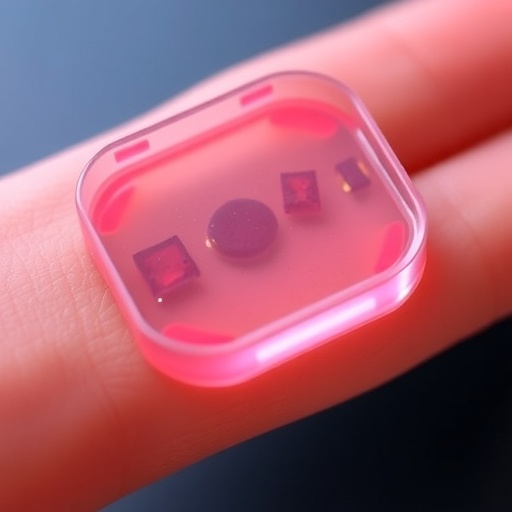
In the ever-evolving domain of healthcare technology, flexible electronics have emerged as a transformative force, ushering in new avenues for monitoring physiological signals with unprecedented precision. The hallmark of these systems lies in their capacity to integrate seamlessly with the human skin, creating interfaces that must balance a delicate duality—exhibiting robust adhesion to capture high-fidelity data, yet permitting gentle detachment to safeguard vulnerable tissues. This intricate balance is especially pronounced in postoperative free flap monitoring, a clinical arena where timely and accurate detection of vascular complications such as venous congestion, arterial spasm, and occlusion is critical to the survival of transplanted tissue.
Traditional methods of free flap monitoring, despite their clinical utility, are frequently hamstrung by significant limitations. High financial costs, cumbersome wired configurations, and lack of portability impede widespread adoption in fast-paced clinical settings. Moreover, the complexity of interpreting monitoring data, coupled with the challenge of distinguishing arterial from venous complications, undermines diagnostic accuracy and reproducibility. Flexible electronics present a promising antidote to these challenges, yet the technological frontier remains strewn with hurdles—the interface materials struggle to meet clinical demands for strong adherence during monitoring and minimal adhesion during removal to preclude further tissue trauma.
Addressing this exigent need, a pioneering research collective has innovated a soft biosensor equipped with a printable, thermoresponsive hydrogel interface tailored for precise and differentiated detection of blood circulation complications in postoperative free flaps. The core innovation centers on a hydrogel formulation whose adhesion properties are tunable, enabling dynamic control over the interface’s interaction with the skin. This interface layer not only ensures intimate contact during signal acquisition, thus minimizing noise and signal loss, but also facilitates a benign detachment process that significantly reduces the risk of skin and wound damage, a crucial consideration given the fragility of flap tissues.
The hydrogel interface’s printability marks a notable advance in flexible electronics manufacturing. By meticulously tuning the rheological properties of the hydrogel inks, the team achieved direct ink writing with exceptional precision, boasting line widths below 720 micrometers and patterning capabilities that require under 30 seconds. This rapid, customizable fabrication is paramount for tailoring biosensor geometries to diverse clinical scenarios and anatomical variances. The advanced chemical architecture of the hydrogel integrates thermoresponsive monomers alongside adhesive functional groups, thereby delivering a robust initial adhesion strength of 27.8 kPa and an extensive adhesion modulation range spanning over tenfold. This synergy between chemical composition and mechanical performance epitomizes the integration of material science principles with biomedical engineering.
Functionally, the flexible hydrogel biosensor is designed to monitor vital indicators—specifically reflective infrared photoplethysmography (PPG) signals and thermal data—directly from the surface of free flaps. The clinical implementation demonstrated not only the sensor’s ability to couple intimately with flap skin but also its capacity for gentle removal without compromising tissue integrity. This dual capability represents a substantive improvement over existing monitoring systems, which often necessitate trade-offs between measurement fidelity and tissue safety.
A major breakthrough yielded by this research is the introduction of a novel diagnostic metric termed the “balance index,” derived from the morphological analysis of PPG waveforms. The balance index quantitatively identifies venous congestion, enabling early and differentiated detection of vascular complications that are notoriously difficult to discern in clinical practice. Pilot clinical studies substantiate the hydrogel biosensor’s efficacy, showcasing its precision in delineating arterial versus venous issues—an invaluable diagnostic feature that surpasses the binary assessments offered by conventional methods.
Beyond diagnostic accuracy, the hydrogel biosensor’s design–wireless, low-cost, and mechanically benign—addresses pressing logistical and patient comfort concerns prevalent in current monitoring paradigms. Compared to commercial microcirculation monitoring systems, this technology markedly reduces the risk of mechanical damage and facilitates easier use in various clinical environments, including outpatient settings and remote monitoring applications.
The implications of this technology extend far beyond free flap surgery. The printable, thermoresponsive hydrogel interface stands as a versatile and universal platform for flexible electronics in healthcare, promising widespread adoption across myriad biosensing modalities. By leveraging the tunable adhesion and rapid customization features of the hydrogel, future devices can achieve unprecedented conformity and patient-specific adaptability, transforming biosensing into a truly personalized practice.
From a materials science perspective, the integration of thermoresponsive monomers imparts a temperature-dependent switchability to the hydrogel’s adhesion, opening pathways for dynamically controlled interfaces that respond to the body’s microenvironment. This strategy elegantly sidesteps the limitations of conventional adhesives, which often suffer from persistent stickiness or insufficient bonding strength, thereby bridging a crucial gap in interface engineering.
Moreover, the hydrogel’s chemically tunable properties enable precise modulation of its viscoelastic characteristics, optimizing both sensor performance and wearer comfort. Such advancements underscore the importance of interdisciplinary approaches that amalgamate polymer chemistry, tissue mechanics, and electronic engineering to realize next-generation healthcare devices.
As flexible electronics inch increasingly toward clinical translation, this study’s findings spotlight the quintessential role of intelligent interface design in surmounting existing barriers. The harmonization of superior adhesion in active monitoring phases with facile, damage-free detachment exemplifies a paradigm shift, setting a new benchmark for patient-centric biosensing technologies.
In conclusion, the development of a printable, thermoresponsive hydrogel interface integrated within a flexible biosensor platform heralds a new epoch in blood circulation monitoring for postoperative free flaps and beyond. By marrying sophisticated material engineering with clinical pragmatism, this technology promises to enhance patient outcomes, streamline clinical workflows, and catalyze the proliferation of portable, wireless health monitoring systems worldwide.
Subject of Research: Flexible electronics and hydrogel interfaces for postoperative blood circulation monitoring.
Article Title: Printable Thermoresponsive Hydrogel Biosensors for Precise Blood Circulation Monitoring in Postoperative Free Flaps.
Web References: 10.1093/nsr/nwag058
Keywords
Flexible electronics, biosensors, hydrogel interfaces, free flap monitoring, photoplethysmography, blood circulation complications, thermoresponsive hydrogels, adhesion tuning, wearable health devices, wireless biosensing, polymer chemistry, tissue-engineered interfaces


