

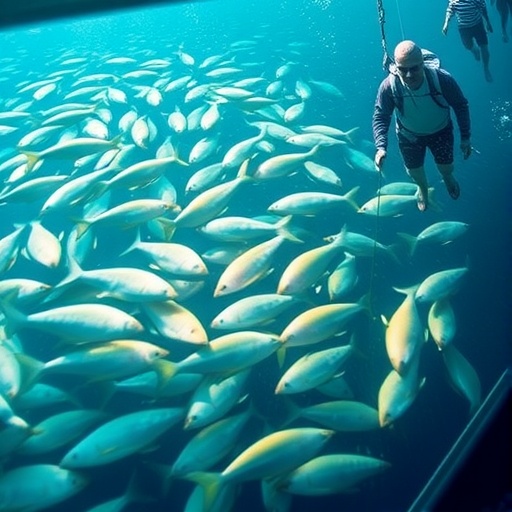
In recent years, aquaculture has surged as a critical solution to meeting the escalating global demand for food. The farming of aquatic organisms, including fish, shrimp, and other marine species, has blossomed into a multi-billion-dollar industry producing over 94 million tons of seafood annually as of 2022. Despite this impressive scale, the sector faces formidable challenges, especially during the early developmental stages of aquatic animals. High mortality rates, caused by disease outbreaks, environmental fluctuations, and stress-induced vulnerabilities, continue to curb productivity and limit the industry’s full potential.
Addressing these persistent bottlenecks, researchers at the Okinawa Institute of Science and Technology (OIST) have engineered an innovative, scalable aquaculture platform designed specifically to revolutionize early life phase management in aquatic farming. This pioneering system automates critical processes such as hatching and post-hatchling transfers, which are traditionally manual and laden with risks. Through automation, the OIST team aims to minimize pathogen exposure and handling-induced stress, while also significantly reducing labor requirements and operational costs.
Originally developed to support difficult cephalopod research at OIST, the system’s robust design has demonstrated remarkable versatility. Cephalopods like squid and octopus are notoriously fragile during their hatchling phases, with extreme sensitivity to manual manipulation posing a significant threat to survival. Dr. Zdenek Lajbner, leader of the project, explains that leveraging light and water flow to gently guide these hatchlings offers a game-changing method to improve survival rates and reduce animal stress simultaneously.
The development team, which includes researchers such as Ryuta Nakajima, Mehmet Arif Zoral, Peter Babiak, John Parker, Mouez Lassoued, and Jonathan Miller, first validated the efficacy of this modular prototype across multiple cephalopod species. It became rapidly apparent that the core principle—autonomous movement guided by optofluidic stimuli—also applies broadly to other aquatic species like fish and shrimp. This cross-species applicability dramatically increases the potential impact of the technology within the aquaculture sector.
The innovative system runs on the fundamental idea of substituting direct physical handling with automated sensory cues that encourage natural, autonomous animal movement. By integrating light gradients and carefully controlled water currents, hatchlings and juvenile aquatic animals can be coaxed through transport and sorting systems with minimal physical stress. This strategy not only enhances welfare outcomes but also improves the reliability and precision of routine operations.
Another key component of the system is its IoT-enabled sensor network that continuously monitors environmental parameters critical to aquatic health, including temperature, salinity, and dissolved oxygen levels. These sensors provide real-time feedback, enabling remote monitoring and instant alerts in the event of adverse conditions. The constant flow of data allows for dynamic adjustments and ensures optimal rearing environments that support better survival and growth.
The platform’s modular architecture has been carefully engineered for adaptability, allowing it to be retrofitted into existing aquaculture facilities, operate as autonomous recirculating units, or function as mobile systems suitable for diverse farming contexts. This flexibility addresses a major hurdle facing aquaculture technology adoption—compatibility with varying infrastructure and operational scales.
Incorporating advanced artificial intelligence capabilities further propels the platform’s transformative potential. Automated counting, size-based sorting, and behavioral monitoring provide robust tools for early-stage stock assessment and health evaluations. Machine learning algorithms analyze behavioral indicators and physical characteristics, enabling objective and rapid determinations of stock quality, which were previously reliant on time-consuming, subjective human observations.
This standardization of early-life stage handling and monitoring offers a vital pathway toward increased efficiency and sustainability in aquaculture. By moving away from labor-intensive manual methods toward fast, precise, and data-driven decision-making, farmers can optimize output while enhancing animal welfare. This shift promises to produce substantial gains in both economic terms and ecological impact.
Animal stress during hatchling manipulation and transfer has long been recognized as a significant factor contributing to elevated mortality rates and reduced subsequent growth performance. Operational improvements that boost early survival rates, even modestly, ripple through the production cycle, resulting in exponential increases in yield and profitability. Furthermore, reducing mortality lowers wasted feed inputs, labor demands, and tank downtime, delivering compelling benefits to farm scalability.
Dr. Lajbner emphasizes the urgency of scalable aquaculture innovations amid a backdrop of intensifying wild fisheries depletion and climate change pressures. Global aquatic food consumption has soared over 480% since the 1960s, intensifying the need for sustainable intensification of marine farming. He estimates that achieving a 15 to 25 percent increase in early stage survival could dramatically enhance effective production volumes on commercial farm scales.
The OIST team is actively seeking partnerships with industrial hatcheries to validate and refine this platform under commercial conditions. Their goal is to expand species testing beyond cephalopods and fish and to scale the system for deployment in large-scale aquaculture operations worldwide. This collaborative approach aims to bridge the gap between academic innovation and practical industry implementation.
Ultimately, the automated light and flow-guided aquaculture system represents a landmark advancement in the precision and scalability of aquatic farming technologies. By harmonizing biological sensitivity with cutting-edge automation, sensor networks, and AI, it paves the way toward a more sustainable, efficient, and humane future for global aquaculture.
Subject of Research: Animals
Article Title: Automated Light and Flow-Guided Aquaculture Platform Enhances Early Life Survival and Welfare in Aquatic Farming
News Publication Date: 2024
Web References: https://openknowledge.fao.org/items/fc009d49-a649-4b30-bf93-f88787d78402
References:
- Food and Agriculture Organization of the United Nations (FAO), The State of World Fisheries and Aquaculture 2024
- Chary K, Brigolin D, Callier MD (2022) Farmscale models in fish aquaculture–An overview of methods and applications. Reviews in Aquaculture 14(4):2122-57.
Image Credits: Andrew Scott/OIST
Keywords: Aquaculture, Fisheries, Fisheries management, Agriculture, Cephalopods, Crustaceans, Aquatic animals, Livestock


