

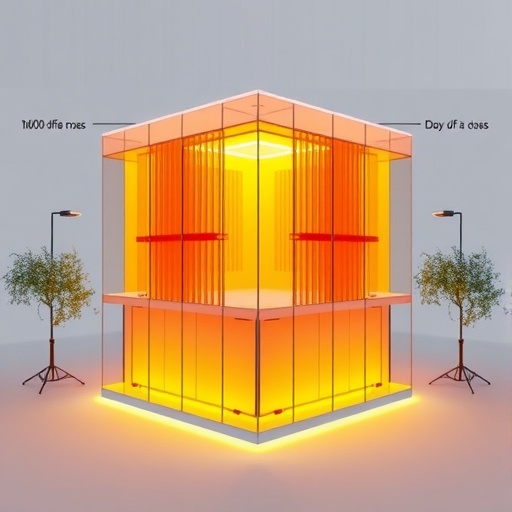
In the quest for more energy-efficient buildings, researchers continually seek innovative materials and systems that can reduce energy consumption without compromising occupant comfort. A recent breakthrough from a team of Chinese scientists introduces a phase-change thermal diode that promises to revolutionize passive climate control for dynamic building envelopes. This novel system leverages cutting-edge material science to enable directional heat transfer, significantly reducing the need for mechanical cooling and heating across a variety of climates.
The phase-change thermal diode operates on the principle of unidirectional heat flux control, a concept that has been explored but remains difficult to implement effectively in real-world building applications. By integrating phase-change materials (PCMs) with thermally asymmetric structures, the researchers have designed a device that preferentially allows heat to flow in one direction while substantially impeding it in the opposite direction. This behavior is akin to an electrical diode but applied to heat, which is traditionally challenging to control without active systems.
One of the key advances of this thermal diode lies in its use of optimized hydrophobic surfaces. These surfaces reduce adhesion forces and facilitate the phase-change process by altering nucleation and growth dynamics of the enclosed liquid or vapor. When coupled with a vacuum environment inside the diode’s construction, this results in dramatically improved thermal rectification—the ratio of forward to reverse heat flow—compared to conventional materials or structures.
The vacuum setting inside the thermal diode plays a crucial role in mitigating heat conduction through air and other gases, supporting a more efficient and controlled phase-change process. This environment heightens the temperature gradient across the PCM interface, creating more pronounced thermal rectification. Such an approach is meticulously adaptive to diverse external weather conditions, making the thermal diode highly suitable for deployment in various climate zones.
Extensive simulations complemented by experimental validation demonstrate that this phase-change thermal diode system can reduce cooling energy consumption by between approximately 12% and 21% in buildings across China’s different climatic regions. This performance breakthrough indicates its potential for considerable energy savings, which could have a profound impact on large-scale building energy consumption worldwide if widely adopted.
Beyond reducing operational energy demands, the device is remarkably simple to manufacture. The materials and fabrication methods employed are scalable and compatible with current construction practices, potentially lowering barriers to adoption. This simplicity stands in contrast to many other advanced thermal management technologies, which often require complex and costly installation or maintenance procedures.
Its adaptability is another compelling feature. The thermal diode can be integrated into dynamic building envelopes, which are architectural systems designed to respond actively or passively to environmental changes. By enabling passive control of heat flow direction, the device enhances the responsiveness of building façades without electric input or moving parts, fitting seamlessly into smart building design paradigms aimed at sustainability and occupant comfort.
Furthermore, the innovation demonstrates an elegant synergy between fundamental materials science and applied building technology. It exemplifies how interdisciplinary research can lead to tangible advancements in green architecture, improving energy efficiency while addressing the increasing demands for climate resilience and indoor environmental quality.
As buildings account for a substantial proportion of global energy use and carbon emissions, technological breakthroughs like this phase-change thermal diode offer much-needed pathways to achieve net-zero energy buildings. The integration of passive thermal management systems reduces reliance on HVAC systems, which are traditionally energy-intensive and subject to maintenance challenges.
In the broader context of sustainable urban development, passively controlled building envelopes equipped with such thermal diodes could transform how energy flows within cities, contributing to reduced urban heat islands and lowering peak electricity loads on power grids. The ripple effects of these innovations extend beyond individual buildings, fostering more resilient and energy-secure communities.
Looking ahead, further research is warranted to explore the long-term durability of the materials under varied environmental stresses and to optimize system configurations for different building types and geographic locations. However, the foundational work completed by the Chinese team provides a promising template for next-generation energy-saving technologies in architecture.
In summary, the development of a phase-change thermal diode with hydrophobic surfaces and vacuum settings marks a significant stride toward smarter, greener buildings. By enabling unidirectional heat transfer with high rectification efficiency and straightforward manufacturability, it paves the way for passive, energy-saving dynamic building envelopes that can perform effectively across diverse climates. This advancement not only holds promise for substantial cooling energy reductions in China but also sets a compelling precedent for global efforts to revolutionize building energy efficiency.
Subject of Research: Phase-change thermal diode for passive building envelope energy savings
Article Title: New Phase-Change Thermal Diode Revolutionizes Passive Energy Management in Buildings
News Publication Date: 2024-06-12
Web References: Not provided
References: Not provided
Image Credits: Not provided
Keywords
Phase-change materials, thermal diode, unidirectional heat transfer, building energy efficiency, hydrophobic surfaces, vacuum insulation, cooling energy reduction, passive building envelope, dynamic façade, sustainable architecture


