

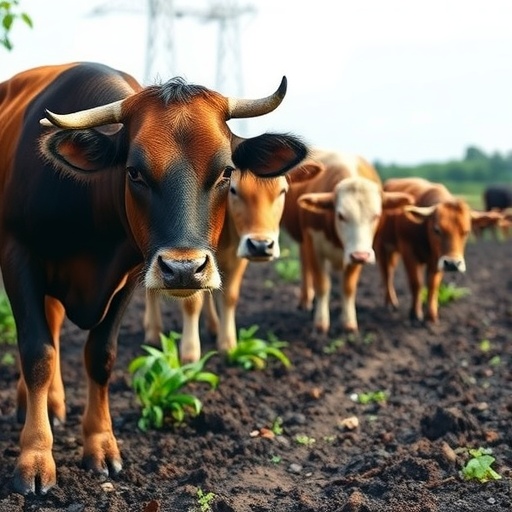
A groundbreaking study has revealed that biochar, a carbon-rich material fed to dairy cows, largely endures the entire digestive process, maintaining its remarkable chemical stability. This discovery heralds a promising new avenue for integrating livestock management with climate change mitigation strategies. By surviving digestion and passing into manure, biochar can potentially serve as a long-term carbon sink when applied to agricultural fields, thereby holding substantial promise for sustainable farming and environmental conservation alike.
Biochar, produced through pyrolysis—a process of heating biomass such as wood or crop residues in a low-oxygen environment—is celebrated for its porous structure and high carbon content. These properties not only improve soil fertility but also stabilize carbon for extended periods, preventing its rapid release as carbon dioxide. Until now, research about the fate of biochar consumed by animals remained sparse, leaving questions about its integrity post-digestion and its ultimate impact on carbon cycling unanswered.
In this recent experimental study published in the journal Biochar, scientists meticulously tracked biochar through the digestive pathways of dairy cows. Employing sophisticated analytical techniques, including chemical oxidation and spectral analysis, the researchers quantified the fraction of biochar recovered in fecal matter and examined any alterations in its molecular composition. Their findings were striking: between 70 and 90 percent of ingested biochar was recoverable, with its core chemical structures—particularly condensed aromatic carbon rings known for resisting microbial degradation—remaining intact.
This selective preservation of the most chemically robust biochar components during digestion is particularly significant. It implies that the biochar excreted in manure retains the volatility and resistance required for prolonged stability once integrated into soils. Such persistence is a vital criterion for effective carbon sequestration, as it minimizes re-emission of greenhouse gases and offers a durable sink within agricultural landscapes. This durability also underscores the potential for biochar to outlast the short-term cycling typical of organic matter in soil ecosystems.
Moreover, this study sheds light on an intriguing dual benefit of biochar use in livestock systems: while enhancing soil carbon storage, it concurrently offers ancillary environmental advantages. Biochar mixed within manure could act as a stabilizing agent for nutrients, reducing the volatilization of nitrogen compounds like ammonia—a notorious agricultural pollutant—and lowering methane emissions from manure, which are potent contributors to climate warming. These ecosystem services could substantially reduce the carbon and nitrogen footprints of livestock production.
Beyond environmental implications, the influence of biochar on soil health further underscores its agricultural value. When applied to fields via manure, biochar’s porous matrix can improve soil structure by enhancing water retention and nutrient holding capacity. This not only fosters better crop growth but also aids in soil resilience under climatic extremes, enabling more sustainable farming practices. Researchers speculate that this combination of benefits will make biochar a crucial component in future integrated farm-management systems.
To validate their chemical quantification, the researchers compared multiple measurement techniques, confirming that chemical oxidation methods yielded the most precise and reproducible estimates of biochar content in dung samples. This methodological rigor establishes a reliable benchmark for future studies aiming to unravel the complex interactions between feed additives, animal digestion, and soil carbon dynamics, thereby advancing the field of agroecology.
However, the research team cautions that the performance of feed-biochar is contingent upon the initial quality and composition of the biochar material. Different feedstock origins, pyrolysis temperatures, and resulting physicochemical characteristics could all influence digestion retention and subsequent soil impacts. Hence, further longitudinal field studies evaluating a diversity of biochars and their effects on animal health, nutrient cycling, and ecosystem services remain a critical next step.
This pioneering work opens a novel conceptual framework for designing integrated livestock feeding strategies that contribute holistically to climate mitigation. By harnessing the synergistic potential of biochar to improve animal guts, reduce emissions, and enhance soil carbon storage, it positions agriculture not merely as a source of emissions but as a vital player in planetary stewardship, potentially transforming farming systems into active climate solutions.
The ramifications of this study extend beyond the realm of agricultural science: they touch on global efforts to reconcile food security with ecological balance. In a world grappling with escalating greenhouse gas concentrations, innovations such as feed-integrated biochar illustrate how interdisciplinary research can generate unexpected yet scalable solutions for the climate crisis. If broadly adopted, such practices might transform livestock farming from a climate challenge into part of the solution.
Importantly, these findings prompt a reevaluation of manure management practices. Traditional agricultural systems often overlook the carbon sequestration potential inherent in animal wastes. By integrating biochar feed additives and optimizing manure application methodologies, farmers can enhance the carbon storage function of soils, contributing to regional carbon budgets and soil health simultaneously. This represents a paradigm shift in sustainable agricultural intensification.
As the study concludes, the convergence of animal nutrition and soil science in this research not only deepens our understanding of biochar’s ecological roles but also exemplifies how complex biological systems can be leveraged for environmental gain. With further refinement and field validation, biochar feeding strategies could become a cornerstone technique in achieving net-zero emissions targets within the livestock sector, underscoring the promise of innovative biogeochemical interventions.
Subject of Research: Not applicable
Article Title: Recovery and composition of biochar after feeding to cattle
News Publication Date: 17-Jan-2026
Web References: http://dx.doi.org/10.1007/s42773-025-00507-6
References: Walz, I.L., Dittmann, M. & Leifeld, J. Recovery and composition of biochar after feeding to cattle. Biochar 8, 13 (2026).
Image Credits: Iva Lucill Walz, Marie Dittmann & Jens Leifeld
Keywords: Agriculture, Refuse derived fuels, Herbivores, Organic farming


