

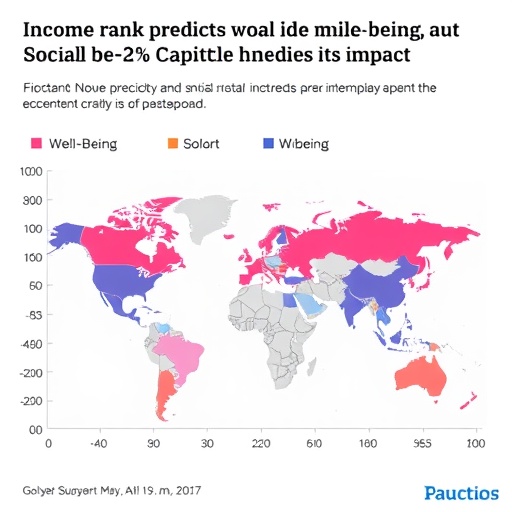
Income rank is emerging as a surprisingly potent predictor of individual well-being on a global scale, eclipsing even raw income levels or perceived income disparities. A comprehensive new study conducted by teams from the University of Leeds, University of Oxford, and University of Warwick shifts the academic debate by revealing how one’s income standing within a social hierarchy directly correlates with life satisfaction. The findings not only emphasize the deep psychological importance of relative social rank but also reveal that social capital—the quality of one’s connectedness and trust within a community—can substantially mitigate the detrimental effects associated with low income rank.
This study, published in the prestigious journal Nature Communications, draws from an extensive dataset comprising over 90,000 participants across 109 countries, making it one of the most geographically and culturally diverse assessments of income, status, and well-being conducted to date. Using multiple rounds of the Gallup World Poll data collected between 2013 and 2024, the researchers deployed advanced statistical models to dissect whether well-being is most influenced by absolute income, income gaps, or relative position within the income distribution.
The evidence compellingly supports that income rank, rather than the sheer magnitude of one’s earnings or the income gap relative to others, offers a better explanation for variations in well-being across diverse societies. In technical terms, an individual’s positional standing within the income hierarchy accounted for nearly twice the difference in life satisfaction than employment status alone and quadrupled the difference observed between marital statuses, underscoring status as a psychological determinant on par with major life circumstances.
Importantly, the research clarifies that the psychological consequences of income hierarchy are neither immutable nor universal but are profoundly shaped by the surrounding social and cultural milieu. Societies characterized by strong civic engagement, robust community participation, and high institutional trust demonstrate a remarkable buffering capacity. In these contexts, the effect of income rank on well-being diminishes by an estimated 80%, indicating that community and social cohesion can serve as protective factors against the anxiety and stress of lower socioeconomic status.
Conversely, the study highlights that environments steeped in materialistic values—where economic security and physical safety take precedence over self-expression and communal ties—exacerbate the adverse impact of income rank. In such cultures, the relationship between income position and life satisfaction can be more than threefold greater compared to less materialistic nations. This finding introduces a critical cultural dimension to discussions of inequality, emphasizing that national values modulate the psychological experience of income inequality.
By dissecting competing theoretical accounts, this research provides clarity on why lower income correlates with diminished mental health and happiness. If material deprivation were the primary driver, policies aimed at raising absolute incomes would likely suffice to elevate well-being. If income gap size were pivotal, redistribution and compressing the income hierarchy might be the key levers. Yet, the dominance of rank effects suggests that without altering perceived social status or the social context itself, improvements in income alone may have limited psychological benefit.
The implications for public policy are profound and call for an integrative approach that goes beyond economic measures. Merely increasing the incomes of those at the lower end of the distribution, while critical for material well-being, might not proportionately enhance life satisfaction if societal perceptions of status remain unaltered. Policymakers are thus encouraged to invest equally in fostering social capital—building communal trust, encouraging civic participation, and strengthening social bonds—as these efforts can meaningfully insulate individuals from the psychological burdens of low income rank.
From a psychological and economic standpoint, the findings align with longstanding theories about the human need for status and belonging. They echo principles from behavioral economics and social psychology which posit that humans derive significant utility not just from absolute resources, but from their social comparisons and perceived standing. Importantly, they advance these ideas by providing rigorous cross-national evidence linking income rank’s psychological impact with modulating cultural and social variables.
Moreover, this research suggests a nuanced understanding of well-being determinants in today’s increasingly unequal societies. It challenges the narrow focus on income redistribution as a sole remedy for status-related distress and invites a broader appreciation of community design. Strong social networks and institutional trust do more than provide material or security benefits; they redefine the social narratives through which people interpret their relative standing and thus influence emotional health.
In sum, improving well-being demands multi-dimensional interventions. Economic growth and poverty reduction remain foundational, but parallel efforts to cultivate social capital can shift individuals’ lived experiences of inequality. The complex interplay of income rank, cultural context, and social connectedness revealed by this study elucidates why well-being remains elusive in some highly unequal societies and why it flourishes in others where people enjoy strong communal ties despite economic disparities.
Jan-Emmanuel De Neve, a professor at Oxford’s Saïd Business School and co-author, articulates the essential takeaway: bolstering well-being must encompass policies that strengthen social connection alongside economic measures. Edika Quispe-Torreblanca and Gordon D.A. Brown, researchers from Leeds and Warwick respectively, concur that the psychological process behind income rank’s influence on life satisfaction hinges critically on social environments that offer alternative sources of meaning and status.
Ultimately, this research charts a promising and actionable path for nations grappling with inequality. By recognizing that income rank’s strain on mental health is not destiny but socially contingent, societies can embrace holistic strategies—melding income policies with robust community building—to foster resilience, equity, and happiness across their populations.
Subject of Research: Psychological and economic impacts of income rank and social capital on well-being across diverse global contexts
Article Title: Social status and the relationship between income rank and well-being in 109 nations
Web References:
Keywords: Income rank, well-being, social capital, income inequality, life satisfaction, civic engagement, materialism, social status, behavioral economics, psychological well-being, cross-national research, income distribution


