

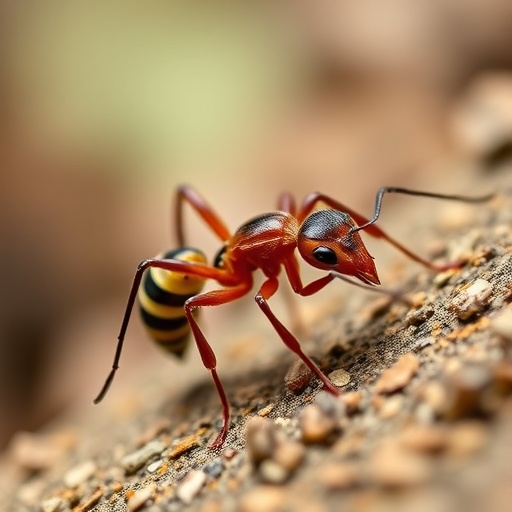
In the ever-evolving landscape of scientific research, one area gaining remarkable attention is the impact of environmental pollutants on living organisms. A recent study conducted by Nyckees, de Vega, and Sittinger focuses on the implications of titanium dioxide nanoparticles and glyphosate exposure on the ant species Cardiocondyla obscurior. This work sheds light on the complex interactions between modern agricultural chemicals and emerging nanomaterials, providing critical insights into their fitness-related effects on this fascinating insect model.
The introduction of titanium dioxide nanoparticles in various consumer products has raised concerns about their potential ecological effects. This study employs Cardiocondyla obscurior as a model organism to examine these effects, emphasizing not only the toxicity of these materials but also the nuanced changes they invoke in biological fitness. By investigating both individual and colony-level responses, the research provides a comprehensive overview of how such pollutants might affect ecological dynamics.
Glyphosate, a widely used herbicide, has come under fire for its potential health risks and environmental consequences. By analyzing its interaction with titanium dioxide nanoparticles, the researchers aim to uncover synergistic effects that may exacerbate or mitigate the impacts of these substances. The choice of Cardiocondyla obscurior is particularly significant, as its behavioral patterns and social structures may manifest subtle effects that can be overlooked in other model species.
The study employs a series of rigorous experiments to assess the physiological responses of the ants to various concentrations of titanium dioxide and glyphosate exposure. Metrics such as foraging efficiency, reproductive success, and competitive interactions within colonies are meticulously measured. The results indicate alarming trends; both pollutants independently affect fitness, but their combination leads to compounded effects that can alter colony viability.
One striking finding of this research is the marked reduction in foraging efficiency observed in colonies exposed to both titanium dioxide nanoparticles and glyphosate. Ants are social foragers, and any disruption to their ability to locate and collect food sources can lead to a cascading effect within the colony, potentially jeopardizing its survival. This highlights the critical nature of understanding how contemporary chemicals can alter fundamental behaviors in social insects.
Moreover, the study delves into the reproductive health of Cardiocondyla obscurior. Exposure to these pollutants resulted in reduced reproductive outputs among colonies, which raises concerns about long-term population stability. With insects playing a vital role in ecosystems as pollinators and decomposers, the ramifications of diminished reproduction could extend far beyond the immediate population affected by these chemicals.
Interactions among ants in social settings are key to their survival, and this research evaluates how exposure to titanium dioxide and glyphosate alters competitive behaviors. The study finds that exposure diminishes aggression and territorial behaviors, which could disrupt established hierarchies and resource allocation within colonies. Such alterations could further exacerbate the challenge of survival in an already stress-laden environment.
One of the most concerning outcomes of the study is the observation of compromised immune responses in ants subjected to both pollutants. Insects are not exempt from the impacts of environmental stressors, and a weakened immune system can significantly increase their vulnerability to diseases and other pathogens. This insight is particularly critical in light of the ongoing global decline of pollinator populations.
The innovative nature of this research lies in its integration of nanomaterials into traditional ecological studies. While the potential applications of titanium dioxide nanoparticles are vast, their implications for non-target organisms must be meticulously examined. This study serves as a reminder of the intricate connections within ecosystems and the need for comprehensive risk assessments when introducing such novel substances into the environment.
Further exploration of the potential molecular mechanisms underlying these fitness effects could pave the way for future studies. Identifying specific pathways affected by titanium dioxide and glyphosate exposure could lead to more targeted approaches in agrochemical regulation and environmental management. The potential for bioremediation strategies could also emerge from understanding how certain organisms manage to thrive in pollution-laden environments.
Cardiocondyla obscurior, often overlooked in research, provides a valuable framework for understanding broader ecological interactions impacted by pollutants. Insights garnered from this study can inform conservation strategies and agricultural practices aimed at minimizing chemical exposure to non-target species. By addressing these issues, a more harmonious relationship between agriculture and biodiversity can be envisioned, benefiting both human interests and ecological balance.
As society grapples with the challenges posed by environmental pollutants, this research acts as a clarion call for a more nuanced understanding of the implications these substances carry for wildlife. The findings advocate for continued inquiry into the intersection of human activity and ecological integrity, underscoring the urgency of mobilizing research to support sustainable practices.
In conclusion, the compelling evidence put forth by Nyckees, de Vega, and Sittinger not only illuminates the immediate effects of titanium dioxide nanoparticles and glyphosate on Cardiocondyla obscurior but emphasizes the importance of holistic environmental assessments. With a focus on the interplay between pollutants and insect health, this study represents a significant contribution to the field of environmental science, inviting further exploration into the intricate web of life impacted by human-induced chemical exposure.
The research highlights not only the environmental implications of nanoparticles and herbicides but also the broader message that humanity must tread lightly on the planet. As we innovate and develop new materials and agricultural techniques, the health of our ecosystems must remain a priority, and findings such as these should inform policy and practice moving forward.
Subject of Research: Fitness-related effects of titanium dioxide nanoparticles and glyphosate on Cardiocondyla obscurior
Article Title: Fitness related effects of titanium dioxide nanoparticles and glyphosate exposure on Cardiocondyla obscurior.
Article References:
Nyckees, D., de Vega, R.G., Sittinger, R. et al. Fitness related effects of titanium dioxide nanoparticles and glyphosate exposure on Cardiocondyla obscurior.
Environ Sci Pollut Res (2026). https://doi.org/10.1007/s11356-025-37388-y
Image Credits: AI Generated
DOI: https://doi.org/10.1007/s11356-025-37388-y
Keywords: titanium dioxide, glyphosate, Cardiocondyla obscurior, environmental pollutants, fitness effects, social insects, ecological interactions.


