

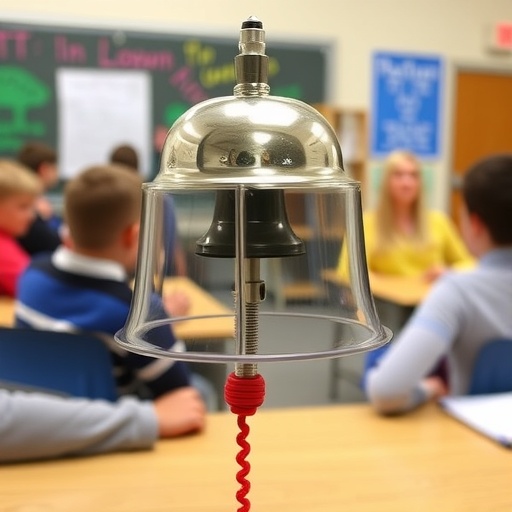
In the ever-evolving landscape of educational environments, the classroom stands as a microcosm where intricate social dynamics unfold. Recent research by Associate Professor Mika Ishino from Doshisha University, Japan, offers groundbreaking insights into how a sequence of subtle actions governs social tension at the onset of lessons—a phase often overlooked but critical in shaping classroom interactions. This study meticulously analyzes how teachers’ bodily orientation and responses to temporal cues, such as the ringing of the school bell, architect the ‘tightness’ or ‘looseness’ of social tension during the crucial opening moments of a lesson.
At its core, the study draws from Erving Goffman’s sociological theory of social occasions, which dichotomizes situations into “tight” and “loose” contexts. Tight occasions come with a web of strict, often onerous obligations necessitating specific behaviors, while loose occasions allow for greater freedom and less regimented actions. In classroom settings, phases oscillate between these states; for example, a lecture demands tight attention, whereas group discussions permit relaxed interaction. However, the initial moments of a class, often marked by greetings and preparatory steps, serve as the bedrock upon which the entire lesson’s social tension is laid.
Professor Ishino’s study contrasts two English language teachers within the same secondary school: Ms. Kajihara and Mr. Furuhata. Using a multimodal conversation analysis—a sophisticated technique combining verbal, bodily, and environmental cues—the research probes into how these educators’ behaviors at the pre-opening phase influence the classroom’s social atmosphere. The temporal cue of the school bell, signaling transition, becomes a pivotal device whose interpretation and response set the tone for students’ subsequent interaction paradigms.
Ms. Kajihara’s approach to the school bell is relatively relaxed. At the bell, she continues sorting handouts, not immediately addressing the students to stop or focus. Her instructions for standing and greeting are general and less immediate. Students exhibit a looser posture, and some even avert their gaze until prompted. This behavioral pattern culminates in a ‘loose occasion’ in social tension terms, affording students a more casual entry into the formal class structure. The findings highlight how her bodily orientation—remaining engaged with her task rather than commanding attention—fosters an environment with minimal social constraints at the outset.
Conversely, Mr. Furuhata’s class epitomizes the ‘tight occasion.’ Instantly ceasing his work upon the school bell’s sound, he assumes a formal posture at the podium, emphasizing the authority of the impending lesson. His verbal prompts are repetitive and precise, enforcing a collective adherence to expected conduct—students must stand straight, face forward, and await the teacher’s greeting before engaging. His physical positioning and commands constitute an embodied enactment of social tightness, underscoring institutional expectations and reinforcing the school’s hierarchical systems.
This juxtaposition reveals how spatial and temporal modalities—the body, objects like handouts and podiums, and auditory cues such as bells—intersect as powerful semiotic resources in classroom interaction. Crucially, the embodied practices of teachers are not neutral but deeply influential in constructing the micro-societal frameworks of tension and order. These findings invite educators to reconsider their implicit communicative strategies at moments as seemingly trivial as the ringing of the bell, as these shape not only attention but also social order.
The study represents a novel contribution to educational linguistics and conversation analysis fields by intertwining physical orientation and temporal responsiveness with social theories of tension. It challenges the conventional emphasis on verbal instruction and curriculum delivery, spotlighting the embodied and environmental layers that influence student engagement and classroom climate. These nuanced insights could become instrumental in teacher training programs, helping practitioners cultivate desired social atmospheres aligned with pedagogical aims.
Moreover, the implications ripple beyond individual classrooms. By recognizing the embodiment of institutional power and social norms during transitional moments, educational policymakers can better appreciate how micromanagement of classroom rituals affects student behavior and learning readiness. Such an understanding urges deliberate design of school bells, classroom layouts, and teacher movement patterns to optimize the initiation of social interactions within educational contexts.
The empirical rigor of the research is underpinned by its methodological framework—multimodal conversation analysis—which captures the interplay of voice, gesture, gaze, posture, and material environment. This holistic approach magnifies subtleties often invisible in traditional observational studies, uncovering how intricacies of human behavior coalesce into complex social signals. It also resonates with interdisciplinary scholarship, bridging linguistics, sociology, psychology, and education.
Dr. Ishino’s experiential grounding as a former formal classroom teacher lends authenticity and practical significance to the analysis. Her firsthand understanding of educational settings equips her examination with reality-based sensitivity to power dynamics and behavioral cues. Consequently, the research transcends theoretical abstraction, offering actionable insights for classroom practitioners striving to balance control and freedom to foster effective learning environments.
This investigation into the pre-opening phase of the lesson underscores that the seemingly mundane rituals of greeting and preparation are potent sites where social structures are enacted and students’ comportment is primed. The study challenges educators, scholars, and administrators alike to reflect on and innovate the choreography of classroom opening sequences, acknowledging their impact on social tension, student discipline, and the overall educational experience.
Ultimately, the research uncovers that the embodied interactional cues—teachers’ bodily orientation, timing, and use of space—act as critical devices in delineating social tension and regulate the classroom atmosphere. These findings contribute valuably to the broader discourse on classroom management, teacher-student interaction, and the sociology of education, expanding our understanding of how micro-level interaction rituals shape macro-level educational outcomes.
This pioneering study will feature in the forthcoming special issue of Linguistics and Education, slated for publication in June 2026. It signals promising directions for future research that can explore varied educational contexts, cross-cultural dimensions, and technological interventions in managing classroom social dynamics, emphasizing that effective education is as much about managing social contexts as it is about content delivery.
Subject of Research: People
Article Title: Body, podium, school bell: devices for establishing a social tension at the pre-opening of the classroom interaction
News Publication Date: 1-Jun-2026
Web References:
https://doi.org/10.1016/j.linged.2026.101514
Image Credits: Dr. Mika Ishino from Doshisha University, Japan
Keywords: Teaching, Middle school, Education, Social interaction, Students


