

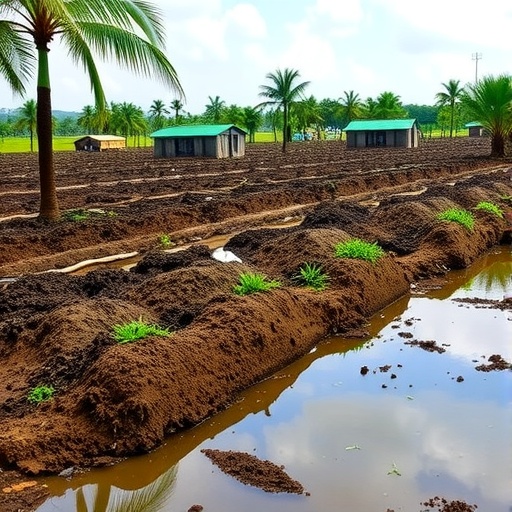
In the intricate dynamics of environmental pollution, heavy metals have emerged as critical subjects of investigation, particularly in agricultural contexts. Recent studies have focused on the heavy metal contamination in soils, raising concerns about their mobility and ecological risks. A significant contribution to this discourse comes from a recent study by Odigie, Orugba, and Shittu, who delve into the depths of ferralitic oil-palm soils that have been amended using palm oil mill effluent (POME). Their research provides important insights into the distribution and behavior of heavy metals, shedding light on potential risks associated with their presence in these soils.
The researchers’ study methodically examines the spatial distribution of heavy metals within the soil profiles. This involved taking depth-resolved samples from various layers of the soil, allowing for an in-depth analysis of how heavy metals participate in the soil matrix at varying depths. The heavy metals of primary concern often include lead, cadmium, nickel, and chromium, which are notorious for their detrimental effects on both environmental health and agricultural productivity. The strategic sampling of ferralitic soils facilitates a better understanding of how these metals can persist and behave within the soil environment.
To evaluate the mobility of heavy metals, the researchers applied sequential extraction techniques. These methods help differentiate between various forms of heavy metals found in the soil, providing insights into their chemical forms and potential bioavailability. Understanding mobility is crucial because it determines the extent to which heavy metals can potentially leach into groundwater or be taken up by crops, thus posing significant risks to both human health and the broader ecosystem. The layers of the soil act as barriers or conduits for these metals, revealing a complex interplay between soil chemistry and contaminant behavior.
The implications of heavy metal contamination are particularly pronounced in agricultural settings. In regions where oil palm cultivation is prevalent, the use of palm oil mill effluents as fertilizers is common, but this practice often goes hand-in-hand with unintended consequences. The waste products from palm oil processing contain not only organic matter but also heavy metals, which may accumulate in soil over time. The research findings highlight the need for a balance between exploiting soil fertility through organic amendment and managing the ecological risks posed by heavy metal accumulation.
The study’s results indicate that certain depths in ferralitic oil-palm soils exhibited higher concentrations of heavy metals. Understanding these variations is essential for agricultural practices as it informs farmers about which soil layers may be most at risk, thus guiding their soil management strategies. Such insights empower agricultural stakeholders to make informed decisions that prioritize sustainability and environmental stewardship, fundamentally altering cultivation practices in contaminated areas.
Moreover, the risk assessment framework adopted by Odigie and colleagues also highlights the importance of evaluating the ecological risks posed by heavy metals in these soils. Employing indices such as the pollution load index and potential ecological risk index allows for a quantifiable assessment of the environmental threats presented by heavy metal contamination. These indices serve as valuable tools for policymakers and environmental managers, enabling them to prioritize areas that require immediate intervention or remediation.
Agricultural practices oriented towards sustainability must be adaptable and informed by ongoing research. The integration of findings such as those presented by Odigie and his team can significantly enhance our understanding of soil health in oil palm plantations. The successful management of heavy metals in soils not only influences the immediate outputs of agricultural production but also safeguards ecosystem integrity for future generations.
The findings further underscore the necessity for best practices in handling palm oil mill effluent. By closely monitoring and controlling the heavy metal content in POME before it is applied to agricultural lands, it becomes possible to mitigate risks associated with soil contamination. This entails systematic testing and ensuring that the effluent treatment processes adequately address heavy metal removal.
On a broader scale, this research aligns with global efforts to address soil pollution and enhance food security in the face of climate change. It supports initiatives aimed at understanding and managing soil health, contributing to discussions about sustainable practices that can decrease contamination while maintaining agricultural productivity. As nations grapple with the effects of agricultural expansion alongside the principles of sustainability, the findings from this study provide actionable intelligence in navigating these challenges.
In conclusion, the research conducted by Odigie, Orugba, and Shittu exposes the critical intersections between heavy metal contamination and agricultural practices in oil palm contexts. As the threat of polluted soils looms over agricultural frameworks, understanding the distribution, mobility, and ecological risks associated with heavy metals is crucial. The work complements the ongoing quest for sustainable farming approaches that do not compromise environmental health or agricultural productivity.
Widespread adoption of these insights could lead to better strategies for managing heavy metal risks in agriculture, ultimately benefiting not just local producers and consumers, but also contributing to a broader vision of sustainable ecological management. As researchers continue to monitor and analyze the complexities of soil health, their findings can help create a more informed and environmentally-conscious approach to farming practices worldwide.
Emerging from this research are unanswered questions that beckon further exploration. Understanding the long-term effects of heavy metal accumulation on soil health and crop yield could open avenues for innovative practices that incorporate both productivity and ecological safety. The fine balance between nutrient supplementation via organic amendments like POME and the management of heavy metal content remains a pivotal area of agricultural research.
As the scientific community delves deeper into these complex dynamics, the findings from these studies will be pivotal at forums and discussions surrounding sustainable agriculture. The role of heavy metals in soil health presents as both a challenge and an opportunity—an opportunity for innovation, and a challenge to navigate sensibly. Herein lies the potential for agriculture to evolve in response to pressing environmental concerns.
Ultimately, the road forward will demand a multifaceted approach, pulling in researchers, policy makers, and farmers alike to craft a holistic strategy that nurtures both soil health and agricultural viability. The insights provided by this research serve as a foundational stone in building this future, influencing practices that ensure both food security and ecological sustainability in the face of rising agricultural demands.
Subject of Research: Heavy metals in ferralitic oil-palm soils amended with palm oil mill effluent
Article Title: Depth-resolved distribution, mobility, and ecological risks of heavy metals in ferralitic oil-palm soils amended with palm oil mill effluent
Article References:
Odigie, G.O., Orugba, H.O. & Shittu, W.A. Depth-resolved distribution, mobility, and ecological risks of heavy metals in ferralitic oil-palm soils amended with palm oil mill effluent.
Environ Monit Assess 198, 133 (2026). https://doi.org/10.1007/s10661-026-14995-x
Image Credits: AI Generated
DOI: https://doi.org/10.1007/s10661-026-14995-x
Keywords: Heavy metals, ferralitic soils, palm oil mill effluent, ecological risk, agricultural practices, soil contamination.


